
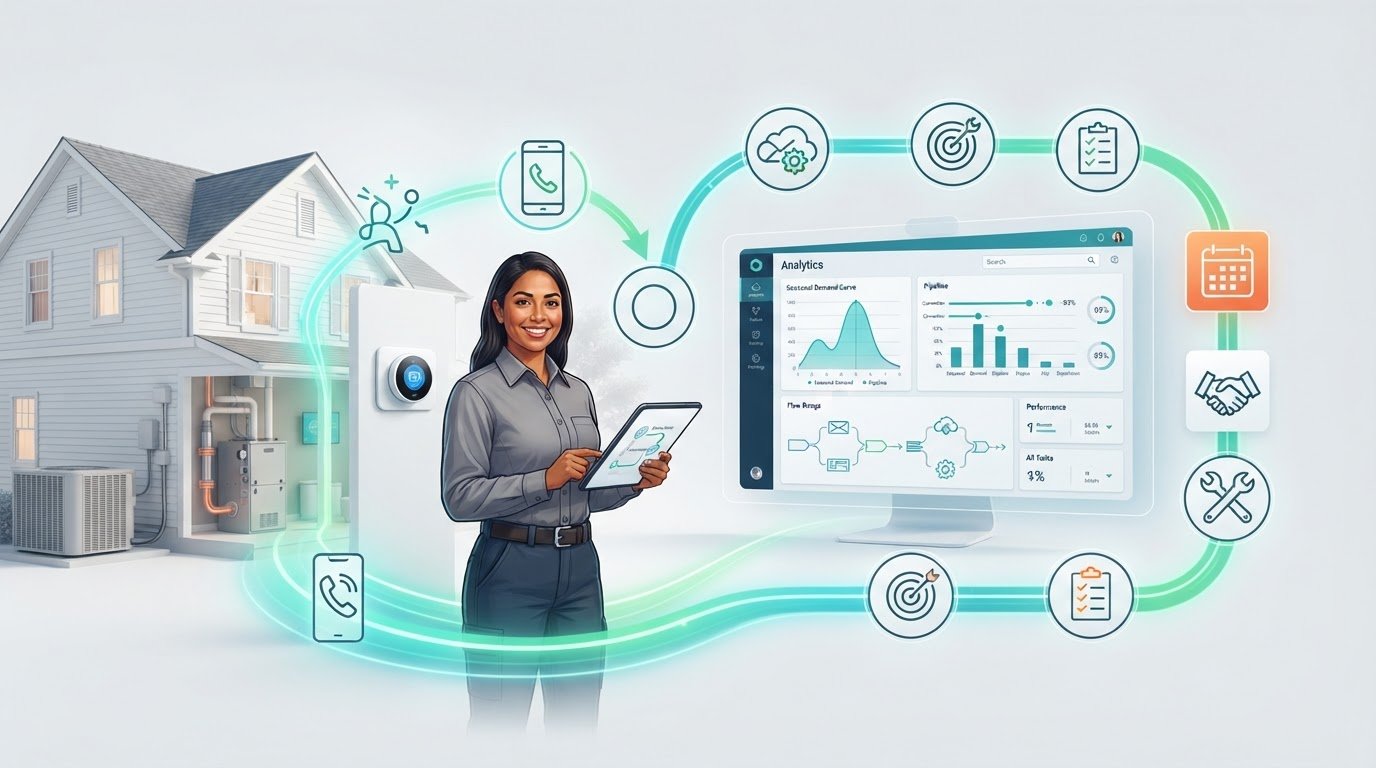
Lead Generation Funnels for HVAC: Build a Pipeline That Books Jobs in 2026
A full inbox can still mean an empty schedule. Lead generation funnels for hvac connect every ad, search result, and customer inquiry to a clear next step: a qualified conversation and an opportunity to book work.
Marketing may bring in calls and form fills, but leads can stall when no one responds promptly, follow-up varies, or you can’t tell which channels produce real sales opportunities. Seasonal changes in demand make a consistent, trackable process even more useful.
This guide explains how to build a practical path from first contact to appointment. You’ll see how paid and organic discovery, focused lead capture, follow-up, and measurement work together, so your team can prioritize qualified prospects instead of treating every inquiry as a win.
You’ll also learn how automation and AI agents can support consistent responses, and how to measure progress through qualified opportunities and booked jobs. The goal is a connected funnel that gives every lead a clear route forward.
Key Takeaways
- Map the steps from a homeowner’s first search or ad interaction to a qualified inquiry, appointment, and completed job.
- Build lead generation funnels for hvac around a specific service need, with a matching landing page and clear next step.
- Look beyond lead volume: track qualification, completed responses, appointments, and closed jobs to see where the pipeline needs attention.
- Improve the funnel step by step by connecting campaign activity with appointment outcomes and refining the parts that lose prospects.
- Use paid advertising, search optimization, Google Business Profile optimization, reputation programs, and lead response tools to support a connected customer journey.
Why HVAC lead generation funnels need to connect marketing with booked work
A campaign can generate calls and form submissions without filling the schedule. Often, the missing piece is a clear path from discovery to follow-up, qualification, and appointment. Lead generation funnels for hvac connect those steps so marketing and sales can see what happens after someone gets in touch. In broad terms, lead generation attracts potential customers. For an HVAC business, an inquiry is only the beginning.
Keep the stages distinct: a lead is someone who contacts the business; a qualified opportunity fits the services offered and has a relevant need; an appointment is a scheduled next step; and a completed job is work carried through to completion. Counting only leads won’t show whether the inquiries were suitable, received a response, or became work. Uneven inquiry flow, missed follow-up, and uncertainty about which channels contribute to bookings are signs that the customer journey needs clearer tracking.
What makes an HVAC lead generation funnel different?
HVAC inquiries can require different next steps. Someone looking for an urgent repair may want a direct response, while a homeowner considering a replacement or installation may need to discuss project scope before scheduling. A single generic path can overlook those differences. Match the landing page, questions, and follow-up to the service need and the prospect’s readiness to move forward.
Give every contact route an owner. Calls and forms should feed into a defined response process, with each inquiry recorded and its status updated. For example, capture the requested service and source, assign the inquiry to a team member, and record whether it was qualified and scheduled. Without clear ownership, a prospect can fall between marketing and sales, and the cause of the breakdown stays hidden.
Which funnel outcomes should HVAC businesses track?
Use the same stage definitions across marketing and sales records. That makes it easier to compare channels and identify where prospects stop progressing:
- Inquiry: A call, form submission, or other contact from a potential customer.
- Qualified lead: An inquiry that matches the business’s services and has a clear, relevant need.
- Appointment: A scheduled conversation, assessment, or service visit.
- Completed job: Work that has been carried through to completion.
A qualified HVAC lead is an inquiry from a potential customer whose stated need aligns with the services offered and merits a sales follow-up. Track how many inquiries reach each next stage, not just how many arrive. Lead counts show activity; stage-by-stage records reveal whether responses are completed, appointments are scheduled, and jobs are won. Consistent definitions make those records useful for improving the funnel.
How HVAC lead generation funnels move prospects from discovery to inquiry
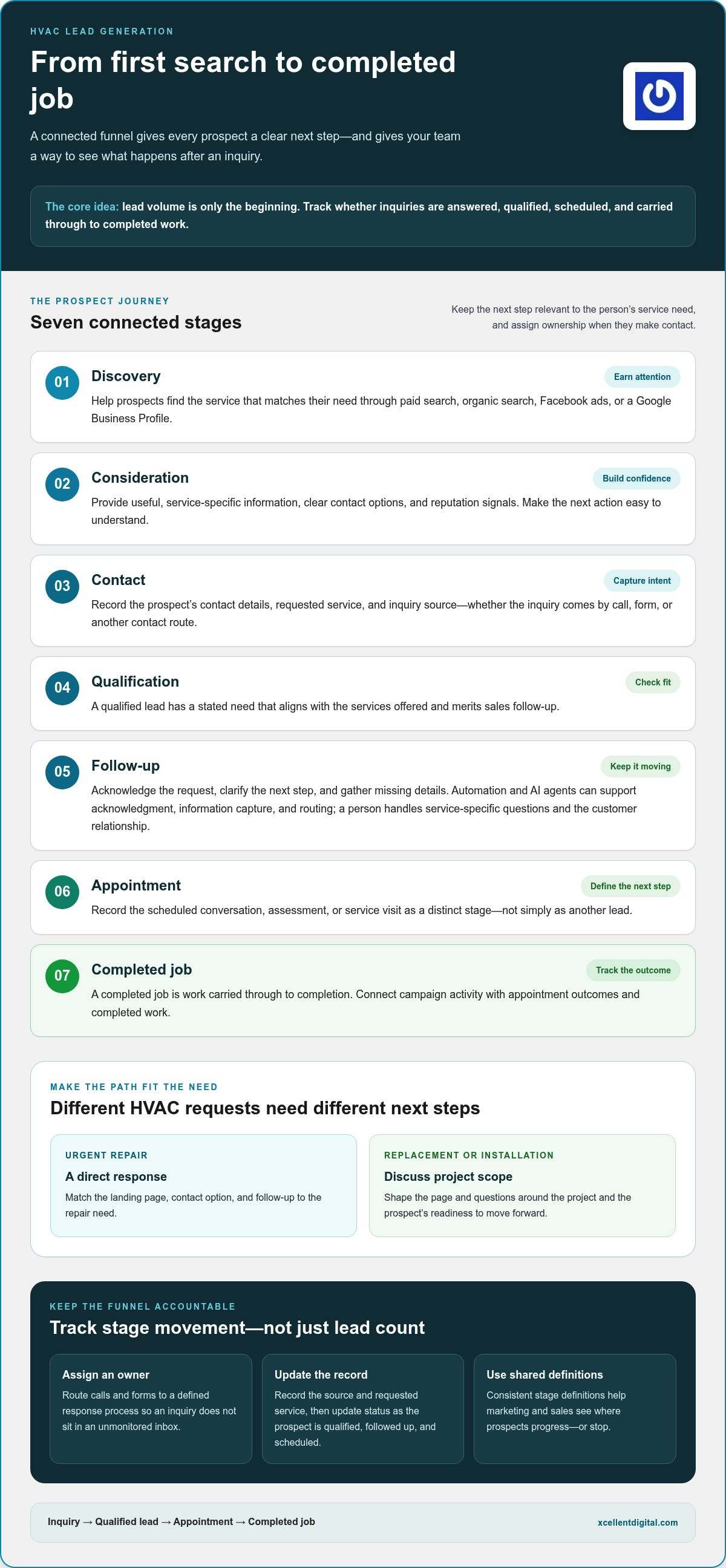
A strong funnel gives prospects a clear next step at every point and makes sure each inquiry reaches someone responsible for moving it forward. Lead generation funnels for hvac turn discovery into consideration, contact, qualification, follow-up, and an appointment through a connected sequence. Each stage should reflect what the prospect needs, not just where the business wants them to click.
How do HVAC prospects discover and evaluate a contractor?
Discovery may begin with paid search, an organic search result, a Facebook ad, or a Google Business Profile. Make the next touchpoint relevant to the prospect’s intent. Someone searching for AC repair should land on information and a contact option related to repair, not a generic page covering every HVAC service. A replacement campaign should focus on that project instead. For more on organic visibility, see this 2026 HVAC SEO guide.
During consideration, useful service details, clear contact options, and reputation signals help prospects decide whether to take the next step. Make the call to action direct: call, request an appointment, or submit an inquiry. Keep the page focused on that action so visitors don’t have to search for what to do next.
What should happen after an HVAC prospect makes contact?
Make every contact route count. Capture the prospect’s contact details, requested service, and inquiry source, then send the information to the appropriate response workflow. Assign clear ownership for calls and form submissions so inquiries don’t sit in an unmonitored inbox. Update records as prospects are qualified, followed up, and scheduled.
Prompt, useful follow-up keeps the conversation moving without guaranteeing a booking. A response can acknowledge the request, clarify the next step, and gather missing details. Automation and AI agents can support acknowledgment, information capture, and routing. A person should handle service-specific questions and the customer relationship.
Discovery earns attention, consideration builds confidence, contact captures intent, qualification checks fit, follow-up keeps the conversation active, and an appointment gives the prospect a defined next step.
- Discovery: Connect search, paid campaigns, social ads, and business profile visibility to the relevant service.
- Consideration: Give prospects useful, service-specific information and a clear way to act.
- Contact and qualification: Capture accurate details, record the source, and determine whether the request fits.
- Follow-up and appointment: Route the inquiry to an owner, continue the conversation, and record the scheduling outcome.
Use this sequence to spot handoff gaps, then improve the campaign, landing page, or response process that needs attention. Sales funnel development can help connect those pieces into a coordinated inquiry journey.
How to judge HVAC funnel quality beyond the number of leads
More inquiries don’t automatically mean better business results. A rise in form fills could bring more qualified opportunities, or it could reflect poor-fit requests that never receive a complete response. To judge lead generation funnels for hvac, track how prospects move through the pipeline and compare outcomes using consistent definitions.
Which funnel measures reveal where prospects drop off?
Review your records from inquiry through closed job. Compare the source, qualification status, response status, and appointment outcome for each inquiry. This can help pinpoint whether the issue is lead quality, a missed handoff, incomplete follow-up, or a scheduling gap. If CRM records are inconsistent or key stages are missing, treat conclusions as tentative until tracking improves.
| Measure | What it reveals | Limitation |
|---|---|---|
| Raw inquiries | How much initial response your marketing attracts. | Doesn’t show fit, follow-up, or sales outcomes. |
| Qualified inquiries | How many requests match your services and merit follow-up. | Depends on staff applying the same criteria. |
| Response completion | Whether inquiries received the intended follow-up. | A recorded response doesn’t prove the prospect engaged. |
| Appointments | Whether conversations advance to a scheduled next step. | Doesn’t show whether the appointment took place or led to work. |
| Closed jobs | Which inquiries ultimately became completed work. | Attribution can be unclear if records omit earlier touchpoints. |
Read these measures in context. Seasonal demand can change inquiry volume, while service mix can affect how quickly prospects decide. Follow-up practices matter, too: a channel may appear weaker if its inquiries aren’t handled consistently. Missing source data or incomplete job records can also distort what the numbers seem to show.
How can HVAC businesses compare marketing channels fairly?
Use the same qualification rules for paid, organic search, and referral inquiries. Compare each channel’s contribution at several stages, not just which one first brought a prospect to the business. A referral may follow earlier online research, so crediting only the first touch can overstate one channel and overlook another. For channel-specific ideas, read this Facebook Ads lead-generation guide.
Start with clean records, then look for patterns across comparable services and time periods. Avoid firm budget decisions based on a single metric or a short stretch of activity. Connected funnel measurement can help align campaign and sales data around outcomes that matter.
How to build and improve an HVAC lead generation funnel step by step
Build the process around a specific service and customer need, then connect each marketing touchpoint to a trackable next step. A focused funnel is easier to manage than one broad campaign trying to speak to every HVAC prospect at once. These lead generation funnels for hvac should make clear what you’re promoting, where an interested prospect should go, and who follows up.
How should an HVAC business set up its funnel foundations?
Choose the service you want to promote and the action you want a prospect to take. Then align the campaign message with a focused landing page. For example, an ad about system replacement should lead to a page about replacement inquiries, with an obvious contact option. Before launching, agree on shared inquiry-stage definitions and assign responsibility for responding.
Use this setup sequence:
- Define the service and audience need. Choose a clear focus, such as repair, maintenance, or replacement.
- Match message to destination. Connect each ad or search page to relevant information and a direct call to action.
- Test the contact path. Confirm that calls and forms capture the details your team needs and reach the right response workflow.
- Assign ownership. Make it clear who handles new inquiries and who updates their status.
- Track outcomes. Record the source, qualification, response, appointment, and job outcome consistently.
How can follow-up automation support HVAC lead handling?
Automation works best when it supports a process your team has already defined. Map what should happen after an inquiry arrives: acknowledge receipt, assign it to the right person, create a reminder if follow-up is still needed, and update the record as the conversation progresses. AI agents and lead response automation can help with acknowledgment and routing, while people handle nuanced questions and service conversations.
Keep the human handoff clear. If an automated interaction surfaces a repair request, replacement interest, or missing detail, route that information so the responsible team member can continue the conversation. Automation should reduce missed steps, not make it harder for prospects to reach a person.
For planning Facebook campaigns that feed into this process, explore the Facebook advertising guide for local businesses.
Review appointment outcomes and completed-job records regularly. Look for one identifiable friction point, such as an unclear landing-page action or an inquiry-routing gap, and adjust that piece first. Give the change time to produce comparable records before changing several parts of the funnel at once. Build a connected HVAC sales funnel with campaign, capture, and follow-up steps aligned.
How XcellentDigital can help connect HVAC marketing to sales follow-up
More channels won’t fix a disconnected pipeline. The value comes from making paid campaigns, organic discovery, lead capture, and follow-up work as parts of one system. XcellentDigital supports HVAC businesses with advertising, search optimization, sales funnel development, and lead response automation. The right mix depends on your goals, current process, and where prospects are dropping off.
Which parts of an HVAC funnel can XcellentDigital support?
Managed Facebook Ads and pay-per-click campaigns can support paid discovery, while search optimization and Google Business Profile optimization support organic visibility. A Reputation Program can help manage online customer feedback and build brand authority. These channels work best when campaign messages lead to relevant next steps instead of sending every prospect to the same generic destination.
Sales funnel development can connect those entry points to a clear inquiry journey. AI agents and lead response automation can support acknowledgment, routing, and follow-up tasks within the process. The goal is coordination: marketing activity should feed a defined sales workflow, while the HVAC team retains the human handoff needed to answer questions and continue the conversation.
What is a practical next step for improving your funnel?
Start with the journey you already have. Map how a prospect discovers your business, makes contact, receives a response, and reaches an appointment. Then use consistent inquiry and sales records to identify the largest observable drop-off. That evidence helps clarify whether the priority is discovery, the contact path, routing, or follow-up, rather than prompting changes to channels without understanding the gap.
The right combination of lead generation funnels for hvac depends on your business goals and current process. Once you’ve mapped the journey, focus on the part that needs attention and connect the next improvement to a measurable stage.
Talk with XcellentDigital about an HVAC funnel and explore how your marketing and sales follow-up can work together.
Turn Your HVAC Funnel Into a Clearer Path to Booked Work
A dependable pipeline takes more than attracting inquiries. Lead generation funnels for hvac work best when campaigns connect to relevant landing pages, every inquiry has a clear follow-up path, and performance is measured through qualified opportunities and appointment outcomes.
Start by identifying where prospects lose momentum, then improve one part of the journey at a time. Managed Facebook Ads and pay-per-click campaigns can support paid discovery, while search optimization and Google Business Profile optimization support organic visibility. Sales funnel development, AI agents, and lead response automation can connect those efforts to organized follow-up.
Your next step is straightforward: map the path from first contact to appointment and note where the handoff gets unclear. Build a more connected HVAC lead generation funnel with XcellentDigital and align your marketing with the way your team handles new opportunities. A clearer process gives you a stronger foundation for continued improvement.
Frequently Asked Questions
What is a lead generation funnel for an HVAC business?
A lead generation funnel is the path a potential customer takes from discovering an HVAC business to making contact and moving toward an appointment. It connects marketing channels, service-specific information, inquiry capture, qualification, and follow-up. For example, a homeowner may find a business through search, visit a relevant service page, submit a request, and receive a response from the team. Tracking each stage helps reveal where prospects move forward or drop off.
How do you generate quality leads for an HVAC company?
Attract prospects whose needs match the services you provide, then make the next step clear. Use focused search content, paid campaigns, social advertising, and a complete business profile to reach people looking for relevant HVAC services. Send each visitor to a page that matches their need, such as repair or replacement, and make it easy to call or submit an inquiry. Review which inquiries become qualified opportunities and appointments to refine your approach.
What should an HVAC lead generation funnel include?
An effective funnel includes discovery, relevant service information, a clear contact option, accurate inquiry capture, qualification, assigned follow-up, and appointment tracking. Each step needs a defined owner or process. Record the inquiry source and update its status as it moves forward, so marketing and sales can work from consistent information. Track completed jobs too, since a submitted form alone doesn’t show whether the funnel contributed to booked work.
How quickly should HVAC companies follow up with new leads?
Follow up as soon as your team can respond usefully, and set an internal response expectation that staff can meet consistently. Acknowledge the inquiry, confirm the requested service, and explain the next step. Assign responsibility for calls and forms so a new request doesn’t sit unattended. If an immediate personal response isn’t possible, an automated acknowledgment can confirm receipt, but it shouldn’t replace appropriate human follow-up.
Can marketing automation help HVAC companies convert more leads?
Marketing automation can support consistent lead handling, but it can’t guarantee that an inquiry becomes a customer. It can acknowledge a request, capture key details, route the inquiry to the right workflow, and remind the team about follow-up. AI agents can help manage parts of this process, while people handle service-specific questions and customer conversations. Review whether automation is helping inquiries move through your process, and adjust it if handoffs become confusing.
How do you measure whether an HVAC lead generation funnel is working?
Track more than total inquiries. Use consistent records to compare qualified leads, completed responses, scheduled appointments, and completed jobs by source. These measures help show whether prospects are a fit and where they stop progressing. Interpret results in context: seasonal demand, service mix, and follow-up practices can influence the numbers. If source or sales records are incomplete, improve tracking before drawing firm conclusions about a channel’s performance.
Should HVAC businesses use SEO or paid ads in their lead generation funnel?
SEO and paid ads can serve different roles, and an HVAC business may use both. Search optimization and Google Business Profile optimization support organic discovery, while pay-per-click and Facebook Ads can put campaign messages in front of potential customers. Connect each channel to a relevant service page and consistent inquiry process. Compare qualified opportunities and appointment outcomes across channels, rather than choosing based only on traffic or raw lead counts.













Leave a Reply
Want to join the discussion?Feel free to contribute!