
Sales Funnel Analytics and KPIs: A Practical Guide for 2026

Sales Funnel Analytics and KPIs: A Practical Guide for 2026

What if leads stall not because you need more activity, but because you can’t see where prospects drop off? Sales funnel analytics and kpis can show which campaigns attract qualified opportunities, where prospects stop moving forward, and whether follow-up is helping turn inquiries into sales. The key is choosing numbers that point to a useful next step.

If lead and sales data live across ad platforms, your website, and your CRM, you can end up with plenty of reports but few clear answers. Clicks and inquiries don’t show by themselves which leads become real opportunities or revenue. Without consistent tracking, it’s harder to locate a bottleneck or decide what to improve.

This guide explains how to choose a focused set of KPIs for each funnel stage, calculate them consistently, and interpret results in context. You’ll learn how to connect campaign activity with lead quality, follow-up, and sales outcomes, then use the evidence to choose what to improve next. Less metric overload, more clarity about where your funnel needs attention.

Key Takeaways

  • Use sales funnel analytics and kpis to see where prospects move forward, stall, or drop out, then focus on the stage that needs attention.
  • Track practical measures such as inquiry-to-qualified-lead rate, appointment or estimate rate, close rate, and lead response time.
  • Compare conversion rates only when funnel stages, lead sources, and measurement windows match.
  • Keep lead status, source, timestamps, and sales outcomes consistent in one source of truth so your reports support sound decisions.
  • Prioritize one bottleneck at a time, then test a targeted change to messaging, qualification, or follow-up.

Sales Funnel Analytics and KPIs: What They Measure and Why They Matter

Sales funnel analytics show how prospects move from their first interaction with a business through inquiry, sale, and retention. They help you see where interest turns into action, where potential customers stall, and whether marketing activity contributes to meaningful sales outcomes. The journey isn’t always a straight line: a prospect might return to your website or respond to a later campaign before deciding to buy. The Purchase Funnel offers foundational context for thinking about this path from awareness to action.

For a service business, funnel analytics can connect activity from Facebook Ads, pay-per-click campaigns, or search optimization with what happens after someone gets in touch. The goal isn’t to collect every available number. It’s to use a small, relevant set of measures to make the next business decision clearer.

How funnel metrics differ from KPIs

A metric describes an activity or outcome. A KPI is a metric selected to measure progress toward a stated business goal. Inquiry count, for example, tells you how many people reached out. Qualified-lead rate shows what share met your criteria for a potential customer. Both can be useful, but they answer different questions.

Choose a KPI because it helps someone act. If the goal is to book more suitable appointments, qualified-lead rate may matter more than total inquiries. Assign an owner who can investigate the result and influence it, such as the person responsible for campaign quality or lead follow-up. Tracking every click, call, and form interaction can bury the signal in noise. Start with measures tied to current goals, then add detail when it helps explain a change or choose an action.

What a service-business funnel can include

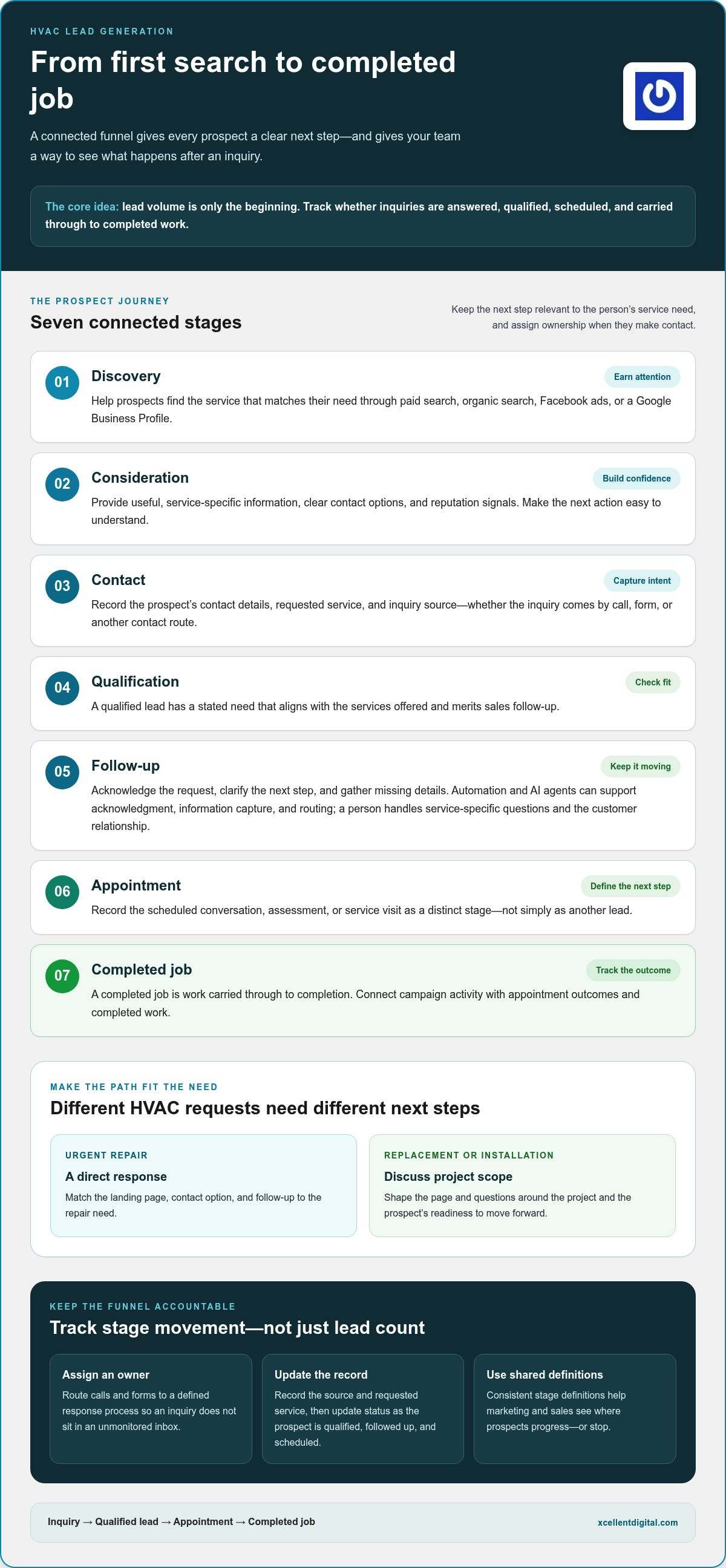
A practical funnel gives your team shared language for tracking prospects. One service-business version might include:

  • Awareness and inquiry: Someone encounters the business and submits a form, calls, or otherwise makes contact.
  • Lead qualification: The business checks whether the prospect’s needs fit the service and sales process.
  • Appointment or estimate: A suitable lead schedules a conversation, visit, or estimate.
  • Sale: The prospect accepts the offer and becomes a customer.
  • Retention: The business tracks continued engagement, repeat work, or referrals where relevant.

Your process may combine, rename, or skip stages. A business that sells without appointments might move directly from qualification to sale. A company with a longer decision process may need additional steps. That’s where thoughtful sales funnel development supports measurement: stages should reflect how prospects actually become customers, not force the team into a generic template.

Before calculating rates, agree on each stage’s name and entry criteria. Decide, for example, what makes an inquiry a qualified lead and when an opportunity counts as a sale. Consistent definitions help everyone interpret the numbers the same way, giving sales funnel analytics and KPIs a reliable foundation for decisions.

Which Sales Funnel KPIs to Track at Each Stage

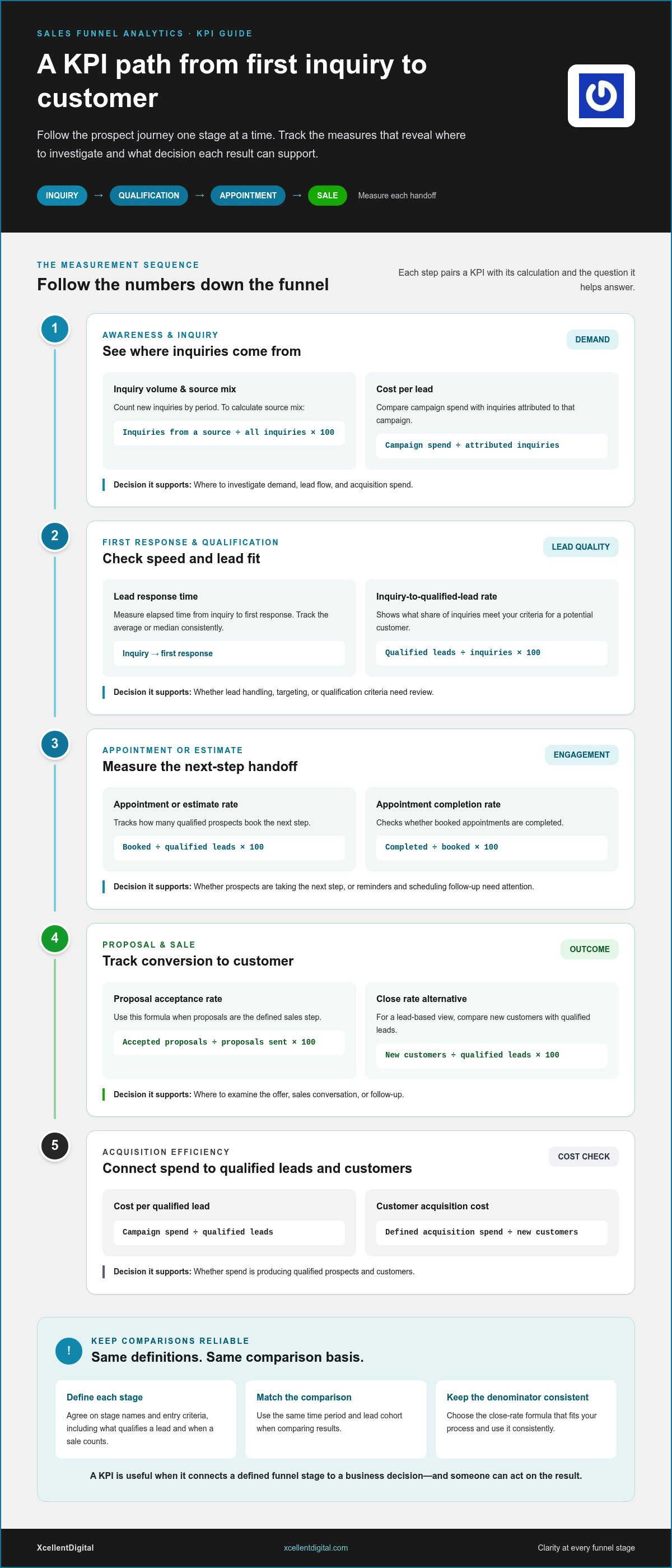
Start with a lean scorecard, not a wall of numbers. A useful KPI connects a clearly defined funnel stage to a business decision, so your team knows what to watch and what action the result might call for. The Sales Funnel Analytics discussion from IBM also emphasizes examining performance across the sales process rather than treating each interaction as an isolated result.

For sales funnel analytics and KPIs, choose measures that match your service process. Use the same time period and lead cohort when comparing results. These core calculations can give a small team a practical starting point:

Stage and KPI What it measures and formula Decision it supports
Inquiry volume and source mix New inquiries by period; source mix = inquiries from a source ÷ all inquiries × 100. Where to investigate demand and lead flow.
Cost per lead Campaign spend ÷ inquiries attributed to that campaign. Whether acquisition spend merits a closer look.
Inquiry-to-qualified-lead rate Qualified leads ÷ inquiries × 100. Whether targeting or qualification criteria need review.
Appointment or estimate rate Appointments or estimates booked ÷ qualified leads × 100. Whether qualified prospects are taking the next step.
Appointment completion rate Completed appointments ÷ appointments booked × 100. Whether reminders or scheduling follow-up need attention.
Proposal acceptance or close rate Accepted proposals ÷ proposals sent × 100; or new customers ÷ qualified leads × 100. Keep the chosen denominator consistent. Where to examine the offer, sales conversation, or follow-up.
Lead response time Elapsed time from inquiry to first response. Track the average or median consistently. Whether lead handling needs more consistent processes.
Cost per qualified lead and customer acquisition cost Campaign spend ÷ qualified leads; total defined acquisition spend ÷ new customers. Whether spend is producing qualified prospects and customers.

Prioritize lead quality before volume

More inquiries don’t automatically mean more opportunity. A campaign can generate activity while attracting people who aren’t a fit, so pair inquiry volume with source mix and qualified-lead rate. Use matching date ranges and consistent definitions. Dividing this month’s spend by leads from a different period, for example, can distort cost per lead or cost per qualified lead.

Track later stages when they fit your process

For a longer sales process, sales-cycle length is the time from a defined starting stage to a sale. Pipeline velocity estimates how quickly qualified opportunities may generate value, often using opportunity count, average deal value, win rate, and sales-cycle length. Treat these as internal comparison tools, not universal benchmarks. After the sale, track retention, repeat purchases, or referrals only if they reflect how your business grows.

Use the smallest scorecard that reveals a next step. If your stages or handoffs need structure, sales funnel development can help connect lead generation, follow-up, and sales outcomes into a process you can measure.

How to Interpret Funnel Analytics Without Misreading the Numbers

A conversion rate is a clue, not a verdict. Before changing a campaign or sales process, check that the records, definitions, and time periods behind the number are sound. Strong sales funnel analytics and KPIs help you locate a possible bottleneck, but they don’t explain its cause on their own.

Find the stage where prospects drop away

Compare the number of prospects entering each stage with the number moving to the next. A sudden drop points to a place worth investigating, but first check for missing records, duplicate inquiries, or leads assigned to the wrong stage. Then break down the figures by source and response time. Weak qualification from one campaign suggests a different issue than suitable leads waiting too long for a reply.

Symptom Plausible causes Next data check
Inquiry volume is steady, but few leads qualify. Audience or message may be attracting poor-fit inquiries; qualification rules may also be applied inconsistently. Compare qualification rates by source and review a sample of lead records against the agreed criteria.
Qualified leads rarely book. The next step may be unclear, scheduling may be difficult, or follow-up may be delayed. Check response times, contact attempts, and booking rates by source.
Appointments are booked but often don’t happen. Scheduling, reminders, or expectations set during booking may need attention. Compare booked and completed appointments, then review cancellation and no-show records.
Sales fall despite stable appointment numbers. Lead fit, offer clarity, proposal follow-up, or sales handling could be affecting close rates. Review outcomes by lead source and compare accepted proposals with proposals sent.

Read conversion rates and attribution in context

For every rate, state the numerator, denominator, cohort, and time period. Compare like with like: use the same stage definitions, lead sources, and measurement windows. A rate based on a handful of inquiries can swing sharply after one or two outcomes. Seasonality can shift demand and customer readiness, too, so avoid treating a brief change as a trend. Industry benchmarks are useful only as context. Check their source, publication date, and whether the population and conversion definition match your business.

Consider this illustrative example, not a benchmark: during one month, a service business records 40 inquiries, qualifies 20, books 12 estimates, completes 9, and wins 3 sales. Inquiry-to-qualified-lead rate is 20 ÷ 40, or 50%. The completed-estimate-to-sale rate is 3 ÷ 9, or about 33%. The second figure doesn’t prove the sales conversation is the problem. Inspect proposal follow-up and lead sources before deciding.

Attribution adds another layer. A prospect may first find a business through search, later see a Facebook ad, then submit an inquiry after returning directly. A single-source report may credit only the last interaction, while another model may share credit across touchpoints. Treat channel attribution as a useful view, not a complete account of why a sale happened, and use consistent reporting rules when comparing performance.
Sales Funnel Analytics and KPIs: A Practical Guide for 2026

Build a Reliable Sales Funnel KPI Tracking and Review Process

A useful dashboard depends on dependable records. If one person marks a lead qualified at first contact while another waits until an appointment is booked, your conversion trends won’t mean much. Build the tracking routine around shared definitions, clear ownership, and checks that catch errors before they shape decisions.

Trend comparisons require consistent stage definitions and date ranges. Keep that rule visible in your reporting process, especially when comparing campaign performance or reviewing changes over time.

  1. Define each stage. Document the exact event that moves a lead into and out of every stage. For example, decide whether a lead becomes qualified after meeting set fit criteria or only after a sales conversation.
  2. Choose focused KPIs. Start with measures tied to a business outcome and add diagnostic KPIs only when they help explain performance. Record each formula, data source, and reporting period.
  3. Assign owners. Name who updates lead status, source, timestamps, and sales outcomes. Set responsibility for checking incomplete records and resolving duplicates, too.
  4. Validate the data flow. Map advertising, website, call, and CRM records where you use them. Test a few sample leads from first interaction through outcome to confirm that sources and stage changes appear as expected.
  5. Review and act. Set a regular review cadence. Record the finding, chosen action, owner, and follow-up result so each review leads to learning, not just another report.

Set definitions, data sources, and ownership

Use one source of truth for each lead’s status, source, key timestamps, and sales outcome. That might be your CRM or another system your team consistently maintains. Campaign platforms can show ad activity, while website analytics can show on-site behavior, but neither should silently replace the agreed record of lead progress and sale outcomes.

Make the workflow easy to follow. If the team relies on automated lead response, keep the response event and its timestamp visible alongside the lead’s later status. Automation can support consistent handling, but it can’t correct unclear stage rules or missing sales updates.

Choose a useful dashboard and review cadence

Keep the dashboard practical: one primary outcome, such as qualified opportunities or completed sales, plus a few measures that help explain movement toward it. Break results down by channel, service, or cohort only when there are enough comparable records to make the view useful. A thin slice of data can create noise instead of insight.

At each review, ask what changed, where it changed, and what evidence supports a next step. If a channel brings inquiries but few qualified leads, check lead records and qualification patterns before changing spend. Log the decision, who owns it, and when you’ll assess the result. This creates a clear feedback loop between campaign activity, follow-up, and sales outcomes.

If you want a clearer process for turning funnel data into coordinated marketing and follow-up, explore sales funnel development with XcellentDigital.

Turn Sales Funnel KPI Insights Into Focused Growth Improvements

Analytics become valuable when they change what you do next. Resist the urge to fix every weak number at once. Prioritize one bottleneck by weighing its likely impact on a business goal, how confident you are about the cause, and whether you can test a practical change. A high-impact issue with clear evidence and a manageable test is usually a stronger starting point than a dramatic-looking metric without context.

Choose the next test from the evidence

Turn the finding into a short test plan: state the observed problem, the most plausible cause, the proposed change, and the KPI that will indicate whether the change helped. For example, if qualified leads from one campaign book fewer estimates than leads from other sources, check the campaign message and the lead’s expectations before changing the booking process. Test one major variable at a time when practical, so you can interpret the result.

Use a defined baseline, such as the same stage’s conversion rate over a comparable period before the change. Keep stage definitions and calculation methods consistent. Choose a review window that fits your sales cycle and the number of leads you typically receive. If volume is low or deals take time to close, allow enough time for outcomes to mature rather than judging the test on early activity alone. The result may support, reject, or leave the original explanation uncertain. Each outcome can guide the next move.

Connect measurement with campaign and follow-up execution

Review advertising source data alongside qualified leads, appointments, and closed sales. A channel producing plenty of inquiries may deserve a closer look if few become qualified opportunities; another source with fewer inquiries may contribute more completed sales. Use the same attribution approach across the comparison, and remember that prospects can interact with multiple channels before making contact.

For example, a review of Facebook Ads for local lead generation should go beyond clicks or form submissions. Follow the leads through qualification and sales outcomes, then investigate where the journey changes. If suitable leads aren’t moving forward, check message alignment, qualification steps, and follow-up consistency before assuming the campaign itself is the only issue.

Lead response automation can support consistent engagement by helping ensure inquiries enter a defined follow-up process. It doesn’t replace measurement: funnel KPIs still show whether leads qualify, book, and become customers. Together, campaign analytics, sales funnel development, and automation can help connect advertising activity with outcomes, without assuming any single change guarantees growth.

Build your next improvement around the evidence, set a baseline, and review what happens. If you’re ready to connect advertising, funnel development, and lead response automation in a more coordinated growth plan, explore XcellentDigital’s growth and automation support.

Make Your Next Funnel Decision Count

Your next step doesn’t need to be a complete overhaul. Choose one business outcome to improve, make sales funnel analytics and kpis part of your regular decision-making, and build from what the evidence shows. A steady cycle of measurement and focused testing can help replace guesswork with clearer direction.

XcellentDigital brings advertising and search optimization together with sales funnel development, while AI agents and lead response automation support prospect engagement and follow-up workflows. Connect those efforts to the outcomes you’re tracking so your marketing activity and sales process can work toward the same goals.

Explore how XcellentDigital connects marketing, funnels, and automation, and take the next step toward more informed growth. Start with one decision, then keep moving forward.

Frequently Asked Questions

What are sales funnel analytics and KPIs?

Sales funnel analytics measure how prospective customers progress through a business’s buying process, while KPIs highlight progress toward an important goal. For a plumbing company seeking suitable service requests, the total number of form submissions is useful context, but the share that meets its service criteria may better show whether lead generation is attracting the right prospects. Define what makes an inquiry qualified first, so the result reflects your actual process rather than a generic metric list.

Which KPIs should a small business track in its sales funnel?

Choose a small set based on the question you need to answer: qualified leads for lead quality, stage conversion for progress, response time for follow-up, close rate for sales outcomes, and acquisition cost when spend and customer records are dependable. A business booking consultations may care about booked appointments, while one selling directly may not need that measure. Add a diagnostic KPI only when it helps explain a real change, such as why qualified inquiries stopped advancing.

How do you calculate sales funnel conversion rate?

Divide the number of leads reaching a specified next stage by the number eligible to enter that stage, then multiply by 100. For example, if 8 of 20 inquiries book an appointment, the inquiry-to-appointment rate is 40%. Label the stages, cohort, and reporting period so the calculation can be repeated fairly. A lead-to-customer rate answers a different question, so don’t compare it directly with an inquiry-to-appointment rate.

What is the difference between a sales funnel metric and a KPI?

A metric is any measured activity or result; a KPI is a metric chosen to judge progress toward a business objective. If a campaign generates 50 inquiries, that count describes volume. If the goal is to attract suitable prospects, the qualified-lead rate may be more useful for assessing progress. The inquiry count still has value, but only alongside context, a person responsible for reviewing it, and a decision it can inform.

How often should you review sales funnel KPIs?

Set a review cadence that fits your lead volume, sales-cycle length, and ability to respond to a finding. A team might check whether new inquiries are being handled regularly, then review conversion trends over a longer interval so outcomes have time to develop. Checking rates too often with only a few records can make normal variation look like a major shift. Keep the schedule consistent and note what action each review prompted.

What happens if your funnel conversion rate drops?

First check whether the calculation, stage rules, or reporting dates changed; a tracking adjustment can create an apparent decline. Then locate the stage where fewer prospects advance and compare sources or customer groups if the records support it. For instance, a drop limited to one campaign may point to lead fit, while a broader decline could warrant checking follow-up or stage handling. Test one focused change against a comparable baseline before making larger adjustments.

Can sales funnel analytics show which marketing channel generates the best leads?

Yes, if source information is recorded consistently and connected to lead qualification and sales outcomes. Compare channels using qualified leads, cost per qualified lead, and closed business, not inquiry totals alone. A channel with fewer inquiries could still be more valuable if more of its prospects become customers. Attribution can be incomplete when buyers encounter several channels, so document how credit is assigned and treat channel comparisons as evidence, not definitive proof of what caused each sale.

Local Map Pack Optimization: 2026 Small Business Guide

Local Map Pack Optimization: 2026 Small Business Guide

A stronger Map Pack presence starts with trust, not tricks. If your business is hard to find for relevant local searches, local map pack optimization can help you focus on the signals that matter: an accurate, complete Google Business Profile, a credible reputation, and useful website content.

It’s frustrating when visibility shifts between search terms or searcher locations, especially when it’s unclear whether to work on your profile, website, or reviews first. There’s no single switch that guarantees a top spot. You can, however, make practical, policy-compliant improvements and track whether they attract the right customers.

This guide explains the main factors behind local results and how to assess what may be holding your business back. You’ll learn how to prioritize profile, search, and reputation improvements, avoid review practices that can undermine trust, and measure visibility alongside calls, direction requests, and qualified leads. The goal isn’t just to show up more often. It’s to understand whether your local presence is helping real prospects take the next step.

Key Takeaways

  • Learn how relevance, distance, and prominence shape local results, and which signals your business can influence.
  • Use local map pack optimization to compare profile accuracy, website relevance, reputation, citations, and measurement before choosing what to improve.
  • Follow a practical workflow to record your baseline, identify gaps, prioritize changes, and review progress.
  • Track visibility alongside calls, direction requests, and lead sources to understand whether local searches bring qualified inquiries.
  • See how coordinated profile, search, and reputation work can support steadier local visibility without promising a particular ranking.

What Local Map Pack Optimization Means for Your Business

When someone searches for a nearby service or business, Google may show a map alongside a short set of business profiles. That prominent group is commonly called the local Map Pack. Local map pack optimization is the work of making your business information clear, relevant, and trustworthy so it can be considered for local searches, without promising a particular placement. It’s one part of local search, which also includes website results and other ways people discover nearby businesses. For background, see Local Search Engine Optimization on Wikipedia.

Map Pack visibility can turn a search into a real customer action. Someone might call from a profile, visit your website to compare services, or request directions before stopping by. Those actions matter because a visible listing is useful only when it connects people with the information they need and gives interested prospects a clear next step.

How the Local Map Pack Appears in Search

The Map Pack often includes a map and business profiles for searches with local intent, such as a service name paired with a place or a phrase like “near me.” The display isn’t identical for every search. Google may show different formats, businesses, or other search features depending on the query and context.

The searcher’s location matters, too. A business may appear more prominently to someone nearby than to someone searching from farther away, even when both enter the same phrase. Relevance and prominence also influence which businesses appear. A single search, or a screenshot from one location, can’t tell you how visible your business is across its service area.

Keep paid placements separate from organic local results when assessing visibility. Standard paid search ads are marked as ads, and Local Services Ads are a distinct paid format where available. Neither is the same as an unpaid Map Pack profile. Comparing like with like helps you understand whether organic local optimization or paid advertising is driving an appearance.

Why Map Pack Visibility Matters Beyond Rankings

A position is only one part of the picture. A profile that appears for a relevant search but has incomplete details may not persuade someone to call. A listing that attracts attention from people outside the business’s service area may also have limited value. Look beyond rank: consider whether the search matches what you offer, whether the profile answers basic questions, and whether people take meaningful next steps.

Measure visibility alongside actions such as calls, website visits, and direction requests. Then connect those interactions with incoming inquiries and, where possible, determine which ones are qualified leads. This gives you a more useful view than a ranking snapshot alone. Search results vary, and a change in displayed position doesn’t automatically mean lead quality or business outcomes have improved.

For a practical starting point, record the searches you care about, the locations from which you check them, and the customer actions you can track. Review those details together over time. This helps distinguish wider visibility from visibility that reaches the right people and contributes to genuine business opportunities.

How Google’s Local Ranking Factors Shape Map Pack Optimization

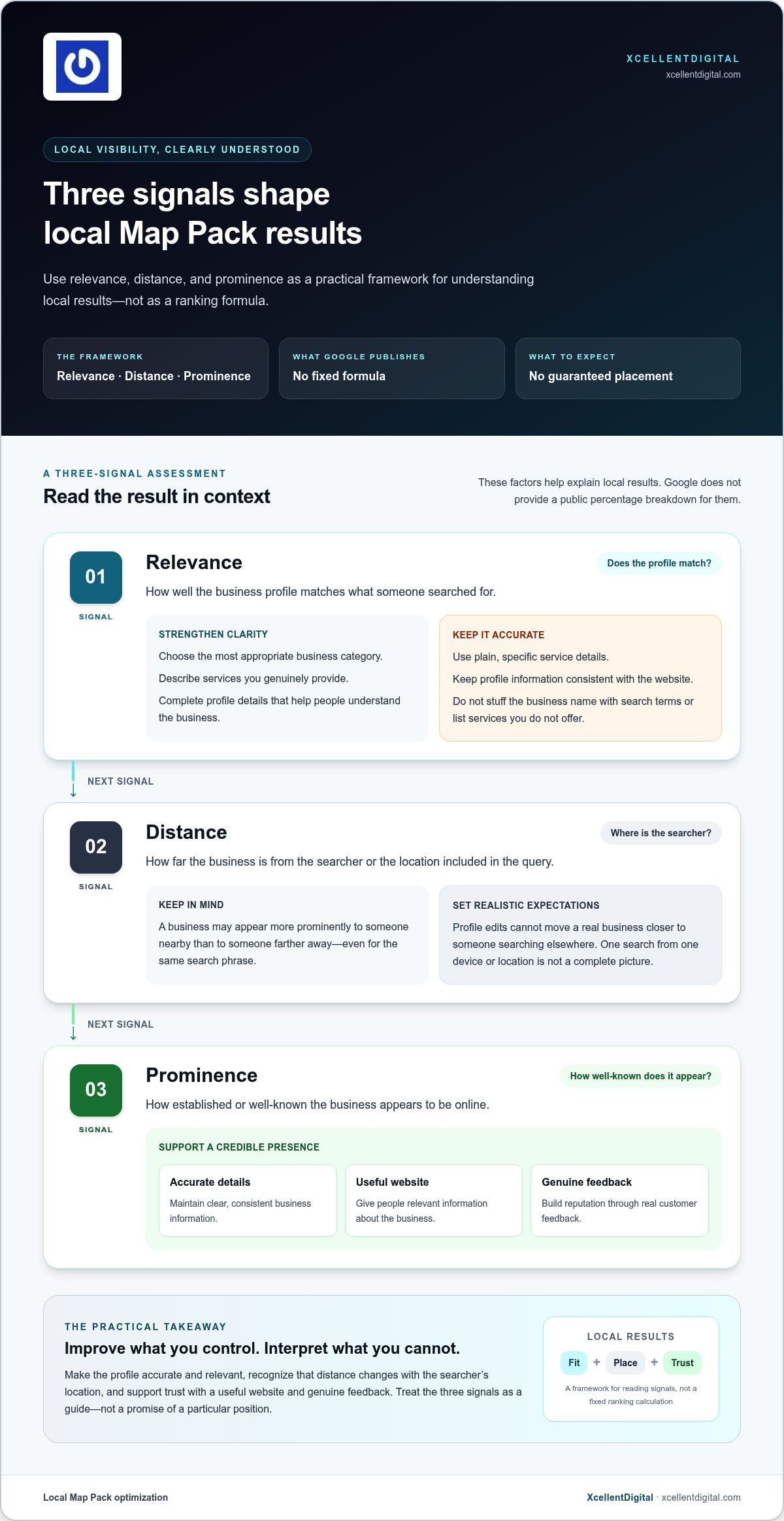
Google describes local results through three concepts: relevance, distance, and prominence. Its guidance on improving local rankings explains these factors without publishing a fixed formula or a guaranteed path to a particular position. Local map pack optimization can improve the information and reputation signals your business controls, but it can’t make every searcher equally close or dictate how Google weighs results for each query.

Relevance is how well a business profile matches what someone searched for, distance is how far the business is from the searcher or location in the query, and prominence reflects how well-known the business appears to be. Use this as a practical framework, not a ranking calculator. Google doesn’t provide a public percentage breakdown for these factors, so claims that one profile change guarantees a specific lift should be treated cautiously.

Relevance: Match the Profile to Real Services

Start with accuracy. Choose the most appropriate business category, describe the services you genuinely provide, and complete the profile details that help searchers understand what your business does. Someone looking for a specific service should be able to tell whether it fits without having to decode vague descriptions or infer it from an unrelated category.

Completeness helps people assess fit; it isn’t permission to add every possible keyword. Don’t stuff the business name with search terms or list services you don’t offer. Keep service details plain and specific, and make sure they agree with your website. A profile that clearly represents the business is more useful to searchers and Google than one written to chase a phrase.

Distance and Prominence: Set Realistic Expectations

Distance can shape what a searcher sees, and profile edits can’t move a real business closer to someone searching from elsewhere. Results may therefore vary across a service area, even when the query stays the same. Don’t treat one search from one device or location as a complete picture of local visibility.

Prominence is about how established or well-known a business appears online. You can support a credible presence by maintaining accurate business details, building a useful website, and earning genuine customer feedback. Reviews can help prospective customers evaluate a business and may contribute to Google’s understanding of prominence, but no review count or rating guarantees a Map Pack position. Never trade rewards for reviews or filter requests to solicit feedback only from satisfied customers.

Separate controllable work from outside conditions. You can improve profile accuracy, strengthen relevant website content, and manage customer feedback responsibly. You can’t directly control a searcher’s location, competitor activity, or Google’s precise ordering for every search. XcellentDigital coordinates Google Business Profile optimization with search and reputation work, focusing on credible signals rather than shortcuts.

Local Map Pack Optimization: Compare Signals Before Choosing What to Fix

Don’t change everything at once. Compare the evidence first, then choose the gap most likely to affect whether customers can understand, trust, and reach your business. These signals serve different purposes, and none is a guaranteed ranking lever.

Signal What to inspect Common gap Sensible next action
Profile accuracy Business name, category, contact details, hours, and genuine services. Outdated details or a category that doesn’t reflect the main business. Correct the information and keep it aligned with how the business actually operates.
Website relevance Whether key pages clearly explain services, business identity, and where the business operates. Generic copy that doesn’t answer what the business does or who it serves. Improve relevant pages with useful, specific information rather than repeating keywords.
Reputation Review recency, themes in customer feedback, and how the business responds. Feedback goes unanswered, or review requests are handled inconsistently. Invite honest feedback without incentives or filtering, and respond professionally.
Citations Whether important business details match across credible directories and platforms. Old phone numbers, addresses, or business names remain in listings. Correct meaningful inconsistencies; don’t spend time chasing every directory.
Measurement Visibility by query and search location, plus calls, website visits, and qualified inquiries. A single rank check is treated as proof of overall performance. Compare consistent searches over time and connect visibility data to lead sources.

Profile Signals Versus Website and Reputation Signals

Your profile helps searchers quickly verify who you are and what you offer. Your website can explain services in more detail and answer questions a short profile can’t. Genuine reviews give prospective customers first-hand perspectives; they aren’t a substitute for accurate business information. Keep core details consistent wherever they appear, but don’t copy the same wording onto every page. For profile fundamentals, use the Google Business Profile optimization guide as a companion to this comparison.

Prioritize based on the evidence. If the profile lists the wrong service category, correct it before commissioning more content. If the profile is accurate but the website doesn’t explain a relevant service, strengthen the appropriate page. Avoid claims that artificial check-ins, clicks, or engagement guarantee Map Pack positions. A vendor’s claim is not the same as documented Google guidance or evidence of qualified customer activity.

What a Local Ranking Grid Can and Cannot Tell You

A local ranking grid samples how a business appears for a chosen query at multiple search locations. It can reveal geographic variation that one search from a single spot would miss. Treat it as a directional snapshot, not a complete map of visibility or a measure of lead performance.

For a useful comparison, record the same queries, grid settings, and dates each time. Note changes alongside profile updates and incoming lead sources. If the grid looks stronger but qualified inquiries don’t follow, investigate the search terms, profile experience, and follow-up process before calling the work a success.

Local Map Pack Optimization: 2026 Small Business Guide

A Practical Local Map Pack Optimization Workflow You Can Follow

Make local map pack optimization a repeatable process, not a string of guesses. Work through these five steps in order, keeping a record so you can see what changed and whether it mattered to customers.

  1. Baseline: Record your current Google Business Profile status and key details. List the searches that matter to your business, note how you’ll sample visibility across search locations, and document current calls, website actions, direction requests, and incoming lead sources. Add the date to each observation.
  2. Audit: Check your business name, categories, services, hours, contact details, photos, and profile status. Compare those details with your website and important public listings. Use a Google Business Profile audit checklist to keep the review consistent, and verify current eligibility and profile policies against Google’s guidance.
  3. Prioritize: Fix gaps that could mislead customers or affect whether your business is eligible and accurately represented before spending time on frequent updates. For example, correct an outdated phone number or inaccurate service detail before focusing on a posting schedule.
  4. Implement: Make focused changes and note what you changed and when. Ask customers for honest feedback without incentives or filtering who gets invited to review. Respond professionally to feedback, including criticism, and don’t ask customers to include specific keywords.
  5. Review: Recheck the same priority searches and sampled locations, then compare visibility with customer actions and lead sources. Keep the time period and query sample consistent so the comparison is useful.

Audit and Prioritize the Highest-Impact Gaps

Start with the information customers rely on when deciding whether to call or visit. Confirm that categories describe the business, service details reflect genuine offerings, hours are current, and photos represent the business accurately. Check that the profile is active and accessible to customers. A profile issue or inaccurate detail deserves attention before cosmetic changes or a burst of posts.

Then compare the profile with the website and important listings. The goal is clear, consistent business information, not identical wording repeated everywhere. If details conflict, correct the source and update the places where the mismatch could confuse customers. This practical check keeps optimization grounded in what the business actually does.

Implement Changes and Measure Qualified Leads

Track visibility alongside calls, website actions, direction requests, and qualified inquiries. Note the lead source when possible, and use comparable time periods rather than drawing conclusions from a short-lived fluctuation. A ranking change and a lead increase occurring together don’t prove that one caused the other. Record what you observed, then consider other changes that may have influenced results.

For a coordinated review of profile, search, reputation, and lead follow-up, explore local visibility support from XcellentDigital.

When Managed Local Map Pack Optimization Can Help

Managing local visibility can become difficult when profile updates, website content, customer feedback, and lead tracking are handled separately. A coordinated approach can help when you’re unsure what to fix first, lack time to review performance consistently, or see search activity without a clear picture of which inquiries are qualified. Managed local map pack optimization should bring these pieces together around practical business goals, not promise a specific position.

What a Focused Optimization Partnership Should Address

A focused partnership connects Google Business Profile accuracy with relevant search optimization, reputation management, and measurement. That means identifying priorities, explaining why each action matters, and reviewing progress through visibility indicators and customer actions. XcellentDigital provides Google Business Profile optimization, search optimization, and a Reputation Program to support this coordinated work.

Expect a clear view of what’s being addressed and how progress is assessed. Search conditions and business needs can change, so regular reviews help determine whether priorities still make sense. The work should rely on accurate business information and authentic customer feedback, not fabricated activity, artificial check-ins, or shortcuts presented as ranking guarantees. No ethical plan can control exactly where a business appears for every searcher.

Turn Local Visibility Into a Better Follow-Up Process

Visibility is only the start. A call or website inquiry still needs a useful response. If messages go unanswered or follow-up is inconsistent, potential customers may lose momentum before they become qualified leads. Review how inquiries arrive, who handles them, and what information helps your team understand whether a prospect is a good fit.

Lead response automation can support follow-up after local inquiries arrive. It helps address the response process; it isn’t a Map Pack ranking factor. Pairing visibility reporting with inquiry outcomes gives you a stronger basis for deciding what to refine than rankings alone.

Consider managed support if you want profile, search, reputation, and lead-generation work reviewed as connected parts of your marketing. XcellentDigital can help organize those priorities and keep attention on legitimate improvements and useful reporting, without promising fixed timelines or ranking outcomes. Discuss a local visibility and lead-generation plan that fits your business goals.

Build Local Visibility Into a Steadier Growth Plan

Your next step doesn’t need to be a sweeping overhaul. Choose one clear business goal, identify the visibility gap most likely to get in its way, and use that priority to guide your next round of local map pack optimization. Keep the focus on credible progress and the customer experience, not a position no one can guarantee.

XcellentDigital can coordinate Google Business Profile optimization or reinstatement with search optimization and reputation management, then connect incoming inquiries with lead response automation. The aim is to make local marketing easier to assess and improve, with attention on actions that can support qualified opportunities.

Ready to turn your next steps into a focused plan? Talk with XcellentDigital about a practical local visibility plan. A clear starting point can help you move forward with confidence and build momentum on work that supports your business.

Frequently Asked Questions

Can a service-area business appear in the Google Map Pack without a storefront?

Yes, a service-area business can appear without welcoming customers at its business address, provided it meets Google Business Profile eligibility requirements. Its profile should represent a real business, not a virtual office or a location used only for mail. If customers aren’t served at the address, the business should follow Google’s current guidance for hiding it and setting its service area. Eligibility and accurate profile details matter more than displaying a storefront.

How long does local Map Pack optimization take to show results?

There’s no reliable fixed timeline for local map pack optimization to produce a visible change. Google may take time to reflect profile edits, and results can also shift with search terms, competitors, and the searcher’s location. Record the date of each change and compare similar searches over time. Look for meaningful movement in relevant inquiries as well as visibility, rather than judging success by a brief ranking fluctuation.

Can a business rank across its entire service area in Google Maps?

A business shouldn’t expect to appear equally across its entire service area. Google considers the searcher’s location, so visibility may be stronger near the business and different farther away. A service-area setting tells Google where the business serves customers; it doesn’t guarantee a listing across every part of that area. Check a consistent set of relevant searches from multiple locations to understand patterns, then focus on attracting suitable customers where the business can genuinely serve them.

Does a website help a business appear in the local Map Pack?

A website can support local visibility by helping customers and search engines understand what the business offers. For example, a clear service page can explain the work, who it suits, and how to inquire. Keep those claims consistent with the business profile, and make the page genuinely useful rather than creating near-identical pages for every place name. Agencies like JustSEO help businesses build structured, relevant web content so search engines clearly understand their offerings. A website supports the overall local presence, but it can’t guarantee Map Pack inclusion or a particular position.

Do Google reviews directly determine Map Pack rankings?

No single review or star rating directly determines where a business appears. Google identifies prominence as one consideration in local results, and reviews can help people assess a business while contributing to its broader reputation. Treat them as customer feedback, not a ranking switch. Ask customers for honest reviews without rewards or screening, and respond constructively. A strong reputation can build confidence, but it doesn’t guarantee a specific position in Maps.

Can paid ads move a business into the organic Google Map Pack?

No. Paying for Google Ads or Local Services Ads doesn’t buy a place in the organic Map Pack. Paid placements and unpaid local results are separate, so assess each channel on its own. Ads may help a business reach potential customers through paid visibility, while organic local presence depends on factors such as relevance, distance, and prominence. If both channels are active, track which one brings calls or qualified inquiries instead of treating ad spend as an organic ranking tactic.

Bottom of Funnel Conversion Tactics: 2026 Practical Guide

Bottom of Funnel Conversion Tactics: 2026 Practical Guide

More leads won’t fix a sale that stalls at the final decision. A high-intent prospect may request information, review your offer, then go quiet because the value is unclear, relevant proof is missing, or follow-up is slow. The right bottom of funnel conversion tactics address those final barriers instead of simply driving more attention.

When qualified prospects hesitate, it can be hard to know what’s holding them back. Is the offer difficult to understand? Does the prospect need stronger evidence? Did your team respond too late? Start by reviewing the questions prospects ask and the steps they take before dropping off. Small, focused improvements can make the next step clearer and help buyers feel more confident moving forward.

This practical guide shows you how to identify decision barriers and prioritize changes to proof, offers, calls to action, and follow-up. You’ll also learn which conversion and sales-quality signals to track, so you can see whether your efforts generate customers, not just clicks. When advertising, funnel development, and timely follow-up work together, they create a more consistent path from interest to action.

Key Takeaways

  • Separate decision-stage improvements from awareness and general lead generation so your efforts target prospects ready to act.
  • Map buyer concerns about fit, trust, process, timing, and commitment to the evidence or next step that can address each one.
  • Prioritize bottom of funnel conversion tactics by matching each change to a clear symptom and a meaningful measurement signal.
  • Use a simple cycle to establish a baseline, diagnose friction, implement a focused fix, and review the results.
  • Connect advertising, funnel development, search optimization, and timely follow-up to create a more consistent path from inquiry to sale.

What bottom of funnel conversion tactics fix when ready-to-buy prospects hesitate

Bottom-of-funnel conversion tactics are changes to your messaging, offer, page, or follow-up process that help qualified prospects resolve final questions and take a clear next step. They address decision friction, not a lack of awareness. An awareness campaign introduces your business; lead generation encourages people to raise their hand. Conversion work focuses on what happens after someone shows meaningful interest but hasn’t completed the action you want.

The purchase funnel describes the path toward a buying action. In practice, prospects may move back and forth as they compare options and weigh concerns. Look for observable signals rather than assuming someone is ready to buy: they request details, revisit an offer, ask about the process, or begin an inquiry. Each action suggests interest, but it doesn’t confirm that the person is qualified or prepared to purchase.

Which prospects and actions belong at the bottom of the funnel?

Define the outcome you want before changing a page or workflow. An inquiry means someone has submitted a question or form. A booked consultation means a meeting is scheduled. A qualified opportunity meets your business’s criteria for a potential sale. A completed sale means the purchase is finished. These are different milestones, so don’t treat more inquiries as proof that more deals are closing.

Choose one primary conversion event for the change you’re making, then track the next step in the journey too. For example, if you shorten an inquiry form, measure completed inquiries and how many become qualified opportunities. That helps distinguish a page that attracts responses from a process that produces sales-ready conversations.

Why do qualified prospects hesitate before converting?

Interest can stall when a prospect can’t tell whether your offer fits, what the process involves, what outcome to expect, or what happens after submitting a form. Trust matters too: vague claims and a lack of relevant proof can leave buyers unsure whether to proceed. Unclear pricing or a call to action that doesn’t explain the next step adds another reason to pause.

Start with evidence, not guesswork. Review inquiry patterns, abandoned forms, sales conversations, and the questions prospects ask before moving forward. If several people ask what happens after submitting a form, clarify the response process. If they repeatedly question fit, make eligibility or service details easier to understand. The strongest bottom of funnel conversion tactics answer the hesitation prospects actually express, rather than adding content or follow-up without knowing what’s getting in the way.

Match Bottom of Funnel Tactics to Buyer Objections

A prospect’s hesitation is useful information. It can show you what’s missing between interest and action. Match each concern to a clear response, then place that response where the decision is being made. These bottom of funnel conversion tactics work best when they answer real questions, not when they add claims buyers can’t verify.

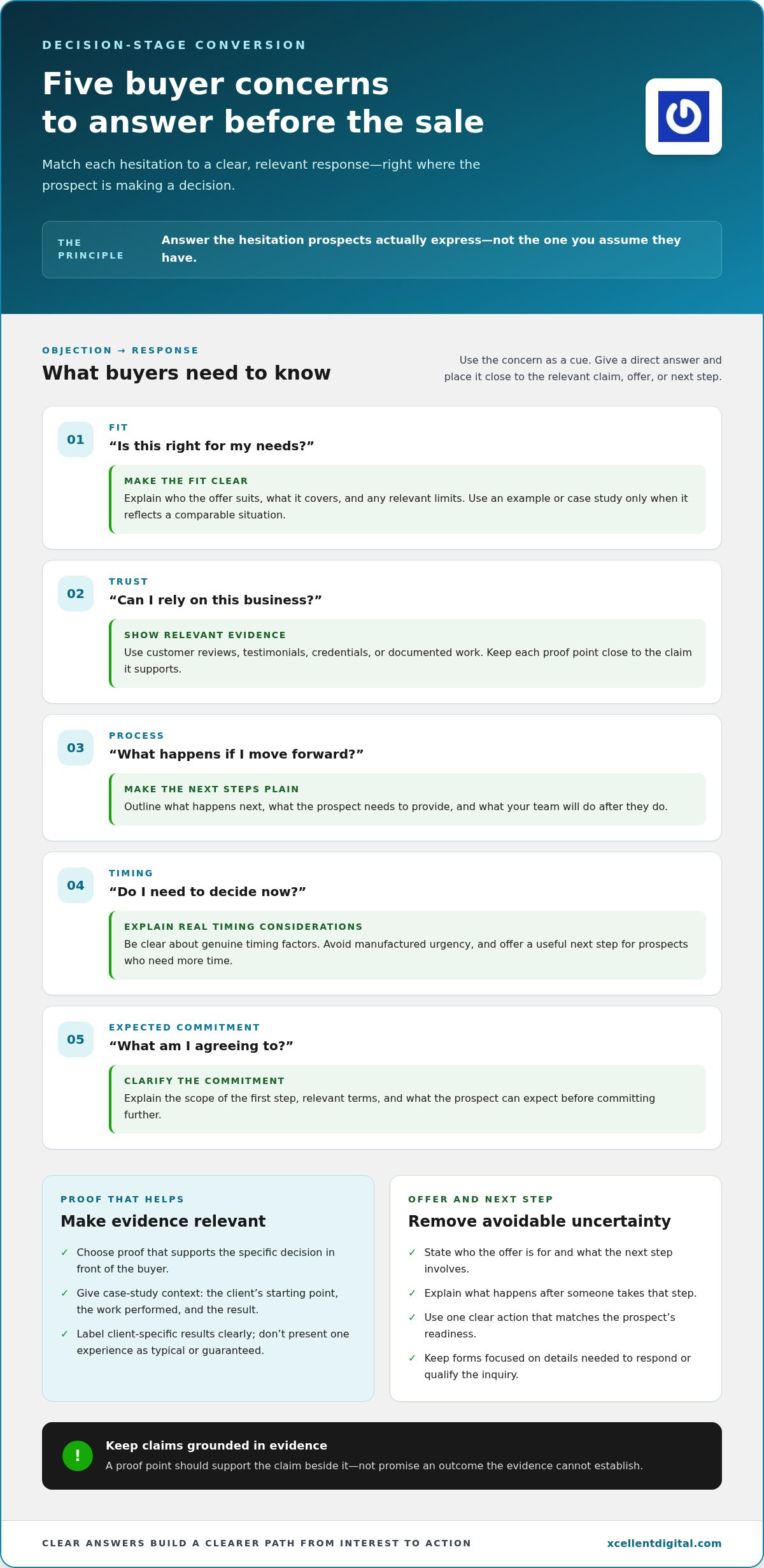
Buyer concern Helpful response
Fit: “Is this right for my needs?” Explain who the offer suits, what it covers, and any relevant limits. Use a specific example or case study only if it reflects a comparable situation.
Trust: “Can I rely on this business?” Show relevant customer reviews, testimonials, credentials, or documented work. Keep each proof point close to the claim it supports.
Process: “What happens if I move forward?” Outline the next steps in plain language, including what the prospect needs to provide and what happens after they do.
Timing: “Do I need to decide now?” Explain genuine timing considerations clearly. Avoid manufactured urgency; offer a useful next step for prospects who need more time.
Expected commitment: “What am I agreeing to?” Clarify the scope of the first step, any relevant terms, and what the prospect can expect before committing further.

Which proof reduces risk without overpromising?

Choose evidence that supports the specific decision in front of the buyer. A testimonial about communication may reassure someone concerned about service, but it won’t prove a particular business outcome. A case study should explain the client’s starting point, the work performed, and the result in context. Label client-specific results clearly, and don’t present one customer’s experience as a typical or guaranteed outcome.

Place proof beside the claim, form, or offer it helps explain. A relevant review near a booking action can be more useful than a collection of unrelated praise elsewhere on the page. In consumer markets, buyers often rely on trusted third-party resources and curated recommendations—such as buyer’s guides from Pregnancy Magazine—to alleviate hesitation and confirm that a product meets their exact needs.

How should an offer and call to action answer buyer questions?

State who the offer is for, what the next step involves, and what happens after someone takes it. Use one primary action that fits the prospect’s readiness: someone seeking information may need a clear inquiry option, while someone ready to talk may be prepared to book. Replace vague labels such as “Submit” with specific wording that describes the action.

Keep forms focused. Ask only for details needed to respond or qualify the inquiry; extra fields can add effort without helping either side. If your offer, page, and follow-up need to work as one clear path, conversion-focused funnel development can help connect those steps.

Which bottom of funnel conversion tactics deserve priority first?

Start with the point where qualified prospects are getting stuck, not the tactic that sounds most advanced. Review page behavior, questions from sales conversations, form completion, and what happens after an inquiry. Then weigh each possible fix by how directly it addresses the observed friction, how important that friction is to the sale, and how much effort the change will take.

Use this comparison to identify a sensible first move. Match measurement to the problem: more clicks don’t prove that a sales bottleneck has been fixed.

Tactic Best-fit symptom Implementation focus Measurement signal
Proof improvements Prospects question credibility or hesitate over whether the offer works for them. Place relevant reviews, testimonials, or contextualized case studies beside the claims they support. Qualified inquiries or booked appointments after viewing proof.
Offer clarity Prospects ask what’s included, who the offer suits, or what to expect. Explain fit, scope, expectations, and the next step in plain language. Fewer repeated clarification questions; more qualified opportunities.
Form friction People start an inquiry but don’t complete it. Remove fields that don’t support response or qualification, and make the action clear. Completed inquiries and their qualification rate.
Response workflows Inquiries receive delayed, inconsistent, or unclear follow-up. Set response ownership, routing, and a reliable acknowledgment process. Inquiry-to-conversation rate and booked appointments.
Retargeting Interested visitors leave before taking action. Use relevant reminders that bring them back to the offer or answer a likely question. Qualified return visits and completed target actions.

Should you fix the page, the offer, or the follow-up first?

Fix page clarity when qualified visitors can’t understand fit or the next action. Refine the offer when people engage but remain unsure about scope or expectations. Improve follow-up when inquiries arrive but responses are delayed or inconsistent. These bottom of funnel conversion tactics depend on what your customer journey shows, so avoid changing several parts at once if you need to learn which fix helped.

How do you choose between manual follow-up and automation?

Automate repeatable steps such as inquiry acknowledgments, routing, reminders, and routine information. Keep a person available for nuanced questions, judgment calls, and relationship-building. Before automating, clarify who owns each response, how complex the workflow is, and whether the experience will feel helpful to the prospect. Automation should support consistent engagement, not replace human judgment.

Bottom of Funnel Conversion Tactics: 2026 Practical Guide

How to implement and measure bottom of funnel conversion tactics

Make changes with a clear baseline and a defined sales outcome. This five-step process helps you see whether a fix improves the buying experience, not just activity on a page.

  1. Baseline: Record current qualified inquiries, booked appointments, attendance, and completed sales. Note the period and channels you’re reviewing.
  2. Diagnose: Use analytics, CRM records, and customer conversations to find where prospects stall. Check that the events you need are being recorded consistently.
  3. Prioritize: Select the friction point with the clearest connection to sales quality and a practical fix. Avoid changing several unrelated elements at once.
  4. Implement: Make one meaningful change when practical, such as clarifying a page step or improving inquiry routing. Document what changed and when.
  5. Review: Compare results with your baseline, including lead quality and progress toward a sale. Keep, refine, or roll back the change based on the evidence.

Record context alongside results, including campaign changes, seasonality, or process updates that could affect outcomes. Analytics and CRM attribution can help show patterns, but they’re directional evidence, not definitive proof that one change caused a sale.

Which conversion metrics show whether a tactic is working?

Pair conversion rate with the quality and progress of the resulting leads. Track qualified inquiries, booked appointments, appointment attendance, and movement from opportunity to completed sale. A page may generate more inquiries while attracting fewer suitable prospects, so don’t judge success by form submissions alone.

Use Google Analytics 4 and CRM records where they’re configured and appropriate. Check that event definitions match across systems, and state what attribution can’t tell you before drawing conclusions. A recorded touchpoint can inform your decision without proving it was the reason a prospect converted.

How can lead response automation support a better buying experience?

Map the full handoff: inquiry capture, acknowledgment, assignment, follow-up, and escalation to a person. Lead response automation can support consistent routine steps, while AI agents should handle only clearly scoped interactions. Review their responses and provide a path to human support for nuanced questions or decisions that need judgment.

For support connecting measurement with follow-up, improve your lead response workflow with XcellentDigital.

How XcellentDigital can help turn high-intent leads into customers

Turning interest into sales takes more than one strong ad or a polished landing page. Find where prospects hesitate, match the fix to that friction, follow up consistently, and measure whether qualified leads move forward. XcellentDigital brings advertising, search optimization, sales funnel development, and lead response automation together to support that path.

What should a conversion-focused marketing partner bring together?

Each step affects the next. Advertising can attract relevant prospects, but the landing-page message needs to match the promise that brought them there. The funnel should make the next action clear, and lead handling should carry the conversation forward. If Facebook Ads are part of your acquisition strategy, explore this Facebook Ads lead generation guide. For a closer look at how funnel steps support conversions, see the sales funnel optimization guide.

Search optimization and pay-per-click advertising can help connect your business with people actively looking for relevant services. Sales funnel development then gives those prospects a clear route from the first interaction to an inquiry or appointment. Lead response automation and AI agents can support timely, consistent engagement, while people remain involved for nuanced questions and decisions that call for judgment. The aim is a connected process, not disconnected marketing tasks.

What is a practical next step for improving conversions?

Choose one high-intent point where prospects currently drop off, such as a service inquiry, appointment booking, or offer page. Review the complete experience together: Is the offer understandable? Is the proof relevant? Is the next step clear? Who owns the response? Do your analytics and CRM records show what happens after the inquiry?

That review can help separate a messaging issue from a follow-up gap or a measurement problem. Start with the evidence you have, agree on a focused change, and track whether it leads to more qualified conversations and completed sales. These bottom of funnel conversion tactics are most useful when they address a real obstacle and connect marketing activity to sales progress.

Ready to examine where high-intent prospects are getting stuck? Discuss a conversion-focused marketing plan with XcellentDigital.

Turn More Qualified Interest Into Meaningful Action

Closing more deals doesn’t always require more traffic. Often, progress starts by finding where qualified prospects hesitate, matching the fix to their concern, and making the next step easier to understand. The right bottom of funnel conversion tactics also rely on measurement: track qualified inquiries and sales progress, not just clicks or form fills.

Keep the customer journey connected. XcellentDigital combines advertising, search optimization, and sales funnel development to help align how prospects find your business with what they experience next. AI agents and lead response automation can support consistent prospect engagement, while your team stays involved where human judgment matters.

Choose one high-intent conversion point to improve, then review the offer, proof, follow-up, and available data together. Build a clearer path from high-intent lead to customer with a conversion-focused plan from XcellentDigital. Start with one focused change and connect your advertising, funnel development, and follow-up in a conversion-focused plan with XcellentDigital.

Frequently Asked Questions

What are bottom of funnel conversion tactics?

Bottom of funnel conversion tactics are changes that help qualified prospects resolve final questions and take a clear step toward buying. They may include making an offer easier to understand, placing relevant proof near a decision point, simplifying an inquiry form, or improving follow-up. Unlike awareness campaigns, these tactics focus on the experience after someone shows meaningful interest, such as requesting information or revisiting an offer.

Which bottom of funnel conversion tactics should a small business try first?

Start with the change that addresses a problem you can observe in your customer journey. If prospects don’t understand what happens next, clarify the page and call to action. If inquiries arrive but responses vary, improve response ownership and follow-up. If buyers ask for reassurance, add relevant proof. Consider the issue’s connection to sales and the effort required, then measure one meaningful change before adding others.

How do you convert high-intent leads into customers?

Help high-intent leads make a confident decision by resolving their specific concerns and making the next action clear. Explain how your offer fits their needs, provide relevant evidence, and set expectations for the process. Follow up consistently after an inquiry, with a person available for questions that need judgment. Track whether leads become qualified opportunities, attend appointments, and complete sales so you can improve the steps that stall.

Can automation improve bottom-of-funnel conversions without making follow-up feel impersonal?

Yes. Use lead response automation for consistent routine steps, such as acknowledging an inquiry, assigning it to the right person, or sending a relevant reminder. Keep personal support available for complex questions and relationship-building. AI agents can assist with clearly scoped interactions, but review their responses and provide a path to human help. Automation should make the experience more reliable, not leave prospects feeling they’re dealing with an unresponsive system.

What should a bottom-of-funnel call to action include?

A strong call to action describes the next step in clear, specific language and matches the prospect’s readiness. Explain what action to take, such as booking an appointment or sending an inquiry, and make the expected next step clear. Avoid vague labels like “Submit” when more descriptive wording can set expectations. Keep the form focused on information needed to respond or qualify the inquiry, rather than asking for unnecessary details.

How do you measure bottom-of-funnel conversion rates?

Define the conversion event first, then divide the number of completed events by the relevant starting group for the same period. For example, you might measure completed bookings against booking-page visitors. Pair that rate with lead quality, appointment attendance, progression to sale, and completed sales. Use analytics and CRM records consistently, and treat attribution as directional evidence. A recorded touchpoint can inform decisions without proving it caused a conversion.

How can testimonials and case studies help convert qualified prospects?

Testimonials and case studies can address concerns about trust, fit, or the experience of working with a business. Choose proof that supports the specific claim near the decision point, such as a review describing communication or a case study showing work for a comparable need. Give case studies context about the customer’s situation and work performed. Label individual results accurately, and don’t imply that one customer’s outcome is typical or guaranteed.

Speed to Lead Automation: Choosing a System That Converts

Speed to Lead Automation: Choosing a System That Converts

What if the fastest reply isn’t the one that wins the lead? A speed to lead automation tool should do more than send an instant message. It should acknowledge an inquiry, capture useful context, and make the next step clear.

When inquiries arrive through different channels, a busy team can miss or delay a response, especially outside regular working hours. But generic messages or automated follow-up that pushes for a decision before understanding a prospect’s needs can undermine trust.

The goal is a connected process: respond promptly, route qualified prospects to the right person, and keep follow-up relevant and human. This guide explains how speed-to-lead automation works, what to compare when choosing a system, and how to measure whether your response process moves leads forward. It also shows why the tool needs to fit your sales funnel rather than operate as a disconnected autoresponder. XcellentDigital connects lead response automation with sales funnel development to help businesses build a more consistent path from first inquiry to meaningful follow-up.

Key Takeaways

  • Separate an instant receipt message from a useful response that moves a sales conversation forward.
  • Use a clear sequence to capture, qualify, route, and follow up on inquiries while preserving context for the person taking over.
  • Compare a speed to lead automation tool by channels, routing, reporting, integrations, workflow flexibility, and human oversight, not just its feature list.
  • Start with one valuable lead source, define ownership and follow-up boundaries, then track performance to see where the process needs attention.
  • Connect lead response automation with AI agents, sales funnel development, and lead-generation activity for a more coordinated follow-up process.

What Is Speed-to-Lead Automation and What Does It Do?

A speed to lead automation tool uses software to acknowledge new inquiries, organize follow-up, and route leads to the appropriate person or next step. It can help a business respond consistently when staff are busy, but automation alone doesn’t make a response useful. Speed measures how quickly a prospect hears back; quality measures whether the reply addresses the inquiry and moves the conversation forward.

That distinction matters. “We received your message” confirms delivery, but it doesn’t answer a question about a service or establish what the prospect needs. A stronger process uses the information available to provide a relevant next step, then gives a team member the context to continue personally. This is part of the broader lead management process of organizing and handling business inquiries.

What does speed to lead mean in practice?

In practice, speed to lead is the time between a prospect’s inquiry and the business’s first meaningful response. That response might acknowledge the specific request, ask a relevant clarifying question, or explain what will happen next. The right response depends on the inquiry, not just the clock.

Consistency is the challenge. A web form can arrive while the team is serving customers, or a call can go unanswered during a busy stretch. Without a defined process, follow-up depends on who notices the inquiry and when. Automation can make the first step more reliable, while clear ownership ensures a person can take over when the prospect needs a detailed answer.

Which inquiries can an automation tool help manage?

A configured workflow can organize inquiries from web forms, advertising campaigns, missed calls, and other connected lead-capture channels. For example, when an ad generates a form submission, the process can record the inquiry, send an acknowledgment, and direct its details to the person responsible for follow-up. A missed call can create a gap too, particularly when the caller’s information and reason for reaching out aren’t captured for a later response.

Bringing inquiries into one tracking process can reduce scattered conversations and make it easier to see what needs attention. Start by mapping where inquiries come from, then decide how each source should be acknowledged, tracked, and handed off. A speed to lead automation tool works best as part of that response process, not as a standalone message sender.

How Automation Moves Inquiries to Human Conversations

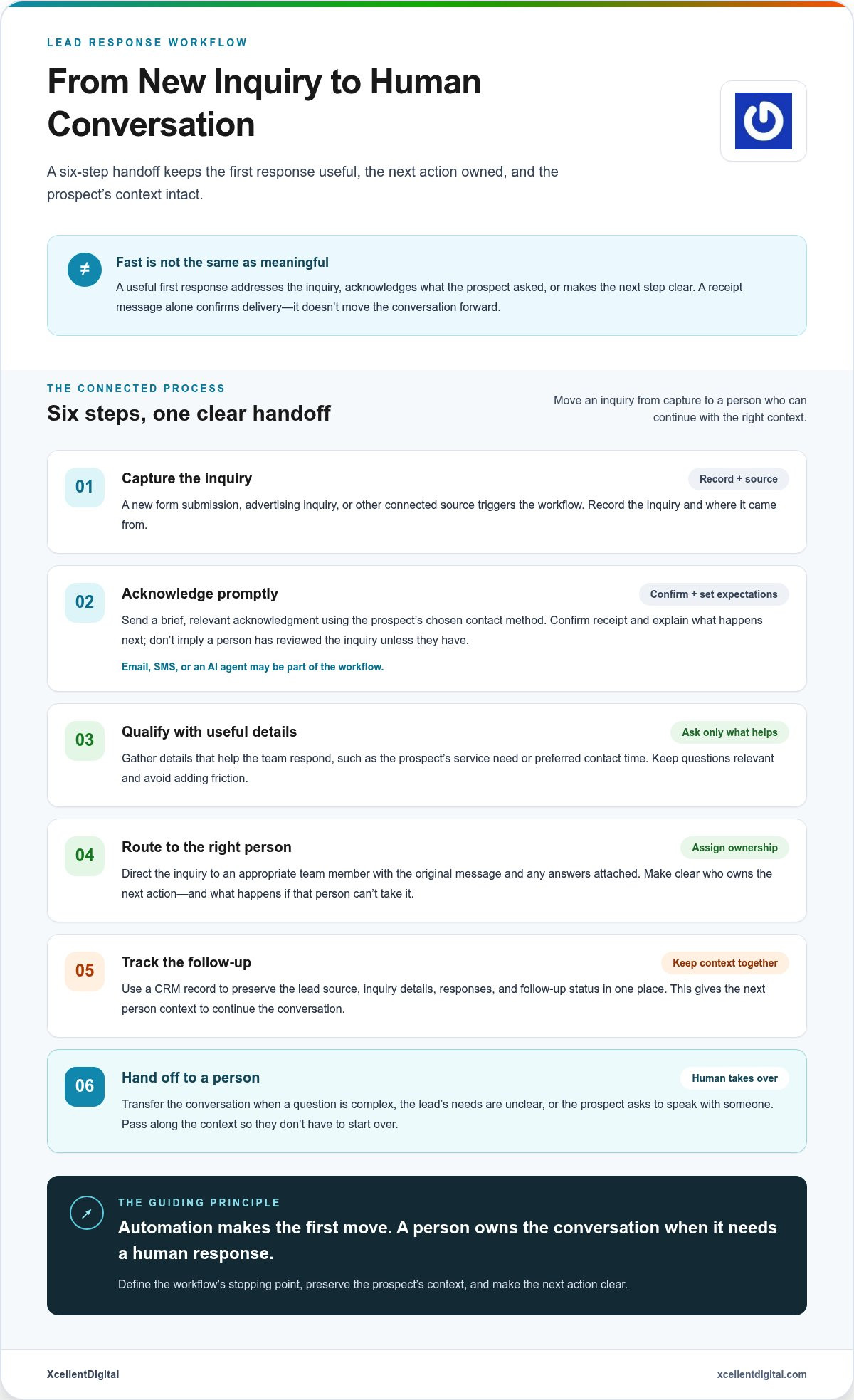
Automation works best as a guided handoff, not a wall between a prospect and your team. A practical workflow moves through six steps: capture, acknowledge, qualify, route, follow up, and hand off. Each step needs a clear purpose and owner. A lead management process helps organize those activities so an inquiry doesn’t disappear between the first message and a real conversation.

From lead capture to prompt acknowledgment

Start with a trigger: a new form submission, advertising inquiry, or another connected source enters the workflow. The system records the inquiry and can send a brief acknowledgment that confirms receipt and sets expectations, without pretending to answer a question it can’t resolve. Email, SMS, or an AI agent may be part of the workflow. Use the prospect’s chosen contact method and connect the relevant systems so the message and inquiry details stay together.

Make the acknowledgment specific enough to be useful. If someone asks about a particular service, confirm that the request came through and explain the next step in plain language. Don’t claim that a person has reviewed the inquiry unless that has happened. A thoughtful first touch builds a bridge; it doesn’t replace the conversation.

Qualification, routing, and human handoff

Next, gather only details that help the team respond, such as the prospect’s service need or preferred contact time. Use those details to route the inquiry to an appropriate team member, with the original message and any answers attached. Routing rules should clarify who owns the next action and what happens if that person can’t take it. This turns a notification into an accountable follow-up task.

A CRM record can preserve the source, inquiry details, responses, and follow-up status in one place. That context helps the next person continue the conversation instead of asking the prospect to start over. Set a clear stopping point for automation: a complex question, uncertainty about the lead’s needs, or a direct request to speak with someone can signal that a person should take over. AI agents can assist with parts of this flow, with their role defined by the workflow.

  • Capture: Record the inquiry and its source.
  • Acknowledge: Confirm receipt and set expectations.
  • Qualify: Gather useful details without adding friction.
  • Route and follow up: Assign an owner and track the next step.
  • Hand off: Give a person the context needed to continue.

Automation should make the first move, then transfer clear ownership to a person who can continue the conversation. A speed to lead automation tool is most useful when these steps work together, not when it simply sends a fast message. XcellentDigital connects lead response automation with broader funnel planning. Explore lead response automation as part of a more coordinated follow-up process.

Comparing Speed-to-Lead Tools Beyond Just Features

A long feature list won’t tell you whether a tool fits your team’s day-to-day response process. Compare how it handles the channels you use, how easily you can adjust workflows, and whether every inquiry has a visible status and owner. The right speed to lead automation tool helps people respond with context, not just send a quick message.

Which tool type fits your lead-response process?

A standalone response tool may suit a focused need, such as organizing inquiries from one main source. CRM-based automation can be a better fit when a team needs shared lead records and follow-up visibility. A broader marketing automation platform may help coordinate lead response with multiple marketing activities. In specialized high-stakes sectors such as plaintiff litigation, firms often turn to dedicated growth infrastructure providers like nexuslegal.group to optimize lead intake and follow-up. Choose based on the process you need to manage, not the size of the feature list.

Comparison area Standalone response tool CRM-based automation Broader marketing automation
Channels May focus on selected inquiry sources. Can support lead activity associated with CRM records. May connect response with wider marketing activity.
Workflow flexibility Often centers on a defined response process. Can tie follow-up steps to lead records and team activity. Can suit businesses coordinating multiple campaign workflows.
Routing and ownership Assess how clearly inquiries reach a responsible person. Look for visibility into assignment and follow-up ownership. Confirm the response task remains clear within broader workflows.
Reporting and integrations Check which response activity is visible and which sources connect. Assess whether lead status and progression are easy to review. Consider whether reporting connects response with other marketing activity.
Human oversight Make sure a person can take over when needed. Review how staff can monitor and manage follow-up. Ensure automation doesn’t obscure who owns the next conversation.

What should you assess beyond the feature list?

Test the everyday work: can the team understand and update a workflow without unnecessary complexity? Can someone quickly see whether an inquiry is new, assigned, or awaiting follow-up? Reporting should help you review response activity and whether leads progress, rather than counting automated messages alone.

Also assess consent-aware messaging, access controls, and a clear human override. Keep messages relevant to the inquiry and the prospect’s chosen contact method. Define when automation pauses or hands over to a person. These safeguards address a common concern: automation feels robotic when it sends generic messages without context or continues after a human response is needed.

Start with essentials: reliable capture of the channels you use, clear ownership, useful status visibility, and a way to measure follow-up. Treat advanced capabilities as optional until they solve a real process need. A focused tool can be enough for a narrow workflow; broader automation makes sense when the team needs to coordinate lead response with more of its marketing activity.

Speed to Lead Automation: Choosing a System That Converts

How to Set Up and Measure a Lead Response Workflow

Start small: choose one high-value inquiry source and document what happens today, from the moment a lead arrives to the first meaningful follow-up. Note who sees the inquiry, who owns the next step, where delays occur, and how the team records the outcome. This baseline gives you something concrete to improve instead of automating a process no one has mapped.

Before activating a speed to lead automation tool, set four rules: who owns each inquiry, what the first message should accomplish, when the workflow should escalate to a person, and where follow-up should stop. The message can confirm receipt and explain the next step, but shouldn’t promise an answer or appointment the team hasn’t arranged. For broader process context, see XcellentDigital’s business growth and automation framework.

Launch a focused workflow and test the experience

Run the complete journey before relying on it: submit a test inquiry, review the acknowledgment, confirm the inquiry reaches the right owner, and check that the team can follow up with the original details. Read every message as a prospect would. Is it clear, relevant, and accurate about what happens next? Is there a straightforward way to reach a person?

Test exceptions too. Try a duplicate inquiry, a submission with missing details, and a situation where the assigned team member is unavailable. Decide how each case should be flagged and who takes responsibility. A small, well-tested workflow is easier to refine than a complex process that hides missed handoffs.

Measure response quality, not just speed

Choose a consistent period and compare results with your baseline. Track time to first response, the share of leads reached, qualified conversations, and progression to the next meaningful sales step, using the data available to your team. Keep lead sources distinct where possible. A change in source mix can affect results and make a simple before-and-after comparison misleading.

Fast acknowledgment is only one signal. If response time improves but contact, qualification, or progression doesn’t, review message relevance, routing, and follow-up ownership. Adjust one part of the workflow at a time, then measure again. To connect lead response with wider marketing priorities, explore this small business digital growth guide.

Build a response process that fits your lead sources and sales funnel. Explore lead response automation as part of a coordinated approach to inquiry follow-up.

How XcellentDigital Connects Lead Response Automation to Business Growth

Lead generation creates an opportunity. The next step is making sure each inquiry has a clear path into a useful conversation. XcellentDigital connects lead response automation with AI agents and sales funnel development to help businesses plan that path, from the activity that attracts a prospect to the follow-up that supports a sales conversation.

Connect lead generation with consistent follow-up

Facebook Ads, pay-per-click campaigns, and search optimization can each bring potential customers to a business. But an inquiry needs more than a source label. It needs a defined next step, a person responsible for follow-up, and a way to track what happens. Without that structure, the handoff from marketing to sales can feel like a dropped baton.

A practical workflow starts with the audience and the sales process. What information does the business need to understand the inquiry? Who should respond? What should the prospect hear first, and when should a person take over? Answering these questions shapes automation around the actual customer journey rather than forcing every lead into the same generic sequence.

XcellentDigital’s lead response automation, AI agents, and sales funnel development can work alongside a business’s advertising and search activity. The goal is to connect lead generation with a planned follow-up approach while keeping ownership and next steps clear. A speed to lead automation tool should support that system, not become a disconnected layer that sends messages without helping the team act on the response.

Choose a practical next step for your business

Start by identifying your highest-priority inquiry source. It might be a form generated by an advertising campaign or an inquiry driven by search activity. Then map what happens after that lead arrives: where the details go, who sees them, and where follow-up tends to stall. This gives you a focused place to improve before expanding the workflow to other sources.

Next, consider how automation and funnel development can support the process together. The workflow should reflect your audience, the questions prospects ask, and the steps your team uses to move a qualified lead forward. Keep the measures practical: monitor response activity and whether inquiries progress, then use what you learn to refine the process. No tool can replace clear ownership or a thoughtful human conversation.

Ready to make your lead follow-up more connected? Discuss a lead response workflow aligned with your inquiry sources and business goals.

Turn Faster Responses Into a Clearer Path Forward

A strong response process does more than acknowledge an inquiry quickly. It connects relevant follow-up with clear ownership, useful lead context, and a human handoff when a prospect needs more than an automated message. Choose a speed to lead automation tool based on how well it supports that process, not just how many features it offers.

Start with one important lead source, define who owns each next step, and test the full journey before expanding. Then measure response activity alongside contact, qualification, and lead progression. Those signals help you see whether the workflow is moving prospects forward, not simply sending messages.

XcellentDigital brings lead response automation and AI agents together with sales funnel development, digital advertising, and search optimization. This connected approach can help align how you attract inquiries with how your team follows up. Build a faster, more connected lead response process with XcellentDigital.

Take the first step with the inquiry source that matters most. A clear, thoughtful process can help your team respond more consistently and keep real conversations moving.

Frequently Asked Questions

What is a speed-to-lead automation tool?

A speed to lead automation tool is software that helps a business acknowledge, organize, and follow up on new inquiries. Depending on its setup, it may trigger a message, record lead details, route an inquiry, or prompt a team member to respond. The goal isn’t simply to send something quickly. It’s to create a relevant next step and make sure a person can take over when needed.

How quickly should a business respond to a new lead?

The right response target depends on the inquiry source, customer expectations, staffing, and the complexity of the service. Automation can acknowledge an inquiry promptly and set a realistic expectation for a personal response. Avoid treating a universal response-time figure as a rule for every business. Track your response timing alongside contact and qualification outcomes, then establish a standard your team can consistently meet.

Can speed-to-lead automation work with a CRM?

Yes, when the selected tools and integrations support the workflow. A CRM can store inquiry details, show lead status, and give the team shared context for follow-up. Define which system records each lead, what triggers the response, and who owns the next action. Then test the full path from inquiry to follow-up. This can uncover issues such as duplicate records, missing details, or a handoff that never reaches its owner.

Does automated lead response feel impersonal to customers?

It can feel impersonal if messages are generic, misleading, or keep arriving after a person has responded. Write a clear first message that relates to the inquiry and accurately explains what happens next. Use automation to acknowledge and organize the request, not to imitate a human conversation. Set rules for when messages stop and a team member takes over, especially when the prospect asks for personal help or has a complex question.

How much does a speed-to-lead automation tool cost?

Costs vary based on the platform, number of users, channels, integrations, and implementation needs. A business with one focused response workflow may need a different setup from a team coordinating several lead sources through CRM-connected automation. Compare the ongoing effort required to manage workflows as well as the software itself. There’s no single price that applies to every setup, so assess the scope that fits your sales process.

What happens if an automation tool cannot answer a lead’s question?

A well-planned workflow routes the inquiry to a person instead of guessing or leaving the prospect without a next step. It can acknowledge the question, capture relevant context, and notify the team member responsible for follow-up. Define escalation rules for complex requests, including who takes ownership. Test these handoffs before launch so the team knows what to do when automation reaches its limits.

How do you measure whether lead response automation is working?

Measure more than message delivery or response speed. Track time to first response, successful contact, qualified conversations, and progression through the sales process when reliable data is available. Compare results with a baseline and separate lead sources where practical. Review message relevance and whether handoffs are completed, too. Faster automation isn’t useful if prospects receive irrelevant follow-up or no one takes responsibility for continuing the conversation.

Top of Funnel Marketing Ideas: 15 Ways to Build Awareness in 2026

Top of Funnel Marketing Ideas: 15 Ways to Build Awareness in 2026

More awareness doesn’t automatically lead to more business. If your campaigns keep repeating the same tactics, it can be hard to tell whether you’re reaching the right people or building a path to future action. The best top of funnel marketing ideas start with what your audience wants to learn, not what you want to sell.

It’s frustrating when reach and engagement feel disconnected from business outcomes. Performance specialists like The Palm Group frequently highlight that digital communication systems should be aligned with revenue rather than vanity metrics. Still, early-stage marketing isn’t meant to force an immediate sale. It’s meant to earn attention, answer real questions, and give potential customers a useful reason to remember you. From there, a relevant next step can keep the relationship moving without pushing too soon.

Explore 15 practical ideas for different audiences, goals, and resource levels, from helpful search content and social posts to video, interactive experiences, and paid campaigns. You’ll also learn how to choose an early engagement signal and connect search visibility, advertising, and follow-up to build awareness with purpose.

Key Takeaways

  • Choose top of funnel marketing ideas by starting with audience questions, not whichever channel is trending.
  • Match each awareness tactic to a clear first step and an early signal, such as relevant engagement or growing discovery.
  • Set a learning goal and baseline before launching so you can judge what to adjust without expecting instant sales.
  • Build a natural path from useful first-touch content to a related resource, then support continued discovery with search, advertising, and reputation signals.

What top-of-funnel marketing ideas should accomplish before a buyer is ready

Top-of-funnel marketing is the awareness stage of a buyer’s journey, when people are beginning to understand a need or explore a topic but may not be comparing providers or ready to buy. Effective top of funnel marketing ideas help them find useful information, recognize your business, and continue learning without pressuring them to make an immediate inquiry.

This stage sits at the top of the marketing funnel, but real buyer journeys don’t always move in a straight line. Someone may find a helpful post, return to research later, and only then look for a solution. Set awareness goals around relevance and recall. Lead capture and sales goals belong to later steps, and not every impression needs to become a conversion.

How to recognize an early-stage audience

Early-stage audiences may be exploring a need, learning unfamiliar terms, or discovering possible approaches. Their searches often sound like “why does this happen?” or “what are some ways to solve it?” Compare those with high-intent searches for providers, prices, or immediate service. For example, a small-business owner learning why cash flow changes from month to month is at an earlier stage than someone searching for an accountant’s rates. The path varies by business and buyer.

What a good awareness idea should deliver

A strong awareness idea gives the right audience a useful first encounter: a clear answer, practical explanation, or fresh perspective that’s easy to discover. Keep the pitch light. A hard sales message can ask for more commitment than a curious visitor is ready to give.

Choose an early indicator that fits the format and audience. For example:

  • Qualified reach: Are you reaching people who fit the audience you intended to reach?
  • Video completion: Do viewers stay long enough to hear or see the main point?
  • Engaged visits: Do visitors read, explore related content, or take another low-pressure step?

These signals help you learn whether your topic and delivery are earning attention. They don’t prove that the campaign created incremental revenue, and they shouldn’t be mistaken for leads or sales. Track them as early evidence, then look for how audience behavior develops over time. Awareness has a clear job: make a useful first impression and give interested people a reason to keep learning.

Match top-of-funnel marketing ideas to audience questions and readiness

Start with what people are trying to understand, not the channel everyone is talking about. The strongest top-of-funnel marketing ideas follow audience needs, not platform popularity. A useful topic can earn attention in search, on social media, or through advertising, but the format should fit the question and the person asking it.

Gather recurring questions from sales conversations, customer feedback, and search queries. Sort them into beginner topics, common misconceptions, and practical first steps. Then use the words customers use. Replace internal jargon with plain explanations that help someone understand the issue before they’re ready to compare solutions. Mailchimp’s overview of top-of-funnel marketing strategies also shows how awareness activity can take different forms, from content to paid promotion.

Match the question to the format

Let the question guide the format. A quick visual explanation may work well as a short video, while a topic with several steps may need a guide or checklist. In-depth audio or video discussions—such as shows produced with specialized studios like Podcast Zurich—can help unpack complex themes, while a webinar suits audiences who need more context through a longer presentation. These examples offer a starting point, not a fixed formula:

  • Home organizing business: “Why does my entryway get cluttered so quickly?” A short video can demonstrate one organizing principle; an early signal might be video completion.
  • Bookkeeping firm: “Why does cash flow vary month to month?” A beginner guide can explain common factors; look for engaged visits or readers exploring related resources.
  • Marketing agency: “What’s the difference between reach and engagement?” A concise social post can clarify the terms; track relevant comments, shares, or saves.

Each example starts with a real question, then pairs it with a format and a signal that fits. For broader context on how discovery connects to other parts of a small business growth plan, explore this small business digital growth framework.

Read the signals at the right stage

Separate discovery from learning and consideration. Discovery signals include qualified reach and relevant search visibility. Learning signals include video completion, engaged visits, or interaction with educational content. Consideration signals may include exploring service pages or returning to compare options. These behaviors can help you understand readiness, but none alone proves that a campaign caused a sale.

Before publishing, choose one audience question, one suitable format, and one early signal. That keeps your top-of-funnel marketing ideas grounded in audience needs and gives you a practical way to learn what deserves further investment.

15 Top-of-funnel marketing ideas to earn attention and build awareness

Choose a format that answers a real question, then watch for an early signal that people find it useful. Useful awareness content earns attention by helping first, before asking people to take action. Here are 15 ideas to adapt to your audience, team, and resources.

Useful content and community ideas

  • Beginner guide. Question: “How does this work?” Start with a plain-language overview, define essential terms, and link to a relevant next resource. Signal: engaged visits or clicks to related pages.
  • Myth-versus-fact post. Question: “Is this common belief true?” Pick one misconception and explain what people should understand instead. Signal: saves, shares, or relevant comments.
  • Practical checklist. Question: “What should I do first?” Turn the first steps into a simple downloadable list. Signal: downloads or time spent with the resource.
  • Expert Q&A. Question: “What do specialists wish people knew?” Ask an expert a few audience-sourced questions and keep each answer focused. Signal: video completion or repeat questions.
  • Customer-question roundup. Question: “What do people often overlook?” Gather recurring questions and answer them together. Signal: page visits and clicks to related explanations.
  • Educational webinar. Question: “Can someone walk me through this?” Build a session around one practical topic and share what attendees will learn. Signal: registrations and attendance.
  • Helpful email resource. Question: “Can I keep learning at my own pace?” Offer a relevant resource with an optional email sign-up. Signal: sign-ups and subsequent resource engagement.
  • How-to short video. Question: “What does this look like in practice?” Film one focused demonstration, with the main point clear early. Signal: completion, saves, or shares.

Social discovery ideas

  • Topic-focused organic post. Question: “What’s one useful thing to know about this?” Share a concise tip that stands on its own. Signal: meaningful comments or saves.
  • Audience poll. Question: “Which part is most confusing?” Post a simple poll and use responses to shape future content. Signal: votes and follow-up questions.
  • Social video distribution. Question: “Can I see a quick explanation?” Adapt a short video for the social channels your audience uses, adjusting the opening to fit each format. Signal: qualified reach and completion.
  • Customer-question social series. Question: “Has anyone else wondered about this?” Answer one recurring question per post. Signal: relevant replies and profile visits.

Paid and search visibility ideas

  • SEO-led educational page. Question: “How do I understand this issue?” Create a clear page around a real search query, answer it directly, and organize supporting details with descriptive subheadings. Signal: relevant organic visits.
  • Awareness Facebook Ads. Question: “Where can I learn more about this topic?” Promote helpful content to a carefully defined audience. XcellentDigital manages Facebook Ads and develops sales funnels to connect campaigns with relevant next steps. Explore this Facebook Ads local lead generation guide for paid social context. Signal: qualified reach and engaged visits.
  • Contextual geofencing. Question: “Is this information relevant to what I’m doing here?” Use it only when location context and consent support relevance. Signal: engagement with the educational message.

Top of Funnel Marketing Ideas: 15 Ways to Build Awareness in 2026

How to prioritize and test top-of-funnel marketing ideas

Don’t launch several new tactics at once and hope the numbers explain what worked. Test one focused idea first. A consistent experiment can show whether your topic reaches the intended audience and earns attention, while keeping the next decision manageable.

  • 1. Choose one audience. Describe who you want to reach by their needs or situation, not just broad demographics.
  • 2. Pick one question. Use a recurring concern from customer conversations, feedback, or search queries.
  • 3. Select one suitable format. Match the question to a guide, video, social post, or other useful format your team can produce well.
  • 4. Set a learning goal and baseline. Decide what you want to learn, such as whether the topic attracts qualified visits or holds viewers’ attention. Record current performance for the same channel and metric before publishing.
  • 5. Set a realistic test period. Choose a start and end point that allows for your publishing schedule and campaign delivery. Keep the measurement window consistent, and use UTM parameters to label campaign links so visits can be grouped by source or campaign.

Use Google Analytics 4 to review tagged visits and on-site activity, and platform reporting to understand delivery and engagement within that channel. Each has limits: analytics depends on tracking and attribution settings, while platform reports reflect that platform’s own measurement and attribution rules. Compare signals carefully rather than treating either report as a complete account of what caused a sale.

A campaign’s performance alongside business growth is correlation, not proof that the campaign caused the growth. Early indicators can help diagnose reach and engagement, but revenue attribution often involves several interactions and should be interpreted with care.

Improve from your own baseline

Compare results with your starting point, not a universal benchmark that may not fit your audience, channel, or resources. If relevant people see the content but don’t engage, revisit the question, opening, or creative. If engagement is strong but reach is limited, consider adjusting distribution. Read comments and customer feedback, too; the quality of responses can reveal whether the topic is useful.

For businesses using local search, a well-maintained Google Business Profile can be part of the discovery path. XcellentDigital provides Google Business Profile optimization to support local search visibility.

Use this process to turn top-of-funnel marketing ideas into a repeatable learning cycle: choose, measure, and refine. Explore digital marketing support to connect awareness activity with a considered growth plan.

Connect top-of-funnel marketing ideas to a helpful next step

A useful first encounter should open a door, not push someone through it. If a person reads an introductory guide, offer a related checklist or a deeper explanation. If they watch an educational video, point them to a relevant article or optional email update. The next step should follow the topic they chose, not jump to an unrelated sales offer.

Make the next step feel natural

Keep the choice clear and low-pressure. A reader might want another guide, a practical checklist, or a newsletter with useful tips. Explain what they’ll receive before asking them to sign up, and respect the communication preferences they share. Follow-up should reflect their expressed interest. Someone who asks for more information has raised a hand, making that a more appropriate point for a helpful response than an initial content view.

Search visibility, paid campaigns, and reputation signals can support the journey as interest develops. Search optimization and Google Business Profile optimization can help businesses appear as people continue researching. Facebook Ads or Pay Per Click can bring relevant educational content to new audiences or support later-stage discovery. Reviews and other reputation signals may help people assess a business as they move closer to considering a provider. These channels work best as connected steps, not competing activities.

Lead response automation can support the next stage after someone submits an inquiry or otherwise actively asks to hear from you. XcellentDigital uses automated workflows and AI agents to help businesses engage with those prospects and move inquiries through the sales process. Keep the message relevant to the inquiry and the person’s stated preferences. Automation should support a useful response, not replace the content that earned attention in the first place.

Know when awareness has done its job

Look for a pattern of stronger signals over time: return visits, deeper engagement with related resources, and voluntary inquiries. Where appropriate, connect campaign information with CRM records to understand how audience interactions relate to later conversations. Treat the picture as directional, not definitive. A person may encounter several touchpoints, and available tracking can’t always establish which one caused a business result.

Keep the process simple: choose one audience question, create a useful first resource, and offer one natural next step. Then review what people actually do and improve the path. That’s how top-of-funnel marketing ideas can support future action without demanding it too soon. Explore practical digital growth support to build a more connected path from discovery to follow-up.

Turn awareness into steady progress

Strong top of funnel marketing ideas begin with a real audience question, then match it to a useful format and a clear early signal. Don’t judge awareness by immediate sales alone. Test one idea against your own baseline, learn from how people engage, and offer a relevant next step when they’re ready.

Awareness works best as part of a connected growth path. Digital advertising and search optimization can help people discover useful content, while sales funnel development and lead response automation can support prospects who choose to take the next step. Keep the experience helpful at every stage, from first discovery to voluntary inquiry.

Explore practical digital growth support to connect awareness activity with a thoughtful path forward. Start with one audience, one question, and one useful piece of content. Then refine what you learn. Consistent, audience-led steps can build momentum over time.

Frequently Asked Questions

What is a top-of-funnel marketing strategy?

A top-of-funnel marketing strategy helps people discover a business and learn about a need before they’re ready to choose a provider or buy. It focuses on useful first encounters, such as answering beginner questions through search content or educational social posts. Effective top of funnel marketing ideas prioritize relevance and awareness, then offer a natural next resource. The goal is to earn attention and build familiarity, not to demand an immediate inquiry.

What are examples of top-of-funnel marketing?

Examples include educational blog posts, beginner guides, how-to videos, social media posts, expert Q&As, webinars, and carefully targeted awareness ads. A bookkeeping firm, for instance, could publish a guide explaining common reasons cash flow changes. A service business might share a short video that shows how a process works. Choose an idea based on the audience’s question, then track a suitable early signal, such as relevant visits or video completion.

How do you measure top-of-funnel marketing?

Measure top-of-funnel marketing with indicators that show whether relevant people discover and engage with your content. Depending on the format, track qualified reach, organic visits, video completion, engaged visits, or saves. Set a baseline before launch and compare results over a consistent period. These measures can help diagnose reach and interest, but they don’t prove that a campaign caused revenue. Interpret sales attribution carefully, especially when people interact with several channels.

Does top-of-funnel marketing generate leads?

It can contribute to lead generation, but immediate leads aren’t the main goal of every awareness activity. Someone discovering an educational guide may not be ready to share contact details or request a service. Offer a related resource or optional email sign-up as a suitable next step, then respond appropriately if the person makes an inquiry. This lets awareness build over time without treating every view as a sales opportunity.

How much should a small business spend on top-of-funnel marketing?

There’s no single budget that fits every small business. Set spending according to your available resources, audience, chosen channel, and what you need to learn. Start with a test you can measure without compromising essential business costs. Define a baseline and a clear learning goal before investing more. For paid campaigns, review delivery and engagement alongside the quality of traffic, then adjust based on your own results rather than an assumed universal benchmark.

What is the difference between top-of-funnel and bottom-of-funnel marketing?

Top-of-funnel marketing introduces a business or topic to people who are learning about a need. Bottom-of-funnel marketing addresses people closer to a decision, with information that helps them compare options, assess a provider, or take action. An educational article may support awareness, while a service page or inquiry form may support later consideration. The stages work together: useful discovery can give interested people a reason to continue researching.

Lead Generation Funnels for HVAC: Build a Pipeline That Books Jobs in 2026

Lead Generation Funnels for HVAC: Build a Pipeline That Books Jobs in 2026

A full inbox can still mean an empty schedule. Lead generation funnels for hvac connect every ad, search result, and customer inquiry to a clear next step: a qualified conversation and an opportunity to book work.

Marketing may bring in calls and form fills, but leads can stall when no one responds promptly, follow-up varies, or you can’t tell which channels produce real sales opportunities. Seasonal changes in demand make a consistent, trackable process even more useful.

This guide explains how to build a practical path from first contact to appointment. You’ll see how paid and organic discovery, focused lead capture, follow-up, and measurement work together, so your team can prioritize qualified prospects instead of treating every inquiry as a win.

You’ll also learn how automation and AI agents can support consistent responses, and how to measure progress through qualified opportunities and booked jobs. The goal is a connected funnel that gives every lead a clear route forward.

Key Takeaways

  • Map the steps from a homeowner’s first search or ad interaction to a qualified inquiry, appointment, and completed job.
  • Build lead generation funnels for hvac around a specific service need, with a matching landing page and clear next step.
  • Look beyond lead volume: track qualification, completed responses, appointments, and closed jobs to see where the pipeline needs attention.
  • Improve the funnel step by step by connecting campaign activity with appointment outcomes and refining the parts that lose prospects.
  • Use paid advertising, search optimization, Google Business Profile optimization, reputation programs, and lead response tools to support a connected customer journey.

Why HVAC lead generation funnels need to connect marketing with booked work

A campaign can generate calls and form submissions without filling the schedule. Often, the missing piece is a clear path from discovery to follow-up, qualification, and appointment. Lead generation funnels for hvac connect those steps so marketing and sales can see what happens after someone gets in touch. In broad terms, lead generation attracts potential customers. For an HVAC business, an inquiry is only the beginning.

Keep the stages distinct: a lead is someone who contacts the business; a qualified opportunity fits the services offered and has a relevant need; an appointment is a scheduled next step; and a completed job is work carried through to completion. Counting only leads won’t show whether the inquiries were suitable, received a response, or became work. Uneven inquiry flow, missed follow-up, and uncertainty about which channels contribute to bookings are signs that the customer journey needs clearer tracking.

What makes an HVAC lead generation funnel different?

HVAC inquiries can require different next steps. Someone looking for an urgent repair may want a direct response, while a homeowner considering a replacement or installation may need to discuss project scope before scheduling. A single generic path can overlook those differences. Match the landing page, questions, and follow-up to the service need and the prospect’s readiness to move forward.

Give every contact route an owner. Calls and forms should feed into a defined response process, with each inquiry recorded and its status updated. For example, capture the requested service and source, assign the inquiry to a team member, and record whether it was qualified and scheduled. Without clear ownership, a prospect can fall between marketing and sales, and the cause of the breakdown stays hidden.

Which funnel outcomes should HVAC businesses track?

Use the same stage definitions across marketing and sales records. That makes it easier to compare channels and identify where prospects stop progressing:

  • Inquiry: A call, form submission, or other contact from a potential customer.
  • Qualified lead: An inquiry that matches the business’s services and has a clear, relevant need.
  • Appointment: A scheduled conversation, assessment, or service visit.
  • Completed job: Work that has been carried through to completion.

A qualified HVAC lead is an inquiry from a potential customer whose stated need aligns with the services offered and merits a sales follow-up. Track how many inquiries reach each next stage, not just how many arrive. Lead counts show activity; stage-by-stage records reveal whether responses are completed, appointments are scheduled, and jobs are won. Consistent definitions make those records useful for improving the funnel.

How HVAC lead generation funnels move prospects from discovery to inquiry

A strong funnel gives prospects a clear next step at every point and makes sure each inquiry reaches someone responsible for moving it forward. Lead generation funnels for hvac turn discovery into consideration, contact, qualification, follow-up, and an appointment through a connected sequence. Each stage should reflect what the prospect needs, not just where the business wants them to click.

How do HVAC prospects discover and evaluate a contractor?

Discovery may begin with paid search, an organic search result, a Facebook ad, or a Google Business Profile. Make the next touchpoint relevant to the prospect’s intent. Someone searching for AC repair should land on information and a contact option related to repair, not a generic page covering every HVAC service. A replacement campaign should focus on that project instead. For more on organic visibility, see this 2026 HVAC SEO guide.

During consideration, useful service details, clear contact options, and reputation signals help prospects decide whether to take the next step. Make the call to action direct: call, request an appointment, or submit an inquiry. Keep the page focused on that action so visitors don’t have to search for what to do next.

What should happen after an HVAC prospect makes contact?

Make every contact route count. Capture the prospect’s contact details, requested service, and inquiry source, then send the information to the appropriate response workflow. Assign clear ownership for calls and form submissions so inquiries don’t sit in an unmonitored inbox. Update records as prospects are qualified, followed up, and scheduled.

Prompt, useful follow-up keeps the conversation moving without guaranteeing a booking. A response can acknowledge the request, clarify the next step, and gather missing details. Automation and AI agents can support acknowledgment, information capture, and routing. A person should handle service-specific questions and the customer relationship.

Discovery earns attention, consideration builds confidence, contact captures intent, qualification checks fit, follow-up keeps the conversation active, and an appointment gives the prospect a defined next step.

  • Discovery: Connect search, paid campaigns, social ads, and business profile visibility to the relevant service.
  • Consideration: Give prospects useful, service-specific information and a clear way to act.
  • Contact and qualification: Capture accurate details, record the source, and determine whether the request fits.
  • Follow-up and appointment: Route the inquiry to an owner, continue the conversation, and record the scheduling outcome.

Use this sequence to spot handoff gaps, then improve the campaign, landing page, or response process that needs attention. Sales funnel development can help connect those pieces into a coordinated inquiry journey.

How to judge HVAC funnel quality beyond the number of leads

More inquiries don’t automatically mean better business results. A rise in form fills could bring more qualified opportunities, or it could reflect poor-fit requests that never receive a complete response. To judge lead generation funnels for hvac, track how prospects move through the pipeline and compare outcomes using consistent definitions.

Which funnel measures reveal where prospects drop off?

Review your records from inquiry through closed job. Compare the source, qualification status, response status, and appointment outcome for each inquiry. This can help pinpoint whether the issue is lead quality, a missed handoff, incomplete follow-up, or a scheduling gap. If CRM records are inconsistent or key stages are missing, treat conclusions as tentative until tracking improves.

Measure What it reveals Limitation
Raw inquiries How much initial response your marketing attracts. Doesn’t show fit, follow-up, or sales outcomes.
Qualified inquiries How many requests match your services and merit follow-up. Depends on staff applying the same criteria.
Response completion Whether inquiries received the intended follow-up. A recorded response doesn’t prove the prospect engaged.
Appointments Whether conversations advance to a scheduled next step. Doesn’t show whether the appointment took place or led to work.
Closed jobs Which inquiries ultimately became completed work. Attribution can be unclear if records omit earlier touchpoints.

Read these measures in context. Seasonal demand can change inquiry volume, while service mix can affect how quickly prospects decide. Follow-up practices matter, too: a channel may appear weaker if its inquiries aren’t handled consistently. Missing source data or incomplete job records can also distort what the numbers seem to show.

How can HVAC businesses compare marketing channels fairly?

Use the same qualification rules for paid, organic search, and referral inquiries. Compare each channel’s contribution at several stages, not just which one first brought a prospect to the business. A referral may follow earlier online research, so crediting only the first touch can overstate one channel and overlook another. For channel-specific ideas, read this Facebook Ads lead-generation guide.

Start with clean records, then look for patterns across comparable services and time periods. Avoid firm budget decisions based on a single metric or a short stretch of activity. Connected funnel measurement can help align campaign and sales data around outcomes that matter.

Lead Generation Funnels for HVAC: Build a Pipeline That Books Jobs in 2026

How to build and improve an HVAC lead generation funnel step by step

Build the process around a specific service and customer need, then connect each marketing touchpoint to a trackable next step. A focused funnel is easier to manage than one broad campaign trying to speak to every HVAC prospect at once. These lead generation funnels for hvac should make clear what you’re promoting, where an interested prospect should go, and who follows up.

How should an HVAC business set up its funnel foundations?

Choose the service you want to promote and the action you want a prospect to take. Then align the campaign message with a focused landing page. For example, an ad about system replacement should lead to a page about replacement inquiries, with an obvious contact option. Before launching, agree on shared inquiry-stage definitions and assign responsibility for responding.

Use this setup sequence:

  • Define the service and audience need. Choose a clear focus, such as repair, maintenance, or replacement.
  • Match message to destination. Connect each ad or search page to relevant information and a direct call to action.
  • Test the contact path. Confirm that calls and forms capture the details your team needs and reach the right response workflow.
  • Assign ownership. Make it clear who handles new inquiries and who updates their status.
  • Track outcomes. Record the source, qualification, response, appointment, and job outcome consistently.

How can follow-up automation support HVAC lead handling?

Automation works best when it supports a process your team has already defined. Map what should happen after an inquiry arrives: acknowledge receipt, assign it to the right person, create a reminder if follow-up is still needed, and update the record as the conversation progresses. AI agents and lead response automation can help with acknowledgment and routing, while people handle nuanced questions and service conversations.

Keep the human handoff clear. If an automated interaction surfaces a repair request, replacement interest, or missing detail, route that information so the responsible team member can continue the conversation. Automation should reduce missed steps, not make it harder for prospects to reach a person.

For planning Facebook campaigns that feed into this process, explore the Facebook advertising guide for local businesses.

Review appointment outcomes and completed-job records regularly. Look for one identifiable friction point, such as an unclear landing-page action or an inquiry-routing gap, and adjust that piece first. Give the change time to produce comparable records before changing several parts of the funnel at once. Build a connected HVAC sales funnel with campaign, capture, and follow-up steps aligned.

How XcellentDigital can help connect HVAC marketing to sales follow-up

More channels won’t fix a disconnected pipeline. The value comes from making paid campaigns, organic discovery, lead capture, and follow-up work as parts of one system. XcellentDigital supports HVAC businesses with advertising, search optimization, sales funnel development, and lead response automation. The right mix depends on your goals, current process, and where prospects are dropping off.

Which parts of an HVAC funnel can XcellentDigital support?

Managed Facebook Ads and pay-per-click campaigns can support paid discovery, while search optimization and Google Business Profile optimization support organic visibility. A Reputation Program can help manage online customer feedback and build brand authority. These channels work best when campaign messages lead to relevant next steps instead of sending every prospect to the same generic destination.

Sales funnel development can connect those entry points to a clear inquiry journey. AI agents and lead response automation can support acknowledgment, routing, and follow-up tasks within the process. The goal is coordination: marketing activity should feed a defined sales workflow, while the HVAC team retains the human handoff needed to answer questions and continue the conversation.

What is a practical next step for improving your funnel?

Start with the journey you already have. Map how a prospect discovers your business, makes contact, receives a response, and reaches an appointment. Then use consistent inquiry and sales records to identify the largest observable drop-off. That evidence helps clarify whether the priority is discovery, the contact path, routing, or follow-up, rather than prompting changes to channels without understanding the gap.

The right combination of lead generation funnels for hvac depends on your business goals and current process. Once you’ve mapped the journey, focus on the part that needs attention and connect the next improvement to a measurable stage.

Talk with XcellentDigital about an HVAC funnel and explore how your marketing and sales follow-up can work together.

Turn Your HVAC Funnel Into a Clearer Path to Booked Work

A dependable pipeline takes more than attracting inquiries. Lead generation funnels for hvac work best when campaigns connect to relevant landing pages, every inquiry has a clear follow-up path, and performance is measured through qualified opportunities and appointment outcomes.

Start by identifying where prospects lose momentum, then improve one part of the journey at a time. Managed Facebook Ads and pay-per-click campaigns can support paid discovery, while search optimization and Google Business Profile optimization support organic visibility. Sales funnel development, AI agents, and lead response automation can connect those efforts to organized follow-up.

Your next step is straightforward: map the path from first contact to appointment and note where the handoff gets unclear. Build a more connected HVAC lead generation funnel with XcellentDigital and align your marketing with the way your team handles new opportunities. A clearer process gives you a stronger foundation for continued improvement.

Frequently Asked Questions

What is a lead generation funnel for an HVAC business?

A lead generation funnel is the path a potential customer takes from discovering an HVAC business to making contact and moving toward an appointment. It connects marketing channels, service-specific information, inquiry capture, qualification, and follow-up. For example, a homeowner may find a business through search, visit a relevant service page, submit a request, and receive a response from the team. Tracking each stage helps reveal where prospects move forward or drop off.

How do you generate quality leads for an HVAC company?

Attract prospects whose needs match the services you provide, then make the next step clear. Use focused search content, paid campaigns, social advertising, and a complete business profile to reach people looking for relevant HVAC services. Send each visitor to a page that matches their need, such as repair or replacement, and make it easy to call or submit an inquiry. Review which inquiries become qualified opportunities and appointments to refine your approach.

What should an HVAC lead generation funnel include?

An effective funnel includes discovery, relevant service information, a clear contact option, accurate inquiry capture, qualification, assigned follow-up, and appointment tracking. Each step needs a defined owner or process. Record the inquiry source and update its status as it moves forward, so marketing and sales can work from consistent information. Track completed jobs too, since a submitted form alone doesn’t show whether the funnel contributed to booked work.

How quickly should HVAC companies follow up with new leads?

Follow up as soon as your team can respond usefully, and set an internal response expectation that staff can meet consistently. Acknowledge the inquiry, confirm the requested service, and explain the next step. Assign responsibility for calls and forms so a new request doesn’t sit unattended. If an immediate personal response isn’t possible, an automated acknowledgment can confirm receipt, but it shouldn’t replace appropriate human follow-up.

Can marketing automation help HVAC companies convert more leads?

Marketing automation can support consistent lead handling, but it can’t guarantee that an inquiry becomes a customer. It can acknowledge a request, capture key details, route the inquiry to the right workflow, and remind the team about follow-up. AI agents can help manage parts of this process, while people handle service-specific questions and customer conversations. Review whether automation is helping inquiries move through your process, and adjust it if handoffs become confusing.

How do you measure whether an HVAC lead generation funnel is working?

Track more than total inquiries. Use consistent records to compare qualified leads, completed responses, scheduled appointments, and completed jobs by source. These measures help show whether prospects are a fit and where they stop progressing. Interpret results in context: seasonal demand, service mix, and follow-up practices can influence the numbers. If source or sales records are incomplete, improve tracking before drawing firm conclusions about a channel’s performance.

Should HVAC businesses use SEO or paid ads in their lead generation funnel?

SEO and paid ads can serve different roles, and an HVAC business may use both. Search optimization and Google Business Profile optimization support organic discovery, while pay-per-click and Facebook Ads can put campaign messages in front of potential customers. Connect each channel to a relevant service page and consistent inquiry process. Compare qualified opportunities and appointment outcomes across channels, rather than choosing based only on traffic or raw lead counts.

Hiring a Local Ad Agency vs. a National One: How to Choose in 2026

Hiring a Local Ad Agency vs. a National One: How to Choose in 2026

The closest ad agency isn’t automatically the best fit, and a national team isn’t automatically out of touch. When you’re weighing hiring a local ad agency vs a national one, the real question is whether the team can understand your customers and turn that insight into measurable growth.

Local knowledge can be valuable, but an agency’s address won’t tell you how it communicates, manages campaigns, reports on performance, or connects advertising with search visibility and lead follow-up. A nearby team may have useful market familiarity, while a nationally serving agency may offer the channel capabilities your business needs.

This guide compares agency models based on local insight, service depth, communication, and measurement. Use the criteria to identify what your business needs and how to evaluate whether an agency can deliver it. You’ll also see how a nationally serving agency can build campaigns around local customer intent, bringing broad digital capabilities and relevant local strategy into the same growth process.

Key Takeaways

  • When weighing hiring a local ad agency vs a national one, compare how each team’s operating model fits your goals, customers, and campaign reach.
  • Assess how an agency uses audience research, customer feedback, search intent, and campaign data to shape locally relevant messaging.
  • Compare agencies using the same goals, channels, audience, and conversion definitions so their strategies and reporting are easier to evaluate.
  • Use a practical decision process to identify whether you need focused campaign support or connected marketing and automation.
  • Advertising, search visibility, and lead follow-up can work together to support locally targeted customer acquisition.

Hiring a Local Ad Agency vs. a National One: What Actually Changes?

Local familiarity can sharpen an advertising message, but a nearby office doesn’t guarantee a stronger campaign. The difference between local and national agencies is usually how they operate: their team structure, expertise, and experience supporting campaigns across different markets. An agency’s location alone doesn’t determine where your ads can run or how effectively they can reach local customers.

The terms describe an agency’s operating footprint, not the boundaries of its campaign targeting. A local agency may focus on clients in a limited area, while a national agency may serve businesses across a broader footprint. Either can support a business whose customers are local. As local, national or global advertising suggests, campaigns can be planned for different geographic scopes, regardless of where the agency is based.

What makes an ad agency local or national?

Physical proximity may make in-person conversations easier, but it isn’t the same as understanding customer behavior. An agency builds market familiarity by learning what customers search for, what influences their decisions, and what makes them choose one business over another. A national agency can apply that research to locally targeted campaigns. A local agency may bring firsthand familiarity, but still needs a clear strategy and reliable execution.

Factor Local agency National agency
Access May offer nearby, face-to-face contact. Often works through remote meetings and shared communication tools.
Specialization May have a focused team and strong regional familiarity. May offer broader specialist roles or experience across markets.
Channel breadth Depends on the team’s capabilities and partners. May coordinate more channels or connected services under one structure.
Market knowledge May bring direct familiarity with local businesses and customer context. Can build local understanding from audience research, customer feedback, search intent, and campaign data.

Does being nearby automatically mean better advertising?

Local context can make messaging more relevant. It may help an agency recognize customer concerns, buying triggers, or differences in how people describe a need. But context matters only when it informs the offer, audience, and campaign decisions. Personal access can make conversations easier; it doesn’t replace strategic expertise, consistent campaign management, or clear reporting.

Hiring a local ad agency vs a national one shouldn’t come down to an address. Results depend on whether the strategy fits your goals, the campaign reaches the right audience, and measurement tracks meaningful actions. The offer matters, too, as does what happens after someone responds. A national agency can build around local customer intent, while a local team can deliver broader expertise if it has the right capabilities. Judge the fit by the work and how it’s measured.

Local Knowledge vs. National Capabilities: Which Matters More?

Distance doesn’t prevent an agency from learning a market. Strong local messaging comes from useful customer insight, not an office address. Search terms, customer conversations, reviews, campaign responses, and sales-team feedback can reveal what people care about, how they describe a need, and what makes them take action. The right agency turns those signals into creative and targeting decisions, then reviews performance to see what resonates.

That’s the real choice in hiring a local ad agency vs a national one: which combination of context and capability suits your growth needs? Neither model wins by default. A nearby agency may bring familiarity and convenient face-to-face access. A nationally serving team may bring channel specialists or connected services. Either advantage matters only if it supports your customers and business goals.

Where local agencies can have an advantage

Local familiarity can help an agency recognize the language customers use, the concerns they raise, and the seasonal patterns that shape demand. For example, a business with a predictable busy season may need campaign timing and messaging that reflect how customers plan and buy. In-person conversations can also make it easier to share frontline observations. If you want to explore how a specialized regional firm handles online presence and marketing, you can discover Troyer Websites as an example of focused local service. Still, proximity doesn’t prove an agency has deeper industry knowledge or stronger expertise with a particular advertising platform.

Where a national agency can bring added capability

Broader teams may offer specialists across paid advertising, search optimization, and lead follow-up. That can help when growth depends on more than one channel. Remote collaboration can still incorporate customer interviews, feedback, search intent, and location-based targeting. The important part is having a clear process for sharing insights and applying them to campaign decisions.

Automation and reporting can connect a campaign to what happens after a prospect responds. Lead response automation and AI agents, for example, can support more consistent follow-up, while practical reporting helps teams understand which sources produce meaningful actions. These tools support the process; they don’t replace a relevant offer or thoughtful strategy.

Consideration Potential local strength Potential national strength
Customer context Familiarity with local language, routines, and seasonal demand Research-led insight applied across targeted markets
Team capabilities Direct access and a focused team Access to channel specialists and connected services
Coordination In-person conversations may feel straightforward Remote tools can connect campaign work, reporting, and follow-up

For a clearer picture of how these capabilities can work together, explore connected digital marketing and automation. Choose the model that can use customer insight, execute consistently, and measure progress against the outcomes your business values.

How to Compare Ad Agencies on Strategy, Service, and Results

Make the comparison fair: give each agency the same business goal, target audience, channels, and definition of a conversion. One proposal might count a completed form as success; another might focus on qualified leads or booked opportunities. Without shared definitions, their plans and reports won’t be directly comparable.

Look beyond the pitch. A campaign is a chain of connected work: strategy sets the direction, creative gives people a reason to respond, campaign management reaches the intended audience, reporting shows what is happening, and lead follow-up helps turn interest into a sales opportunity. A gap anywhere in that chain can make advertising activity look stronger than its business value.

What should an agency’s reporting help you understand?

Useful reporting connects campaign activity to outcomes your business cares about. Clicks and form fills can show that people engaged, but they don’t reveal on their own whether those leads fit your offer, booked an appointment, or became customers. A practical report explains which metrics it tracks, how conversions are counted, and what the available data can and can’t attribute to a campaign.

Look for interpretation, not just a dashboard. Reporting should help explain what changed, what appears to be working, and what decision the data supports next. If one channel generates more form fills but those inquiries rarely qualify, that context matters more than the raw lead count.

How should services work together?

Paid advertising, search visibility, and lead response should support one customer journey. Someone may see a Facebook ad, look up the business, compare its online presence, and then submit a request. Campaign messaging, useful search information, and a clear follow-up process can each influence whether that person moves forward.

For channel-specific planning, explore this Facebook Ads local lead generation guide. Google Business Profile optimization can also support locally focused acquisition by helping a business present useful information to people searching for it. This Google Business Profile optimization guide covers that channel in more detail.

  • Strategy: Does the plan connect your audience and offer to a defined business goal?
  • Creative and campaign management: Is there a clear way to refine messaging and targeting based on performance?
  • Measurement: Are conversions defined consistently, with attribution limits explained?
  • Lead follow-up: Is it clear how inquiries are handled and how lead quality informs campaign decisions?

This gives you a stronger basis for hiring a local ad agency vs a national one: compare how each approach connects campaign execution to qualified opportunities, not just activity. The right fit makes ownership, measurement, and next steps clear.

Hiring a Local Ad Agency vs. a National One: How to Choose in 2026

A Practical Framework for Choosing the Right Ad Agency

Choose an agency by working backward from the business problem, not forward from a list of services. A focused campaign may solve a clear visibility gap. If leads also need nurturing, search support, and consistent follow-up, a connected approach may fit better. Use these five steps to make the choice practical.

  1. Name the growth problem. Decide whether you need more visibility, more leads, better-qualified inquiries, or faster responses. Be specific about what needs to change.
  2. Define your customer geography. Identify where your customers are and where you want to reach them. This helps shape targeting and messaging, and clarifies whether your needs focus on one market or span multiple markets.
  3. Map the required channels. Match the problem to the work needed. A defined advertising goal may call for focused campaign support. If paid advertising, search visibility, and lead follow-up all need attention, consider how those pieces could work together.
  4. Check your team’s capacity. Consider who will respond to inquiries, qualify leads, and track what happens after a conversion. If your internal team has limited capacity, lead response automation may help support a more consistent process.
  5. Set measurable expectations. Agree on what counts as a qualified lead or conversion, what reporting will cover, how often progress will be reviewed, and who makes campaign decisions.

Match the agency model to your immediate business need

A specialized agency or team may suit a single, well-defined campaign need. A broader agency model may be more useful when several channels and lead-handling steps must work together. Neither is automatically better. The fit depends on the challenge, your available staff, and how much coordination you want to manage internally.

Set clear expectations before choosing

Compare proposed strategies against the same goals, audience, channels, and conversion definitions. Look for a clear communication rhythm and clarity about campaign ownership, reporting, and lead handling. Strong planning sets realistic expectations; it doesn’t promise a guaranteed result. Make sure the approach explains what will be measured and how those findings will inform decisions.

When hiring a local ad agency vs a national one, this framework keeps the focus on practical fit: customer reach, capabilities, communication, and accountability. If growth and follow-up need to work together, explore growth and automation support.

How XcellentDigital Connects Local Lead Generation With National Expertise

Hiring a local ad agency vs a national one doesn’t have to mean choosing between local relevance and broader digital capabilities. XcellentDigital serves businesses nationally and focuses on lead generation and business growth. Campaigns can be built around local customer intent, with advertising, search visibility, and follow-up aligned to the audiences a business wants to reach.

Build visibility around the way customers search

Search optimization and Google Business Profile optimization support local discovery by helping businesses appear where potential customers look for relevant information. Paid campaigns, including Facebook Ads and pay-per-click advertising, can focus on relevant audiences and service-area intent. Geofencing offers another location-based advertising approach, while reputation programs help businesses manage their online reputation as prospects research their options.

These channels work best when they reinforce the same offer and make the next step clear. A paid ad can introduce a business; search visibility and a well-maintained profile can provide additional context as someone considers reaching out. The campaign focus should reflect the business’s goals and the customers it wants to attract.

Turn incoming interest into a managed sales process

Generating interest is only part of the job. A sales funnel organizes the steps from an initial click or search through a prospect’s action, helping keep the message and next step connected. Lead response automation and AI agents can support consistent prospect engagement, while practical reporting can help show where inquiries come from and what happens after they arrive.

When advertising, search visibility, and follow-up are disconnected, it can be harder to understand which parts of the process need attention. Connecting them creates a clearer view of the customer journey, from discovery to inquiry and subsequent engagement. For a deeper look at how automation supports a connected growth process, read this lead response automation framework.

XcellentDigital brings advertising, search optimization, Google Business Profile services, geofencing, reputation programs, sales funnels, and automation together around lead generation. The right combination depends on your goals, customer intent, and how your team handles incoming prospects. Explore XcellentDigital’s digital marketing and automation solutions to see how connected campaign support can fit into your growth plans.

Choose the Agency That Moves Your Growth Forward

The right agency isn’t defined by how close its office is. It’s the team that understands your customers, matches its capabilities to your goals, and makes campaign performance clear. As you weigh hiring a local ad agency vs a national one, compare how each approach handles strategy, reporting, and the journey from first click to qualified lead.

Look for a plan that fits your customer geography and your team’s capacity. Strong execution connects advertising with search visibility and lead response, rather than treating each as a separate task. Google Business Profile optimization and reinstatement can also support a business’s local search presence.

XcellentDigital brings digital advertising, search optimization, and lead response automation together to support lead generation and business growth. Explore XcellentDigital’s digital marketing and automation solutions to see how a connected approach can fit your goals. Choose with clarity, measure what matters, and take your next growth step with confidence.

Frequently Asked Questions

Is a local ad agency better than a national one?

Neither is automatically better; the right choice depends on your goals, required services, and how you want to work with the agency. A local team may offer convenient in-person access or familiarity with local customer context. A national agency may bring broader digital capabilities and still build campaigns around local intent. When weighing hiring a local ad agency vs a national one, compare strategy, communication, reporting, and lead follow-up rather than relying on location alone.

Can a national ad agency understand my local market?

Yes. A national agency can build local understanding through audience research, customer feedback, search behavior, and campaign data. For example, it can learn which phrases customers use, what questions they ask, and which messages prompt meaningful inquiries. That insight can shape location-targeted campaigns and locally relevant creative. Distance may affect how you meet, but it doesn’t prevent an agency from learning about your customers and applying that knowledge to advertising decisions.

How do I choose between a local and national marketing agency?

Start with the business problem you need to solve, such as low visibility, too few leads, or slow follow-up. Define your target audience and customer geography, then identify the channels and support required. Consider your team’s capacity to handle incoming inquiries. Compare agencies using the same goals, conversion definitions, and reporting expectations. Choose the model that fits the work and communication style you need, not simply the one with the nearest office.

What should I look for when hiring an ad agency?

Look for a clear strategy tied to your audience, offer, and business goals. Make sure the agency explains what it will manage, how it defines conversions, and what its reporting can and can’t show. Consider how campaign insights inform next steps and how lead quality or follow-up factors into the strategy. Clear communication and ownership matter, too. Strong reporting should help you make decisions, not just display clicks, impressions, or form submissions.

Do national ad agencies work with small businesses?

Yes. National agencies can work with small businesses, including those focused on attracting customers in a defined service area. The important question is whether the agency’s strategy and scope fit your needs. A smaller business may need a focused campaign, while another may benefit from coordinated advertising, search visibility, and lead response support. Set clear goals and expectations so the proposed work aligns with your team’s capacity and growth priorities.

Can one agency manage local advertising and lead follow-up?

Yes. An agency with connected capabilities can coordinate locally targeted advertising with search optimization, sales funnels, and lead response automation. XcellentDigital brings digital advertising, search optimization, and automation together, with services including Facebook Ads, Google Business Profile optimization, AI agents, and lead response automation. This can help connect campaign activity to the next steps in the customer journey, while practical reporting supports decisions about what to refine.

Does hiring a local ad agency guarantee better results?

No. Proximity alone can’t guarantee better advertising results. Performance depends on factors such as the business goal, audience, offer, campaign execution, measurement, and how inquiries are handled. A local agency may bring useful market context, but that insight still needs to inform a well-managed strategy. Set realistic expectations, define meaningful conversions, and review what happens after a lead comes in. Choose the agency whose approach best fits those needs.

Google Business Profile Reinstatement Timeline: What to Expect in 2026

Google Business Profile Reinstatement Timeline: What to Expect in 2026

What if the google business profile reinstatement timeline isn’t a countdown you can plan around? A suspension can disrupt how customers find your business on Google Search and Maps, so it’s natural to want a firm answer. But Google doesn’t promise a guaranteed turnaround for reinstatement. Its official guidance says appeal reviews can take up to five business days. That review window is not a promise that your profile will be restored within that time.

Conflicting estimates can add to the pressure, especially when every day offline feels costly. The time involved can vary with the issues under review and the clarity of your supporting evidence. Reports of faster or longer cases may offer context, but they can’t predict what will happen with your profile.

This guide separates Google’s stated review timing from practitioner estimates, explains the stages of an appeal, and outlines what you can check while a case is pending or after you receive a response. You’ll also learn why another appeal or profile edit may not be the right next move. Careful preparation can help reduce avoidable errors, but it can’t control Google’s timing or decision.

Key Takeaways

  • Think of the google business profile reinstatement timeline as a series of review steps, not a countdown based on online estimates.
  • Track submission, any request for information, and the final decision as separate updates so you know what has and hasn’t happened.
  • Before deciding whether to act, check that your supporting documents and profile details are relevant, clear, and consistent.
  • While your appeal is pending, organize your records and check the official status channel. Confirm Google’s current instructions before making changes or submitting again.
  • Consider professional reinstatement support if the case is complex or you’re unsure whether your appeal and evidence are ready.

Google Business Profile reinstatement timeline: what Google officially promises

Google does not publish a guaranteed turnaround for reinstating a suspended Business Profile. Its Help Center guidance says an appeal review can take up to five business days. That describes the review, not a promise that Google will restore the profile within five business days. Google reviews the appeal and decides the outcome. An outside agency can help prepare a case, but it can’t control Google’s queue or decision.

A reinstatement timeline can describe reported experiences or an official review estimate, but it can’t establish a guaranteed deadline for your profile to return. That distinction matters when you’re planning around lost visibility. Treat the five-business-day guidance as information about the appeal review, not a service-level commitment for reinstatement.

Is there an official Google Business Profile reinstatement timeframe?

No guaranteed reinstatement timeframe is published in the cited Google guidance. Google says appeal reviews can take up to five business days, but the review and the final restoration are different outcomes. A case may need further attention, and a review estimate doesn’t guarantee approval. Check the current Google Business Profile Help Center and your appeal status for the latest instructions instead of relying on an estimate copied from an older post.

Why reported reinstatement estimates differ

Businesses don’t all submit the same kind of case. One appeal may clearly address the profile issue and include relevant evidence. Another may involve inconsistent details, questions about eligibility, or several issues that need clarification. Practitioner reports range from a few days to about two weeks for straightforward cases, while more complex cases are sometimes reported to take several weeks. These are reported experiences, not official averages or dependable deadlines.

Online timelines can provide context, but they’re not a forecast for your appeal. A business reporting a quick outcome may not share every detail of its case, while a long-running appeal may involve circumstances that don’t apply to yours. Compare your situation with Google’s current instructions and the evidence you can provide, rather than with someone else’s elapsed days.

For a closer look at the practical stages of preparing and submitting an appeal, see our Google Business Profile reinstatement appeal process guide. The platform itself has evolved from earlier efforts such as Google’s business initiatives, but that history doesn’t establish a current appeal deadline. Focus on the present process: follow Google’s instructions, keep your documentation organized, and don’t treat third-party estimates as promises.

The Google Business Profile reinstatement process: stages that shape the wait

The google business profile reinstatement timeline is easier to understand as a series of stages than as a countdown to a promised date. Each stage answers a different question: Was the appeal submitted? Is Google reviewing it? Does Google need more information? Has a decision been made? These events can happen at different points, and an update at one stage doesn’t confirm what will happen next.

A stage-based view is more reliable than a promised date because it records what has happened without pretending to predict when Google will act. Google controls the review and decision. You control the accuracy of your submission, the supporting information you provide, and how promptly you respond if Google asks for more.

From appeal submission to Google’s review

Use Google’s current official appeal channel and follow the instructions shown for your case. Provide the requested details and attach supporting evidence through the method currently offered in the appeal form. Before submitting, check that your explanation addresses the issue and that the documents support the details you’ve provided. Keep a copy of what you submit and note any confirmation or status information the tool displays.

A submission confirmation means the appeal was received. It does not mean reinstatement has been approved or that a decision is imminent. Check the official channel for available case updates instead of treating a receipt or a period of silence as a final status. For additional background on common appeal steps and documentation, see this Google Business Profile suspension appeal process guide.

When Google requests more information or makes a decision

During review, Google may ask for supporting evidence or clarification. Follow the request closely, check the current instructions for acceptable materials, and submit only information that accurately represents the business. A follow-up request adds a step to the process, but it doesn’t tell you how long Google will take to review your response.

Keep these stages distinct:

  • Pending: The appeal has been submitted, but no final decision is shown. Check the official channel for updates and respond if Google requests information.
  • Information requested: Google needs a follow-up from you. Review the request and its instructions before replying.
  • Decision issued: Google has provided an outcome. If the request is denied, check the notice and current appeal options before deciding what to do next.

A pending case isn’t the same as a denial. Treating it as one may lead to unnecessary resubmissions or changes before you understand the status. If you want help checking appeal readiness, profile details, and supporting evidence, XcellentDigital’s GBP reinstatement support can help you review the case. It cannot control Google’s timing or decision.

What can delay reinstatement, and how to interpret timeline estimates

Some appeal details may make a case harder to assess, but no single factor guarantees a delay or determines the outcome. Treat them as areas to check, not a formula for predicting your Google Business Profile reinstatement timeline. Google’s review timing remains uncertain, and third-party estimates aren’t dependable deadlines for an individual business.

Possible process factor What to check Timing claim
Evidence gaps Does the information you submit clearly support your explanation? No guaranteed delay or review duration can be inferred.
Mismatched details Do profile information and supporting materials consistently describe the business? Inconsistency may raise questions, but it doesn’t predict a specific timeline.
Unresolved eligibility questions Does your appeal address the policy or eligibility concern behind the suspension? Google determines what needs review. There’s no fixed duration to apply.
Case complexity Are several profile issues or explanations involved? Complexity may call for closer assessment, but no outcome or timing is assured.

Which case details may affect the review?

An appeal is easier to assess when its explanation directly addresses the suspected reason for suspension and the supporting information is clear and consistent. For example, if the concern relates to a business detail, documents that don’t match the profile may leave questions unresolved. That doesn’t prove the appeal will take longer or be denied. It does give you a reason to check for gaps before submitting or responding.

Review the profile and related business details for consistency. A Google Business Profile audit checklist can help you organize broader profile checks. For the appeal itself, follow Google’s current instructions about what evidence to provide.

Do repeat appeals or profile edits reset the clock?

Don’t assume that an edit or another submission automatically resets Google’s review clock. Unless Google confirms that effect in its current guidance, a specific reset claim is speculation. Still, multiple submissions or changes made while an appeal is under review can make it harder to keep your explanation, profile details, and evidence aligned.

Before editing the profile or submitting again, check the official status and instructions for your case. If Google has requested information, focus on answering that request accurately. If there’s no request or decision, don’t act on a forum estimate alone. The practical goal isn’t to guess how many days a change might add. It’s to keep your case clear and follow the process Google provides.

Google Business Profile Reinstatement Timeline: What to Expect in 2026

What to do while your reinstatement appeal is pending

Waiting can feel like lost ground, especially if customers usually find you through Google Search or Maps. You can’t control Google’s review pace, but you can keep your records organized, monitor the official appeal channel, and maintain communication through other business channels while the google business profile reinstatement timeline unfolds.

A practical checklist for the waiting period

  • Save your submission. Keep a copy of the appeal, the supporting documents you provided, and any confirmation or status information from Google. Store them together so you can respond consistently if Google requests more information.
  • Check the evidence against the case. Confirm that the information you submitted supports the relevant profile details and directly addresses the suspected suspension issue. Note any discrepancies for reference, but don’t rush to change the profile while you’re unsure what the case requires.
  • Monitor official updates. Check Google’s current appeal channel for available status information and follow any instructions tied to your case. Forum posts and third-party estimates can’t tell you the status of your individual appeal.
  • Keep customers informed elsewhere. Use the communication channels your business already maintains, such as your website, email, or social media, to share accurate contact details and updates. Don’t say that your Google profile has been restored until you can confirm it.

Profile consistency is worth reviewing, but treat it as preparation rather than a reason to make unrequested edits. For broader guidance on keeping your profile information accurate, see this Google Business Profile optimization guide.

Actions to pause until you understand the case status

A pending appeal can create pressure to act immediately. Before doing so, check Google’s current instructions for your case. Avoid sending duplicate appeals without a clear reason and guidance that supports doing so. Multiple versions of your explanation may make it harder to keep your case details consistent, though that doesn’t establish that Google’s review clock will reset.

Also pause profile edits that aren’t necessary or requested. A change could make your current profile harder to reconcile with the information already submitted. If Google asks for a correction or further details, follow the request and keep a record of what you change or provide.

Be cautious of anyone claiming guaranteed reinstatement or privileged control over Google’s timing. No outside provider can decide the appeal or promise when Google will act. Professional support can help you review the appeal, evidence, and profile consistency to reduce avoidable errors. If you want help with your case, explore Google Business Profile reinstatement support.

When reinstatement support makes sense, and what it can realistically do

You don’t have to hire help to appeal a suspended profile. If you understand the issue, can match your supporting evidence to it, and feel confident following Google’s instructions, managing the appeal yourself may be a reasonable choice. If the suspension reason is unclear, profile details don’t line up, or you’re unsure what evidence supports your case, a specialist review may help you prepare more carefully.

No agency can control Google’s appeal queue or guarantee reinstatement. Support can help you assess your appeal and reduce avoidable process errors, but Google alone reviews the case, sets its pace, and decides the outcome. Keep that distinction in mind when evaluating any service or claim about your google business profile reinstatement timeline.

Should you manage the appeal yourself or get expert help?

Choose the approach that fits your case, available time, and confidence. Self-management can work well when the concern is clear and you can explain how your documents address it. Consider a professional review when the cause is uncertain, evidence seems incomplete, or you need another set of eyes on profile consistency before taking the next step.

Consideration Self-management Professional review
Case complexity You understand the suspected issue and what needs explaining. Several details are unclear or difficult to reconcile.
Time You can organize the case and follow Google’s instructions. You want help reviewing the appeal materials and profile details.
Confidence You’re comfortable deciding what information to submit. You’d value a second look at appeal readiness and evidence gaps.

Before working with a provider, ask what its review includes, how communication works, and what it can realistically influence. Be wary of anyone presenting agency assistance as a way to bypass Google’s process or secure a specific result.

How XcellentDigital can support a reinstatement case

XcellentDigital provides Google Business Profile reinstatement support as process guidance, not a shortcut into Google’s review system. A review can help assess whether your appeal addresses the suspected issue, whether supporting evidence is relevant, and whether profile details appear consistent. That can help you make a more informed next move without promising faster review or reinstatement.

If you’re weighing your options, gather your appeal and supporting materials, check the current status through Google’s official channel, and decide whether you’re comfortable handling the next step alone. To discuss Google Business Profile reinstatement support, contact XcellentDigital with questions about your case. There’s no promise of a particular timeline or outcome, but you can find out what support may help with.

Move forward with a clear, careful next step

The google business profile reinstatement timeline isn’t a guaranteed countdown. Google’s stated appeal-review guidance and reports from other businesses offer context, but neither can promise when your profile will be restored. Focus on what you can control: keep your appeal records organized, check Google’s official channel for updates, and make sure any response addresses the issue clearly.

If the case is still pending, avoid rushing into duplicate submissions or profile changes without checking the current instructions. If Google has responded, review the decision and available next steps before acting. A measured approach can help you avoid confusion while Google considers the appeal.

XcellentDigital provides Google Business Profile reinstatement support, along with profile optimization and reputation management. That support can help you review appeal readiness, profile details, and supporting evidence, but Google controls the review and outcome. For a professional review of your case, get expert help reviewing your Google Business Profile reinstatement case.

You can’t set Google’s pace, but you can make your next move informed and deliberate. Keep moving forward with confidence.

Frequently Asked Questions

How long does Google Business Profile reinstatement take?

There’s no dependable universal turnaround for reinstatement. Google says an appeal review can take up to five business days, but that isn’t a promise that your profile will be restored within that period. Some agencies and businesses report faster outcomes or waits of several weeks, especially for complex cases. Treat those experiences as context, not a deadline for your case. Check Google’s current appeal channel for updates.

Does Google publish an official reinstatement timeline?

Google doesn’t publish a guaranteed timeframe for restoring a suspended Business Profile. Its guidance says an appeal review can take up to five business days, which describes the review rather than guaranteeing reinstatement by a specific date. Google alone assesses the appeal and decides the outcome. Before acting on timing advice, check the current Google Business Profile Help Center and the official channel associated with your appeal.

Can I speed up my Google Business Profile reinstatement?

You can’t control Google’s queue or guarantee a faster decision. You can help keep your case clear by following the current appeal instructions, submitting relevant and accurate supporting information, and responding if Google requests more details. Avoid unsupported edits or repeat submissions based only on online estimates. These steps can reduce avoidable confusion, but they don’t promise faster review or approval.

What happens if my reinstatement appeal is still pending?

A pending appeal means you haven’t received a final decision through the available status channel. Check Google’s official appeal tool for updates and instructions, and keep your submitted appeal and supporting documents organized. If Google requests more information, follow the request carefully. While you wait, use other existing business channels to communicate accurate contact details to customers. Don’t treat a pending status as a denial.

Should I submit another appeal if Google has not responded?

Don’t submit a duplicate appeal simply because you haven’t received a response. First, check the current official status and instructions for your case, then follow any action Google specifies. Another submission without a clear reason may make it harder to keep your explanations consistent. If Google issues a denial, review the decision and available options. An additional review may be possible when you can provide new evidence.

Why is my Google Business Profile reinstatement taking so long?

There may be several explanations, and the elapsed time alone doesn’t reveal what’s happening. The case may involve unclear evidence, profile details that don’t match, eligibility questions, or multiple issues requiring review. These factors can make a case harder to assess, but none automatically determines the timing or outcome. Check for official requests, confirm your materials address the suspected issue, and don’t treat third-party estimates as a deadline.

Can a reinstatement specialist guarantee approval or a faster timeline?

No. A specialist or agency can’t control Google’s review queue, decide the appeal, guarantee reinstatement, or promise a faster timeline. Professional support can help assess whether your appeal addresses the suspected issue, whether your evidence is relevant, and whether profile details are consistent. XcellentDigital provides Google Business Profile reinstatement support, but Google makes the decision. Be cautious of any provider claiming privileged access or a guaranteed result.

Increasing Inbound Lead Quality: A Practical Guide for 2026

Increasing Inbound Lead Quality: A Practical Guide for 2026

What if more inquiries aren’t the answer? If your team is busy chasing contacts who never become real opportunities, increasing inbound lead quality starts with connecting marketing signals to a clear picture of who fits your business. A crowded inbox can look like momentum, but form fills alone don’t show whether prospects have a need you can meet, fit your services, or intend to move forward.

It’s frustrating when marketing counts a campaign as a win while sales sees a queue of poor-fit leads. The fix isn’t always to add more form questions or screen prospects out sooner. First, agree on what makes a lead useful, apply the criteria consistently, and track which sources lead to meaningful sales conversations.

This guide explains how to define lead quality using observable fit and intent signals, compare acquisition channels by downstream outcomes, and improve qualification and follow-up without adding unnecessary friction. You’ll see how targeting, capture forms, sales handoffs, and feedback work together, so your team can make better decisions with the leads already coming in.

Key Takeaways

  • Define a qualified lead using practical signals, including business fit, intent, contactability, and ability to serve.
  • Align marketing and sales on one shared definition before changing campaigns or judging performance.
  • Compare paid social, paid search, organic search, referrals, and inbound calls by qualified opportunities and sales feedback, not inquiry volume alone.
  • Improve increasing inbound lead quality by testing audience targeting, offer clarity, and form questions without adding unnecessary friction.
  • Use existing CRM and analytics data to review outcomes regularly and make improvements repeatable.

Increasing inbound lead quality starts with fit, not more form fills

A busy inquiry pipeline can still leave a sales team short on real opportunities. The disconnect often starts when every submission is treated as equally valuable. A more useful approach is to check whether the prospect has a need your business can serve, shows a reason to act, can be contacted, and has a realistic path to becoming a customer. Those signals make lead quality actionable, rather than just a label in a report.

Qualification should help your team prioritize and respond appropriately, not screen people out based on assumptions. A job title that doesn’t match a narrow template or a budget a prospect hasn’t discussed may not tell you enough. Use information tied to the actual sale, then let a conversation fill in what a form can’t reveal.

What makes an inbound lead qualified?

Separate business fit from buying intent. Fit means the prospect’s needs align with what your business can serve. Intent means there’s evidence they’re considering action, such as describing a current need, asking about next steps, or sharing a preferred timeframe.

Look for observable signals: the service they’re seeking, whether the request is within your scope, how soon they need help, and whether they’re willing to discuss their situation. Contactability matters too. A valid way to follow up gives your team a chance to clarify needs and confirm fit. The right criteria depend on your business model and sales process. A considered purchase may need more conversation than a straightforward service request.

Apply these judgments through a consistent process. Lead management covers the broader work of handling inquiries as they move through a business. Lead quality improves when teams use that process to capture useful context, follow up, and record what happened, rather than relying on a form score alone.

Why lead volume can hide quality problems

More inquiries can mean more chances to find customers, but they can also take time away from prospects your team is better placed to serve. A request outside your scope may need a polite response, while an incomplete inquiry might become a strong opportunity after one clarifying question. Don’t treat either as automatically worthless. Record the outcome so you can spot patterns and adjust your criteria based on evidence.

Keep these stages distinct:

  • Form submission: Someone shares information or makes an inquiry.
  • Qualified opportunity: The available details indicate a plausible fit and a reason to continue the sales conversation.
  • Closed customer: The prospect has become a customer.

Lead quality is judged by downstream fit and outcomes, not submissions alone. That distinction gives marketing and sales a more useful basis for deciding what to improve next.

How to define and measure inbound lead quality consistently

Once you know what a promising inquiry looks like, make that definition usable across marketing and sales. Without shared rules, one team may count a form fill as a win while another values only a sales-ready conversation. Align on what qualifies before adjusting campaigns. Otherwise, you risk optimizing for a number that doesn’t reflect business value.

Use a simple cycle to make increasing inbound lead quality measurable:

  • Agree on fit: Define which needs and service requirements your business can realistically meet.
  • Record intent: Capture observable signs of interest, such as a stated need, timeframe, or willingness to discuss next steps.
  • Track outcomes: Follow leads from inquiry through sales acceptance, opportunity creation, and customer status where the data is available.
  • Review definitions: Check sales feedback and outcomes, then update criteria when they no longer reflect how customers actually buy.

Build a practical lead qualification scorecard

Keep the scorecard focused on a small set of criteria tied to your actual ideal customer profile. For example, assign clear values for service fit, stated need, timing, and engagement. Define each value in plain language so different team members assess the same inquiry consistently. Add a “needs review” status for missing or unclear information. An incomplete record shouldn’t become an automatic rejection.

Monitor several measures together. Qualified-lead rate and sales acceptance can show whether inquiries meet the agreed criteria. Opportunity creation and eventual customer outcomes reveal what happens further down the funnel. Treat these as different signals: early indicators can show changes sooner, while later outcomes take longer to develop. No single rate is a universal benchmark. Interpret each against your sales process, lead sources, and past performance.

Connect marketing data to sales outcomes

In your CRM, record the source, campaign, qualification status, and sales disposition using consistent options. A disposition might show that an inquiry was a fit, outside scope, not ready, or unreachable. Compare like-for-like time periods and relevant lead sources, and give later-stage outcomes time to mature before drawing conclusions. For more ideas on sales and marketing alignment, explore proven strategies to improve lead quality.

Start with the data you already collect. If source tracking or sales feedback is missing, fix that foundation before adding another tool. XcellentDigital’s digital marketing and automation services include search optimization, paid advertising, sales funnel development, and lead response automation. Learn more about XcellentDigital’s marketing and automation services.

Compare inbound channels by qualified opportunities, not raw lead count

The channel that brings in the most inquiries isn’t automatically your strongest source. To see what’s working, compare how well each source attracts prospects who fit, show intent, and progress into qualified opportunities. Include sales feedback too: a source may generate fewer leads but more useful conversations.

What each lead source can reveal

Search inquiries can signal an active need, but the search terms and requested service still need to fit your business. Paid social, including Facebook Ads, can introduce an offer to people who aren’t actively searching. Organic discovery, referrals, and inbound calls can also bring valuable prospects, but none is best for every business by default.

Lead source Potential signal What to check
Paid social Interest sparked by an offer or message Audience fit, offer relevance, and sales acceptance
Paid search Search activity related to a current need Query relevance, service fit, and opportunity creation
Organic search Discovery through useful content or search results Landing-page match, inquiry context, and downstream outcomes
Referrals An introduction from an existing contact or customer Fit, expectations, and whether the prospect is ready to talk
Inbound calls Direct interest expressed in a conversation Reason for calling, service fit, and agreed next step

These are clues, not guarantees. Audience, offer, landing page, and sales follow-through all shape a channel’s results. If you’re assessing paid social, this Facebook Ads local lead generation guide can help you consider how campaign setup connects with lead quality.

Use attribution without overstating certainty

Capture source details and UTM parameters consistently where your analytics setup supports them, then connect those records to qualification and sales outcomes. Compare similar time periods and sources, and check that your team uses the same labels. For example, “paid search” shouldn’t mean one campaign in one report and all search advertising in another.

A prospect may discover your business through organic search, return after seeing an ad, then call. That’s an assisted conversion: one interaction helped along the decision, even if another was the final step before contact. Don’t assign all the credit to a single touchpoint when your records show multiple meaningful interactions. A clearer view of the full path makes increasing inbound lead quality more practical: refine channels based on qualified opportunities, not just the easiest number to count.

Increasing Inbound Lead Quality: A Practical Guide for 2026

Improve lead quality with better targeting, capture, and qualification

Make changes in sequence. If you adjust targeting, form questions, and follow-up all at once, you won’t know which change affected lead quality. Start with the people you want to reach, then check whether the offer and capture process attract the right inquiries. Increasing inbound lead quality is a steady cycle of testing and learning, not a reason to add friction everywhere.

  1. Tighten audience fit: Focus campaigns on people whose needs match the services you can deliver.
  2. Clarify the offer: Explain what’s included, who it’s for, and what the prospect can expect next.
  3. Refine the form: Ask only for details that help assess fit or prepare for a useful first conversation.
  4. Review sales dispositions: Check why leads progress, stall, or fall outside your scope, then adjust the weakest part of the path.

Make targeting and offers more specific

Use language that reflects real customer needs and the services your business actually provides. Clear details can help a prospect decide whether an offer fits before submitting an inquiry. For paid social, compare the message and audience with the responses sales receives. The Facebook Ads guide for local businesses offers further context for thinking through campaign choices. If the gap appears across several steps, review your sales funnel to identify where the journey may need refinement.

Reduce friction while collecting useful information

Every question should help with qualification, routing, or the first sales conversation. A question about the requested service or timing may provide useful context. A long form full of details the team won’t use can discourage suitable prospects. After submission, explain the next step and what response to expect. Review lost and disqualified leads regularly to spot patterns in audience, offer, or messaging.

Follow-up matters, but automation should support judgment, not replace it. A response workflow can acknowledge an inquiry, capture key details, and help route it to the right person. Let your team review unclear or unusual situations rather than forcing every prospect through the same scripted path. Test one change at a time, then compare qualification results and sales feedback.

Want to refine targeting, capture, and follow-up as one connected process? Explore XcellentDigital’s digital marketing and automation services.

Turn lead-quality improvements into a repeatable growth system

Lead quality isn’t a one-time campaign fix. Keep a regular review rhythm so you can spot changes in source quality, qualification outcomes, and sales feedback before teams drift back to counting submissions alone. Start with the CRM and analytics data you already have. If source labels, outcomes, or handoff notes are inconsistent, improve those first. Adding tools won’t resolve unclear definitions.

A focused 30-day cycle gives your team a manageable way to learn. Keep the scope narrow and document what changed, so you can connect results to the test rather than guess.

  • Week one: Agree on qualification criteria with marketing and sales. Use available CRM and analytics data to establish a baseline, noting gaps instead of filling them with assumptions.
  • Weeks two and three: Test one change at a time, such as adjusting audience targeting, clarifying an offer, or refining a capture form. Keep other parts of the process steady where practical.
  • Week four: Compare qualified outcomes with the baseline, gather sales feedback, and decide what to keep, revise, or test next.

Repeat the cycle. Some sales outcomes may take longer to appear, so treat early results as directional and revisit them as more information comes in. The aim of increasing inbound lead quality is a reliable learning loop, not a quick win at any cost.

Know when outside support can help

Consider expert support if campaign sources are hard to trace, teams use different definitions of a qualified lead, or sales feedback rarely makes its way back to marketing. These gaps make it difficult to tell whether targeting, the offer, the funnel, or follow-up needs attention. Start by identifying where the handoff or measurement breaks down.

XcellentDigital’s digital growth services include Facebook Ads, Pay Per Click, Search Optimization, Sales Funnel Development, AI Agents, and Lead Response Automation. These services can support connected improvements across targeting, search, funnel stages, and follow-up. AI agents and automation can help apply agreed response steps consistently, while people review exceptions and use judgment when a prospect’s situation needs context. No tool replaces clear criteria or useful sales feedback.

Ready to make your lead-quality process more consistent? Discuss your lead-quality goals with XcellentDigital and explore which part of your marketing-to-sales process to improve first.

Build a Better Lead Pipeline, One Improvement at a Time

Increasing inbound lead quality doesn’t require chasing every new tactic. Start with a shared definition of a good-fit prospect, then judge channels by qualified opportunities and sales feedback rather than inquiry volume alone. Make targeted changes to your audience, offer, forms, and follow-up, and review what happens next. That steady feedback loop helps marketing and sales focus on the signals that support business growth.

The process works best when each part connects: targeting sets expectations, capture gathers useful context, and follow-up helps turn interest into a meaningful conversation. XcellentDigital’s services span digital advertising, search optimization, and sales funnel development, with AI agents and lead response automation available to support consistent workflows. The right approach depends on your goals and how your team currently manages inquiries.

Ready to identify what’s holding your lead pipeline back and choose a practical next step? Talk with XcellentDigital about improving your inbound lead quality. Start by discussing your goals and identifying one part of your marketing-to-sales process to improve.

Frequently Asked Questions

What is inbound lead quality?

Inbound lead quality is how well an inquiry matches your business and its potential to become a useful sales opportunity. Consider whether the prospect has a need you can serve, shows interest in taking action, can be contacted, and has a realistic path to moving forward. A form submission alone doesn’t confirm quality. These signals help your team prioritize follow-up while leaving room to clarify incomplete information through a conversation.

How do you measure the quality of inbound leads?

Measure quality by tracking what happens after an inquiry, not just how many arrive. Agree on a shared qualified-lead definition, then monitor qualified-lead rate, sales acceptance, opportunity creation, and customer outcomes where available. Be clear about each metric’s denominator, such as qualified leads divided by all inquiries. Early indicators can flag changes sooner, while later outcomes take more time. Compare results with your own baseline, not a universal benchmark.

Can increasing lead quality reduce the number of leads?

Yes, increasing inbound lead quality can coincide with fewer inquiries if clearer targeting or offer details discourage poor-fit submissions. That isn’t automatically a problem. Check whether the remaining leads fit your services, receive sales follow-up, and progress into opportunities. If volume falls but qualified outcomes don’t improve, review whether the changes added unnecessary friction or narrowed the audience too far. Use sales feedback alongside counts to judge the tradeoff.

How can I tell which marketing channel generates the best leads?

Compare channels by the share of inquiries that meet your qualification criteria, become sales-accepted, and create opportunities. Record source and campaign details in your CRM, then compare similar time periods and allow time for longer sales journeys to develop. Sales feedback adds context to the figures. A source that starts the journey may assist a later conversion, so avoid giving one touchpoint all the credit when several interactions played a role.

Do longer lead forms improve lead quality?

Not necessarily. A longer form can collect helpful details, but questions that don’t affect qualification, routing, or the first sales conversation may create friction without adding value. Ask for information your team will actually use, such as the service needed or relevant timing, and explain what happens after submission. Review incomplete forms and sales outcomes after making changes. If useful prospects stop submitting, shorten or revise the questions.

Can AI help qualify inbound leads without losing the personal touch?

Yes. AI agents and lead response automation can support consistent initial responses, collect basic context, and route inquiries according to agreed criteria. Keep people involved when a request is unclear, unusual, or needs judgment. Treat automated classifications as helpful signals, not final decisions. Clear response language and an easy path to speak with a person can help preserve a considerate experience while your team uses automation to organize follow-up.

How to Fix a Suspended Google Business Profile in 2026

How to Fix a Suspended Google Business Profile in 2026

If your Google Business Profile has disappeared or lost visibility, missed calls and inquiries may be a concern. But before you appeal, confirm what has happened and look for a possible policy issue. Knowing how to fix a suspended google business profile starts with identifying the problem and correcting what you can verify, not rushing into a request for reinstatement.

This guide explains how to check whether the issue affects your profile or a managing Google account, review common policy concerns, and decide what to address first. You’ll also learn how to prepare a clear reinstatement request and gather supporting evidence for Google’s appeal process.

We’ll cover what to do while you wait, how to respond if your appeal is denied, and when experienced help may be useful. A careful, factual approach can help you avoid preventable missteps and choose a clear next step.

Key Takeaways

  • Before deciding how to fix a suspended google business profile, confirm whether the issue is a suspension, verification problem, access restriction, or disabled profile.
  • Compare the profile with Google’s current policies and correct any issues you can verify before requesting reinstatement.
  • Prepare a factual appeal and relevant supporting evidence, following the instructions in Google’s current appeal workflow.
  • While waiting for a decision, monitor Google’s messages and avoid actions that could complicate your case.
  • If the cause is unclear or the case is complex, experienced support can help review profile details and organize next steps. Google makes the reinstatement decision.

How to Fix a Suspended Google Business Profile: Confirm the Status First

A missing listing can mean fewer chances to be found, called, or contacted. Before changing anything, check what Google says has happened. The first step in how to fix a suspended google business profile depends on whether the profile is suspended, disabled, awaiting verification, or simply inaccessible from your account.

Local business information has mattered to Google for years, as Google’s history with small businesses illustrates. Still, a drop in visibility alone doesn’t prove enforcement. Search results can change for other reasons, so use the account notice and profile status as your starting evidence.

Is the profile suspended, disabled, or simply inaccessible?

Sign in with the Google account that manages the profile. Read any notice or alert, then compare its wording with what you see when you locate the business in Google Search or Maps. A suspension notice points to a policy review; a verification prompt calls for a verification step. If you can’t access the profile, first check that you’re signed into the right account.

Check the scope, too. Does the issue affect one profile, several profiles managed by the same account, or access to the account itself? A visibility change without an explicit notice may have another explanation. Confirm the status through Google’s current Business Profile interface and account messages before appealing.

What to do before changing anything

Pause edits while you establish what happened. Changing business details before diagnosis can make it harder to tell which information is under review. Don’t create a replacement profile, either. A duplicate may add another problem rather than restore the original listing.

Record the facts first. Save the notification, note which Google account you used, and make a dated record of recent profile changes. These details give you a clear reference if you need to explain the situation later.

First-response checklist:

  • Sign in to the Google account associated with the profile.
  • Check account notifications and the profile’s current status in Google’s interface.
  • Compare the notice with what appears in Search or Maps, and determine whether one or multiple profiles are affected.
  • Save the notice and a dated record of recent changes.
  • Hold off on profile edits, repeated access attempts, or creating a replacement until the issue is clear.

Google may update its menus and instructions, so follow the prompts currently shown in your account. Once you know whether this is a suspension, verification issue, disabled profile, or access problem, you can respond to the actual status instead of guessing.

Find and Correct the Google Business Profile Policy Issue

After confirming the profile’s status, investigate what might have triggered the action. An appeal asks Google to review your profile. It isn’t a substitute for correcting inaccurate or policy-inconsistent information. Check Google’s current Business Profile policies before making changes, since eligibility and content rules can change.

Review the whole profile, not just the field you suspect. A mismatch between the business’s real-world identity and its listing may be one clue, but don’t assume a specific detail caused the suspension without evidence. For a broader quality review, use this Google Business Profile audit checklist.

Which profile details should you review?

Start with the business name and primary category. They should accurately describe the business, not add promotional phrases or locations that aren’t part of its real-world name. Compare the listing with current business documents and how customers encounter the business.

Next, check that the address or service-area setup fits the way the business operates and Google’s current eligibility rules. Review the website, phone number, hours, and any duplicate listings for accuracy. Check recent edits as well. A business name or location change may deserve closer review if it no longer reflects the documentation or actual setup.

Review content and management practices, too. Google’s review policies, for example, prohibit practices such as setting staff review quotas or directing employees to request reviews that include specific content. Check the current policy wording rather than relying on hearsay. For a deeper walkthrough of the appeal process and common errors, see this expert guide to reinstatement.

How to correct a suspected compliance problem

Make changes only when you can support them with accurate business information and current Google guidance. If a detail can’t be substantiated, remove or revise it instead of guessing. For sensitive fields such as ownership or location, check Google’s latest instructions before editing. The wrong change can muddy the record.

Keep a simple record of meaningful corrections: what changed, when, and why. That gives you a factual basis for explaining the steps taken in an appeal. Avoid unrelated edits at the same time so the correction history stays clear.

Work methodically. If you’re unsure which details need attention, XcellentDigital offers Google Business Profile reinstatement support to help review the situation and organize next steps. This support can’t control Google’s decision, but it may help you prepare a more focused response.

Prepare a Strong Reinstatement Request and Supporting Evidence

Once you’ve corrected the issue you identified, prepare an appeal that explains what changed and why the profile accurately represents the business. An appeal asks Google to review your case; it doesn’t guarantee reinstatement. Keep the explanation factual and connect each point to the specific concern or correction.

Use the appeal option shown in Google’s current Business Profile workflow. As of July 8, 2026, Google’s appeals tool allows supporting evidence to be attached directly in the appeal form. Follow the instructions displayed for your case, including file requirements and any limits on submissions. Don’t rely on older guides that describe a separate upload step.

What information can help explain a legitimate business?

Choose records that support the exact profile details under review. Depending on the concern and Google’s instructions, relevant material may include a business license, tax certificate, utility bill, or clear photos of permanent storefront signage or branded work vehicles. These are examples, not a universal checklist. Submit only what applies and what the official workflow requests.

Make the connection clear. If the question concerns the business location, provide evidence that helps establish that location. If it concerns the business’s identity, use records that show the name in use. Avoid sending a large bundle of unrelated files, and don’t include sensitive customer or financial information unless Google requests it through an official process. Before submitting, check that documents are readable and consistent with the profile.

How to write a clear reinstatement explanation

Keep the explanation brief, specific, and consistent with your evidence. State what the business does, identify the profile detail you corrected, and explain why the current information is accurate. For example, if you corrected a business name to match its real-world name, say so plainly and point to relevant documentation if requested.

Avoid speculation about Google’s systems, emotional accusations, or claims you can’t support. Don’t say you fixed an issue unless you made and can explain that correction. A focused explanation is more useful than a long defense that introduces unrelated details.

Before sending, confirm that the profile, explanation, and supporting records tell the same story. Keep a copy of what you submit. For a step-by-step walkthrough of the process, see the Google Business Profile reinstatement appeal guide. A careful, consistent request is a sensible next step in how to fix a suspended google business profile, but Google makes the final decision.

How to Fix a Suspended Google Business Profile in 2026

After Appealing: Avoid Delays and Respond to Google Carefully

Submitting the appeal doesn’t end your part of the process. Monitor the Google account connected to the profile, including its notifications and the status shown in Google’s current appeal workflow. If Google asks for clarification or additional information, respond through the channel and by the method it specifies.

Google’s published guidance says appeal reviews can take up to five business days, but some cases take longer. Treat that as guidance, not a deadline or promise. Check the status and timing instructions in the official workflow, and don’t assume silence means approval, denial, or a missed deadline.

What happens after you submit an appeal?

Save a copy of the appeal, any evidence, and the confirmation or case details shown. If Google follows up, answer the specific request and keep your response consistent with the information already provided. Don’t send details that conflict with your profile or earlier evidence. If you’re unsure what a message requires, return to Google’s official instructions rather than guessing.

Check for updates periodically and keep a dated record of communications. That record helps you follow the case accurately if further action is available. For another submission or review, use only the options Google displays for your case.

Which actions can make the situation harder to resolve?

Don’t create a replacement profile to work around the suspension, make repeated unsupported edits, or submit altered or misleading evidence. These steps can complicate the review and make it harder to keep the facts straight. Avoid repeated appeals or complaints before Google responds unless its current workflow specifically directs you to do so.

If Google denies the appeal, read the decision and available next-step instructions carefully. Where Google offers an additional review, provide new, relevant evidence rather than resending the same material without addressing the stated issue. Follow-up options can depend on what Google shows in your account.

A measured follow-up is part of how to fix a suspended google business profile: keep the record clear, follow the official process, and avoid actions that muddy the case. If you’d like experienced support reviewing the situation and organizing next steps, discuss Google Business Profile reinstatement support with XcellentDigital. Google retains control of the decision.

When to Get Google Business Profile Reinstatement Help

Some suspension cases are straightforward: Google identifies a clear issue, you can verify the correct profile details, and you understand the steps shown in the appeal workflow. If the cause remains unclear, profile ownership or location details are complicated, or an earlier appeal didn’t resolve the issue, experienced support may help you organize a focused next step.

A provider can review the profile information and help prepare a compliant response. They can’t override Google’s policies or control its decision. Ask how they assess the situation, what evidence they may need, and how they’ll keep account access under your control. Be cautious of anyone who guarantees reinstatement. No outside provider can promise Google’s outcome.

What should you prepare before asking for help?

A clear record makes it easier to explain the situation without starting from scratch. Gather the suspension notice, the profile identifier, and the Google account context. Add a short timeline of relevant profile changes, corrections already made, and appeals or messages you’ve submitted. Share only the information needed to understand the case, and use a secure channel for sensitive records.

Clarify what you need next, too. Your immediate goal may be to restore an accurate profile and regain visibility; rebuilding customer inquiries may follow once the profile is active. Keeping those priorities distinct helps focus the review on the suspension rather than unrelated marketing changes.

Before engaging a provider, ask direct questions:

  • What profile details or account issues will you review?
  • How will you determine which supporting records are relevant?
  • Will you explain proposed changes and keep me in control of the account?
  • What happens if Google requests more information or declines the appeal?

XcellentDigital offers Google Business Profile reinstatement and optimization services. Support can help you review the situation and organize next steps; Google makes the reinstatement decision. After a profile is restored, accurate information remains central to keeping it aligned with the business.

If you’re unsure how to fix a suspended google business profile or want help assessing your next step, contact XcellentDigital about your profile. Bring the notice and change history you’ve gathered so the conversation can start with the facts.

Take the Next Step Toward Restoring Your Profile

A suspended profile can disrupt visibility and customer inquiries, but a careful response gives you a clearer path forward. Confirm the exact status before acting, correct policy issues you can verify, then submit a concise appeal with relevant evidence. Follow Google’s instructions and keep your records consistent. These steps are the foundation of how to fix a suspended google business profile without adding avoidable confusion.

You don’t have to work through every detail alone. XcellentDigital provides Google Business Profile reinstatement, optimization, and reputation management services. The team can help review your situation and organize next steps, while Google retains control of the reinstatement decision.

Talk with XcellentDigital about your suspended profile if you’d like support assessing what to do next. Start with the notice, profile details, and changes you’ve already made. With a clear record and a sensible plan, you can move forward with greater confidence.

Frequently Asked Questions

How do I fix a suspended Google Business Profile?

Start by checking Google’s notice and confirming which profile and account are affected. Review the profile against Google’s current Business Profile policies, correct details that are inaccurate or unsupported, then follow the appeal instructions shown in your account. Keep your explanation factual and submit relevant evidence requested through the official workflow. Knowing how to fix a suspended google business profile means preparing a clear case, not assuming reinstatement is guaranteed.

Why was my Google Business Profile suspended?

Google may suspend or restrict a profile because of a policy or eligibility concern, but the notice and account context matter. Don’t assume a drop in visibility alone means Google suspended your profile. Review the notification, profile details, recent edits, and current policies to look for a possible issue. If the reason isn’t clear, document what you find before making changes or submitting an appeal.

Can I appeal a suspended Google Business Profile?

Yes, if Google provides an appeal option for your case. First review the profile and correct relevant issues, then follow the instructions in the official account workflow. Prepare a concise explanation and include supporting evidence when the process requests it. Check Google’s current guidance for submission instructions and any applicable limits. An appeal asks Google to review your case; it doesn’t guarantee reinstatement.

How long does Google Business Profile reinstatement take?

Google’s official guidance says appeal reviews can take up to five business days, but actual cases may take longer, and there’s no guaranteed resolution time. Check the appeal status and instructions in the Google account used to manage the profile. Respond to requests through official channels, and avoid repeated submissions unless Google directs you to take another step. Verify current timing guidance in Google’s workflow before relying on an estimate.

What happens if my Google Business Profile appeal is denied?

Read Google’s decision and any follow-up instructions carefully. Check whether the message identifies a profile detail to correct or offers an additional review option. Don’t create a duplicate profile or submit evidence that’s altered, irrelevant, or unsupported. Use Google’s current guidance to understand what steps are available for your case. If the issue remains unclear or complex, consider experienced help reviewing the profile and your previous appeal.

Should I create a new profile if my Google Business Profile is suspended?

No, don’t create a replacement profile simply to get around a suspension. A duplicate or inconsistent listing may complicate the situation, and the right approach depends on the notice and Google’s current policies. Confirm which profile is affected, review the stated issue, and follow Google’s instructions before taking action. If you’re unsure whether a separate listing is eligible, check the current rules rather than creating one and risking another problem.

Can an agency guarantee Google Business Profile reinstatement?

No. An agency can’t control Google’s review or guarantee its decision. A provider may help assess profile details, identify possible compliance concerns, organize relevant evidence, and prepare a clear response. Before engaging one, ask what support it provides and how it handles account access. Be cautious of promises of guaranteed reinstatement, especially if the provider hasn’t reviewed the suspension notice or the profile details behind the case.