

Local Map Pack Optimization: 2026 Small Business Guide
A stronger Map Pack presence starts with trust, not tricks. If your business is hard to find for relevant local searches, local map pack optimization can help you focus on the signals that matter: an accurate, complete Google Business Profile, a credible reputation, and useful website content.
It’s frustrating when visibility shifts between search terms or searcher locations, especially when it’s unclear whether to work on your profile, website, or reviews first. There’s no single switch that guarantees a top spot. You can, however, make practical, policy-compliant improvements and track whether they attract the right customers.
This guide explains the main factors behind local results and how to assess what may be holding your business back. You’ll learn how to prioritize profile, search, and reputation improvements, avoid review practices that can undermine trust, and measure visibility alongside calls, direction requests, and qualified leads. The goal isn’t just to show up more often. It’s to understand whether your local presence is helping real prospects take the next step.
Key Takeaways
- Learn how relevance, distance, and prominence shape local results, and which signals your business can influence.
- Use local map pack optimization to compare profile accuracy, website relevance, reputation, citations, and measurement before choosing what to improve.
- Follow a practical workflow to record your baseline, identify gaps, prioritize changes, and review progress.
- Track visibility alongside calls, direction requests, and lead sources to understand whether local searches bring qualified inquiries.
- See how coordinated profile, search, and reputation work can support steadier local visibility without promising a particular ranking.
What Local Map Pack Optimization Means for Your Business
When someone searches for a nearby service or business, Google may show a map alongside a short set of business profiles. That prominent group is commonly called the local Map Pack. Local map pack optimization is the work of making your business information clear, relevant, and trustworthy so it can be considered for local searches, without promising a particular placement. It’s one part of local search, which also includes website results and other ways people discover nearby businesses. For background, see Local Search Engine Optimization on Wikipedia.
Map Pack visibility can turn a search into a real customer action. Someone might call from a profile, visit your website to compare services, or request directions before stopping by. Those actions matter because a visible listing is useful only when it connects people with the information they need and gives interested prospects a clear next step.
How the Local Map Pack Appears in Search
The Map Pack often includes a map and business profiles for searches with local intent, such as a service name paired with a place or a phrase like “near me.” The display isn’t identical for every search. Google may show different formats, businesses, or other search features depending on the query and context.
The searcher’s location matters, too. A business may appear more prominently to someone nearby than to someone searching from farther away, even when both enter the same phrase. Relevance and prominence also influence which businesses appear. A single search, or a screenshot from one location, can’t tell you how visible your business is across its service area.
Keep paid placements separate from organic local results when assessing visibility. Standard paid search ads are marked as ads, and Local Services Ads are a distinct paid format where available. Neither is the same as an unpaid Map Pack profile. Comparing like with like helps you understand whether organic local optimization or paid advertising is driving an appearance.
Why Map Pack Visibility Matters Beyond Rankings
A position is only one part of the picture. A profile that appears for a relevant search but has incomplete details may not persuade someone to call. A listing that attracts attention from people outside the business’s service area may also have limited value. Look beyond rank: consider whether the search matches what you offer, whether the profile answers basic questions, and whether people take meaningful next steps.
Measure visibility alongside actions such as calls, website visits, and direction requests. Then connect those interactions with incoming inquiries and, where possible, determine which ones are qualified leads. This gives you a more useful view than a ranking snapshot alone. Search results vary, and a change in displayed position doesn’t automatically mean lead quality or business outcomes have improved.
For a practical starting point, record the searches you care about, the locations from which you check them, and the customer actions you can track. Review those details together over time. This helps distinguish wider visibility from visibility that reaches the right people and contributes to genuine business opportunities.
How Google’s Local Ranking Factors Shape Map Pack Optimization
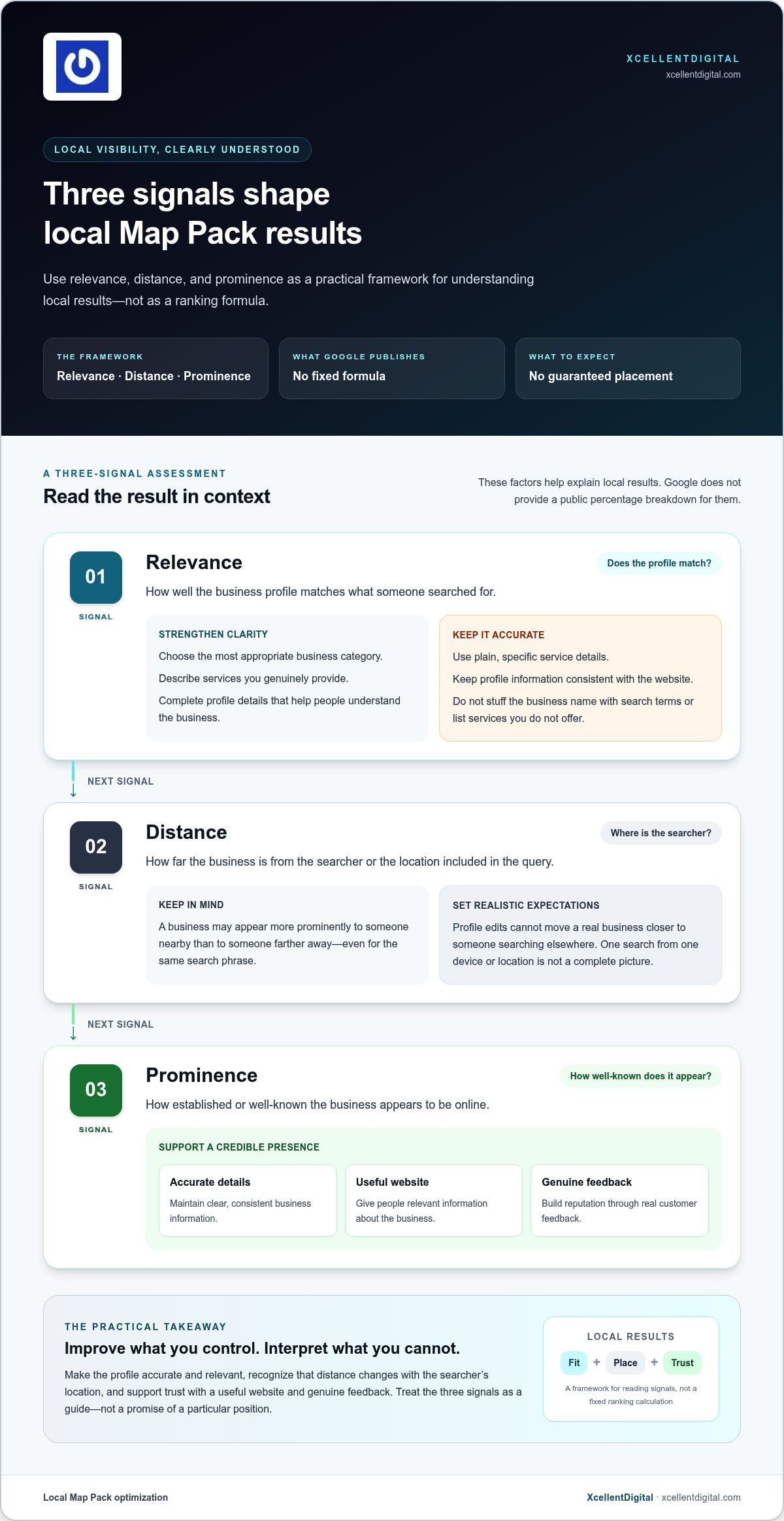
Google describes local results through three concepts: relevance, distance, and prominence. Its guidance on improving local rankings explains these factors without publishing a fixed formula or a guaranteed path to a particular position. Local map pack optimization can improve the information and reputation signals your business controls, but it can’t make every searcher equally close or dictate how Google weighs results for each query.
Relevance is how well a business profile matches what someone searched for, distance is how far the business is from the searcher or location in the query, and prominence reflects how well-known the business appears to be. Use this as a practical framework, not a ranking calculator. Google doesn’t provide a public percentage breakdown for these factors, so claims that one profile change guarantees a specific lift should be treated cautiously.
Relevance: Match the Profile to Real Services
Start with accuracy. Choose the most appropriate business category, describe the services you genuinely provide, and complete the profile details that help searchers understand what your business does. Someone looking for a specific service should be able to tell whether it fits without having to decode vague descriptions or infer it from an unrelated category.
Completeness helps people assess fit; it isn’t permission to add every possible keyword. Don’t stuff the business name with search terms or list services you don’t offer. Keep service details plain and specific, and make sure they agree with your website. A profile that clearly represents the business is more useful to searchers and Google than one written to chase a phrase.
Distance and Prominence: Set Realistic Expectations
Distance can shape what a searcher sees, and profile edits can’t move a real business closer to someone searching from elsewhere. Results may therefore vary across a service area, even when the query stays the same. Don’t treat one search from one device or location as a complete picture of local visibility.
Prominence is about how established or well-known a business appears online. You can support a credible presence by maintaining accurate business details, building a useful website, and earning genuine customer feedback. Reviews can help prospective customers evaluate a business and may contribute to Google’s understanding of prominence, but no review count or rating guarantees a Map Pack position. Never trade rewards for reviews or filter requests to solicit feedback only from satisfied customers.
Separate controllable work from outside conditions. You can improve profile accuracy, strengthen relevant website content, and manage customer feedback responsibly. You can’t directly control a searcher’s location, competitor activity, or Google’s precise ordering for every search. XcellentDigital coordinates Google Business Profile optimization with search and reputation work, focusing on credible signals rather than shortcuts.
Local Map Pack Optimization: Compare Signals Before Choosing What to Fix
Don’t change everything at once. Compare the evidence first, then choose the gap most likely to affect whether customers can understand, trust, and reach your business. These signals serve different purposes, and none is a guaranteed ranking lever.
| Signal | What to inspect | Common gap | Sensible next action |
|---|---|---|---|
| Profile accuracy | Business name, category, contact details, hours, and genuine services. | Outdated details or a category that doesn’t reflect the main business. | Correct the information and keep it aligned with how the business actually operates. |
| Website relevance | Whether key pages clearly explain services, business identity, and where the business operates. | Generic copy that doesn’t answer what the business does or who it serves. | Improve relevant pages with useful, specific information rather than repeating keywords. |
| Reputation | Review recency, themes in customer feedback, and how the business responds. | Feedback goes unanswered, or review requests are handled inconsistently. | Invite honest feedback without incentives or filtering, and respond professionally. |
| Citations | Whether important business details match across credible directories and platforms. | Old phone numbers, addresses, or business names remain in listings. | Correct meaningful inconsistencies; don’t spend time chasing every directory. |
| Measurement | Visibility by query and search location, plus calls, website visits, and qualified inquiries. | A single rank check is treated as proof of overall performance. | Compare consistent searches over time and connect visibility data to lead sources. |
Profile Signals Versus Website and Reputation Signals
Your profile helps searchers quickly verify who you are and what you offer. Your website can explain services in more detail and answer questions a short profile can’t. Genuine reviews give prospective customers first-hand perspectives; they aren’t a substitute for accurate business information. Keep core details consistent wherever they appear, but don’t copy the same wording onto every page. For profile fundamentals, use the Google Business Profile optimization guide as a companion to this comparison.
Prioritize based on the evidence. If the profile lists the wrong service category, correct it before commissioning more content. If the profile is accurate but the website doesn’t explain a relevant service, strengthen the appropriate page. Avoid claims that artificial check-ins, clicks, or engagement guarantee Map Pack positions. A vendor’s claim is not the same as documented Google guidance or evidence of qualified customer activity.
What a Local Ranking Grid Can and Cannot Tell You
A local ranking grid samples how a business appears for a chosen query at multiple search locations. It can reveal geographic variation that one search from a single spot would miss. Treat it as a directional snapshot, not a complete map of visibility or a measure of lead performance.
For a useful comparison, record the same queries, grid settings, and dates each time. Note changes alongside profile updates and incoming lead sources. If the grid looks stronger but qualified inquiries don’t follow, investigate the search terms, profile experience, and follow-up process before calling the work a success.
A Practical Local Map Pack Optimization Workflow You Can Follow
Make local map pack optimization a repeatable process, not a string of guesses. Work through these five steps in order, keeping a record so you can see what changed and whether it mattered to customers.
- Baseline: Record your current Google Business Profile status and key details. List the searches that matter to your business, note how you’ll sample visibility across search locations, and document current calls, website actions, direction requests, and incoming lead sources. Add the date to each observation.
- Audit: Check your business name, categories, services, hours, contact details, photos, and profile status. Compare those details with your website and important public listings. Use a Google Business Profile audit checklist to keep the review consistent, and verify current eligibility and profile policies against Google’s guidance.
- Prioritize: Fix gaps that could mislead customers or affect whether your business is eligible and accurately represented before spending time on frequent updates. For example, correct an outdated phone number or inaccurate service detail before focusing on a posting schedule.
- Implement: Make focused changes and note what you changed and when. Ask customers for honest feedback without incentives or filtering who gets invited to review. Respond professionally to feedback, including criticism, and don’t ask customers to include specific keywords.
- Review: Recheck the same priority searches and sampled locations, then compare visibility with customer actions and lead sources. Keep the time period and query sample consistent so the comparison is useful.
Audit and Prioritize the Highest-Impact Gaps
Start with the information customers rely on when deciding whether to call or visit. Confirm that categories describe the business, service details reflect genuine offerings, hours are current, and photos represent the business accurately. Check that the profile is active and accessible to customers. A profile issue or inaccurate detail deserves attention before cosmetic changes or a burst of posts.
Then compare the profile with the website and important listings. The goal is clear, consistent business information, not identical wording repeated everywhere. If details conflict, correct the source and update the places where the mismatch could confuse customers. This practical check keeps optimization grounded in what the business actually does.
Implement Changes and Measure Qualified Leads
Track visibility alongside calls, website actions, direction requests, and qualified inquiries. Note the lead source when possible, and use comparable time periods rather than drawing conclusions from a short-lived fluctuation. A ranking change and a lead increase occurring together don’t prove that one caused the other. Record what you observed, then consider other changes that may have influenced results.
For a coordinated review of profile, search, reputation, and lead follow-up, explore local visibility support from XcellentDigital.
When Managed Local Map Pack Optimization Can Help
Managing local visibility can become difficult when profile updates, website content, customer feedback, and lead tracking are handled separately. A coordinated approach can help when you’re unsure what to fix first, lack time to review performance consistently, or see search activity without a clear picture of which inquiries are qualified. Managed local map pack optimization should bring these pieces together around practical business goals, not promise a specific position.
What a Focused Optimization Partnership Should Address
A focused partnership connects Google Business Profile accuracy with relevant search optimization, reputation management, and measurement. That means identifying priorities, explaining why each action matters, and reviewing progress through visibility indicators and customer actions. XcellentDigital provides Google Business Profile optimization, search optimization, and a Reputation Program to support this coordinated work.
Expect a clear view of what’s being addressed and how progress is assessed. Search conditions and business needs can change, so regular reviews help determine whether priorities still make sense. The work should rely on accurate business information and authentic customer feedback, not fabricated activity, artificial check-ins, or shortcuts presented as ranking guarantees. No ethical plan can control exactly where a business appears for every searcher.
Turn Local Visibility Into a Better Follow-Up Process
Visibility is only the start. A call or website inquiry still needs a useful response. If messages go unanswered or follow-up is inconsistent, potential customers may lose momentum before they become qualified leads. Review how inquiries arrive, who handles them, and what information helps your team understand whether a prospect is a good fit.
Lead response automation can support follow-up after local inquiries arrive. It helps address the response process; it isn’t a Map Pack ranking factor. Pairing visibility reporting with inquiry outcomes gives you a stronger basis for deciding what to refine than rankings alone.
Consider managed support if you want profile, search, reputation, and lead-generation work reviewed as connected parts of your marketing. XcellentDigital can help organize those priorities and keep attention on legitimate improvements and useful reporting, without promising fixed timelines or ranking outcomes. Discuss a local visibility and lead-generation plan that fits your business goals.
Build Local Visibility Into a Steadier Growth Plan
Your next step doesn’t need to be a sweeping overhaul. Choose one clear business goal, identify the visibility gap most likely to get in its way, and use that priority to guide your next round of local map pack optimization. Keep the focus on credible progress and the customer experience, not a position no one can guarantee.
XcellentDigital can coordinate Google Business Profile optimization or reinstatement with search optimization and reputation management, then connect incoming inquiries with lead response automation. The aim is to make local marketing easier to assess and improve, with attention on actions that can support qualified opportunities.
Ready to turn your next steps into a focused plan? Talk with XcellentDigital about a practical local visibility plan. A clear starting point can help you move forward with confidence and build momentum on work that supports your business.
Frequently Asked Questions
Can a service-area business appear in the Google Map Pack without a storefront?
Yes, a service-area business can appear without welcoming customers at its business address, provided it meets Google Business Profile eligibility requirements. Its profile should represent a real business, not a virtual office or a location used only for mail. If customers aren’t served at the address, the business should follow Google’s current guidance for hiding it and setting its service area. Eligibility and accurate profile details matter more than displaying a storefront.
How long does local Map Pack optimization take to show results?
There’s no reliable fixed timeline for local map pack optimization to produce a visible change. Google may take time to reflect profile edits, and results can also shift with search terms, competitors, and the searcher’s location. Record the date of each change and compare similar searches over time. Look for meaningful movement in relevant inquiries as well as visibility, rather than judging success by a brief ranking fluctuation.
Can a business rank across its entire service area in Google Maps?
A business shouldn’t expect to appear equally across its entire service area. Google considers the searcher’s location, so visibility may be stronger near the business and different farther away. A service-area setting tells Google where the business serves customers; it doesn’t guarantee a listing across every part of that area. Check a consistent set of relevant searches from multiple locations to understand patterns, then focus on attracting suitable customers where the business can genuinely serve them.
Does a website help a business appear in the local Map Pack?
A website can support local visibility by helping customers and search engines understand what the business offers. For example, a clear service page can explain the work, who it suits, and how to inquire. Keep those claims consistent with the business profile, and make the page genuinely useful rather than creating near-identical pages for every place name. Agencies like JustSEO help businesses build structured, relevant web content so search engines clearly understand their offerings. A website supports the overall local presence, but it can’t guarantee Map Pack inclusion or a particular position.
Do Google reviews directly determine Map Pack rankings?
No single review or star rating directly determines where a business appears. Google identifies prominence as one consideration in local results, and reviews can help people assess a business while contributing to its broader reputation. Treat them as customer feedback, not a ranking switch. Ask customers for honest reviews without rewards or screening, and respond constructively. A strong reputation can build confidence, but it doesn’t guarantee a specific position in Maps.
Can paid ads move a business into the organic Google Map Pack?
No. Paying for Google Ads or Local Services Ads doesn’t buy a place in the organic Map Pack. Paid placements and unpaid local results are separate, so assess each channel on its own. Ads may help a business reach potential customers through paid visibility, while organic local presence depends on factors such as relevance, distance, and prominence. If both channels are active, track which one brings calls or qualified inquiries instead of treating ad spend as an organic ranking tactic.













Leave a Reply
Want to join the discussion?Feel free to contribute!