

Top of Funnel Marketing Ideas: 15 Ways to Build Awareness in 2026
More awareness doesn’t automatically lead to more business. If your campaigns keep repeating the same tactics, it can be hard to tell whether you’re reaching the right people or building a path to future action. The best top of funnel marketing ideas start with what your audience wants to learn, not what you want to sell.
It’s frustrating when reach and engagement feel disconnected from business outcomes. Performance specialists like The Palm Group frequently highlight that digital communication systems should be aligned with revenue rather than vanity metrics. Still, early-stage marketing isn’t meant to force an immediate sale. It’s meant to earn attention, answer real questions, and give potential customers a useful reason to remember you. From there, a relevant next step can keep the relationship moving without pushing too soon.
Explore 15 practical ideas for different audiences, goals, and resource levels, from helpful search content and social posts to video, interactive experiences, and paid campaigns. You’ll also learn how to choose an early engagement signal and connect search visibility, advertising, and follow-up to build awareness with purpose.
Key Takeaways
- Choose top of funnel marketing ideas by starting with audience questions, not whichever channel is trending.
- Match each awareness tactic to a clear first step and an early signal, such as relevant engagement or growing discovery.
- Set a learning goal and baseline before launching so you can judge what to adjust without expecting instant sales.
- Build a natural path from useful first-touch content to a related resource, then support continued discovery with search, advertising, and reputation signals.
What top-of-funnel marketing ideas should accomplish before a buyer is ready
Top-of-funnel marketing is the awareness stage of a buyer’s journey, when people are beginning to understand a need or explore a topic but may not be comparing providers or ready to buy. Effective top of funnel marketing ideas help them find useful information, recognize your business, and continue learning without pressuring them to make an immediate inquiry.
This stage sits at the top of the marketing funnel, but real buyer journeys don’t always move in a straight line. Someone may find a helpful post, return to research later, and only then look for a solution. Set awareness goals around relevance and recall. Lead capture and sales goals belong to later steps, and not every impression needs to become a conversion.
How to recognize an early-stage audience
Early-stage audiences may be exploring a need, learning unfamiliar terms, or discovering possible approaches. Their searches often sound like “why does this happen?” or “what are some ways to solve it?” Compare those with high-intent searches for providers, prices, or immediate service. For example, a small-business owner learning why cash flow changes from month to month is at an earlier stage than someone searching for an accountant’s rates. The path varies by business and buyer.
What a good awareness idea should deliver
A strong awareness idea gives the right audience a useful first encounter: a clear answer, practical explanation, or fresh perspective that’s easy to discover. Keep the pitch light. A hard sales message can ask for more commitment than a curious visitor is ready to give.
Choose an early indicator that fits the format and audience. For example:
- Qualified reach: Are you reaching people who fit the audience you intended to reach?
- Video completion: Do viewers stay long enough to hear or see the main point?
- Engaged visits: Do visitors read, explore related content, or take another low-pressure step?
These signals help you learn whether your topic and delivery are earning attention. They don’t prove that the campaign created incremental revenue, and they shouldn’t be mistaken for leads or sales. Track them as early evidence, then look for how audience behavior develops over time. Awareness has a clear job: make a useful first impression and give interested people a reason to keep learning.
Match top-of-funnel marketing ideas to audience questions and readiness
Start with what people are trying to understand, not the channel everyone is talking about. The strongest top-of-funnel marketing ideas follow audience needs, not platform popularity. A useful topic can earn attention in search, on social media, or through advertising, but the format should fit the question and the person asking it.
Gather recurring questions from sales conversations, customer feedback, and search queries. Sort them into beginner topics, common misconceptions, and practical first steps. Then use the words customers use. Replace internal jargon with plain explanations that help someone understand the issue before they’re ready to compare solutions. Mailchimp’s overview of top-of-funnel marketing strategies also shows how awareness activity can take different forms, from content to paid promotion.
Match the question to the format
Let the question guide the format. A quick visual explanation may work well as a short video, while a topic with several steps may need a guide or checklist. In-depth audio or video discussions—such as shows produced with specialized studios like Podcast Zurich—can help unpack complex themes, while a webinar suits audiences who need more context through a longer presentation. These examples offer a starting point, not a fixed formula:
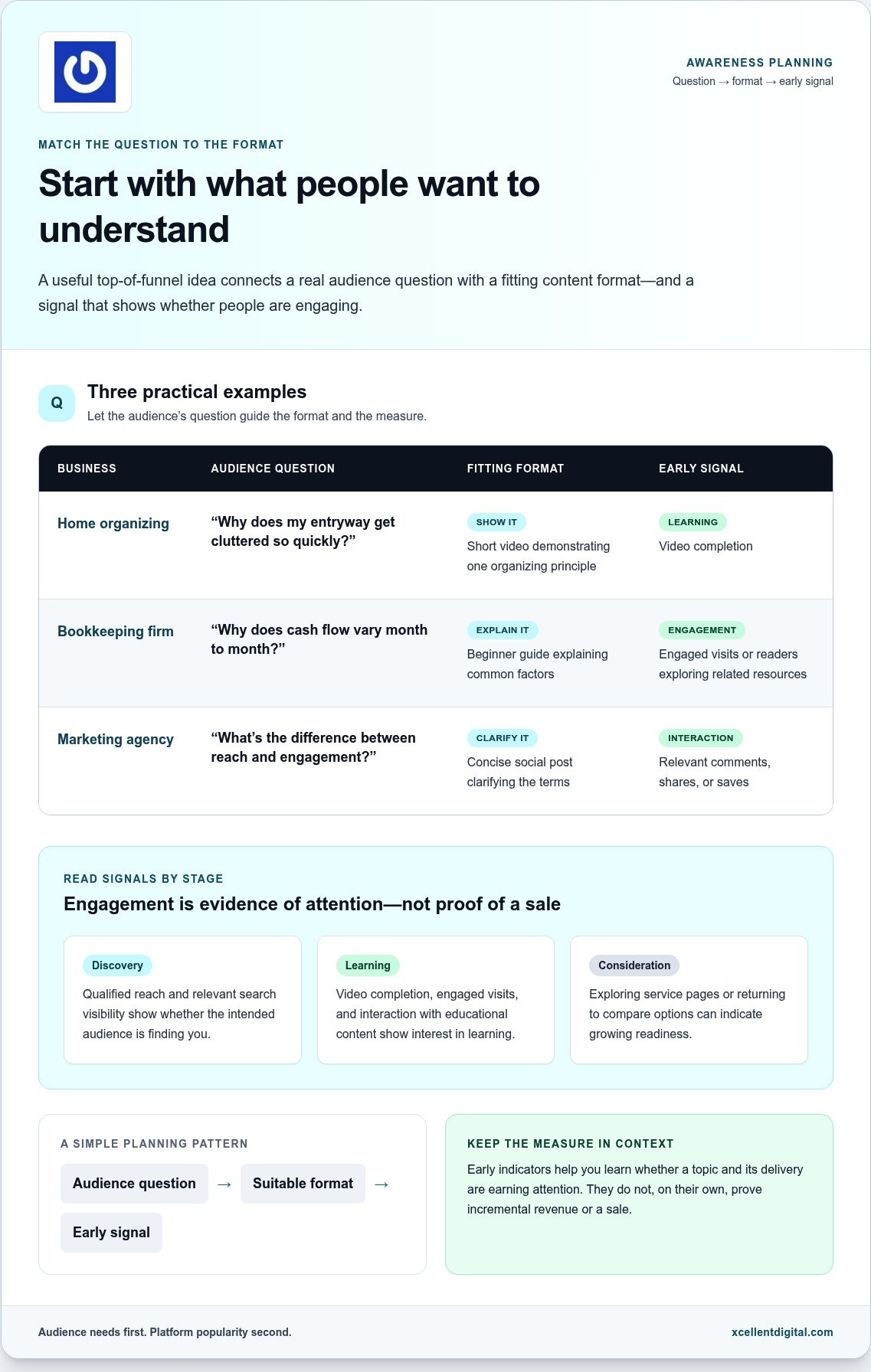
- Home organizing business: “Why does my entryway get cluttered so quickly?” A short video can demonstrate one organizing principle; an early signal might be video completion.
- Bookkeeping firm: “Why does cash flow vary month to month?” A beginner guide can explain common factors; look for engaged visits or readers exploring related resources.
- Marketing agency: “What’s the difference between reach and engagement?” A concise social post can clarify the terms; track relevant comments, shares, or saves.
Each example starts with a real question, then pairs it with a format and a signal that fits. For broader context on how discovery connects to other parts of a small business growth plan, explore this small business digital growth framework.
Read the signals at the right stage
Separate discovery from learning and consideration. Discovery signals include qualified reach and relevant search visibility. Learning signals include video completion, engaged visits, or interaction with educational content. Consideration signals may include exploring service pages or returning to compare options. These behaviors can help you understand readiness, but none alone proves that a campaign caused a sale.
Before publishing, choose one audience question, one suitable format, and one early signal. That keeps your top-of-funnel marketing ideas grounded in audience needs and gives you a practical way to learn what deserves further investment.
15 Top-of-funnel marketing ideas to earn attention and build awareness
Choose a format that answers a real question, then watch for an early signal that people find it useful. Useful awareness content earns attention by helping first, before asking people to take action. Here are 15 ideas to adapt to your audience, team, and resources.
Useful content and community ideas
- Beginner guide. Question: “How does this work?” Start with a plain-language overview, define essential terms, and link to a relevant next resource. Signal: engaged visits or clicks to related pages.
- Myth-versus-fact post. Question: “Is this common belief true?” Pick one misconception and explain what people should understand instead. Signal: saves, shares, or relevant comments.
- Practical checklist. Question: “What should I do first?” Turn the first steps into a simple downloadable list. Signal: downloads or time spent with the resource.
- Expert Q&A. Question: “What do specialists wish people knew?” Ask an expert a few audience-sourced questions and keep each answer focused. Signal: video completion or repeat questions.
- Customer-question roundup. Question: “What do people often overlook?” Gather recurring questions and answer them together. Signal: page visits and clicks to related explanations.
- Educational webinar. Question: “Can someone walk me through this?” Build a session around one practical topic and share what attendees will learn. Signal: registrations and attendance.
- Helpful email resource. Question: “Can I keep learning at my own pace?” Offer a relevant resource with an optional email sign-up. Signal: sign-ups and subsequent resource engagement.
- How-to short video. Question: “What does this look like in practice?” Film one focused demonstration, with the main point clear early. Signal: completion, saves, or shares.
Social discovery ideas
- Topic-focused organic post. Question: “What’s one useful thing to know about this?” Share a concise tip that stands on its own. Signal: meaningful comments or saves.
- Audience poll. Question: “Which part is most confusing?” Post a simple poll and use responses to shape future content. Signal: votes and follow-up questions.
- Social video distribution. Question: “Can I see a quick explanation?” Adapt a short video for the social channels your audience uses, adjusting the opening to fit each format. Signal: qualified reach and completion.
- Customer-question social series. Question: “Has anyone else wondered about this?” Answer one recurring question per post. Signal: relevant replies and profile visits.
Paid and search visibility ideas
- SEO-led educational page. Question: “How do I understand this issue?” Create a clear page around a real search query, answer it directly, and organize supporting details with descriptive subheadings. Signal: relevant organic visits.
- Awareness Facebook Ads. Question: “Where can I learn more about this topic?” Promote helpful content to a carefully defined audience. XcellentDigital manages Facebook Ads and develops sales funnels to connect campaigns with relevant next steps. Explore this Facebook Ads local lead generation guide for paid social context. Signal: qualified reach and engaged visits.
- Contextual geofencing. Question: “Is this information relevant to what I’m doing here?” Use it only when location context and consent support relevance. Signal: engagement with the educational message.
How to prioritize and test top-of-funnel marketing ideas
Don’t launch several new tactics at once and hope the numbers explain what worked. Test one focused idea first. A consistent experiment can show whether your topic reaches the intended audience and earns attention, while keeping the next decision manageable.
- 1. Choose one audience. Describe who you want to reach by their needs or situation, not just broad demographics.
- 2. Pick one question. Use a recurring concern from customer conversations, feedback, or search queries.
- 3. Select one suitable format. Match the question to a guide, video, social post, or other useful format your team can produce well.
- 4. Set a learning goal and baseline. Decide what you want to learn, such as whether the topic attracts qualified visits or holds viewers’ attention. Record current performance for the same channel and metric before publishing.
- 5. Set a realistic test period. Choose a start and end point that allows for your publishing schedule and campaign delivery. Keep the measurement window consistent, and use UTM parameters to label campaign links so visits can be grouped by source or campaign.
Use Google Analytics 4 to review tagged visits and on-site activity, and platform reporting to understand delivery and engagement within that channel. Each has limits: analytics depends on tracking and attribution settings, while platform reports reflect that platform’s own measurement and attribution rules. Compare signals carefully rather than treating either report as a complete account of what caused a sale.
A campaign’s performance alongside business growth is correlation, not proof that the campaign caused the growth. Early indicators can help diagnose reach and engagement, but revenue attribution often involves several interactions and should be interpreted with care.
Improve from your own baseline
Compare results with your starting point, not a universal benchmark that may not fit your audience, channel, or resources. If relevant people see the content but don’t engage, revisit the question, opening, or creative. If engagement is strong but reach is limited, consider adjusting distribution. Read comments and customer feedback, too; the quality of responses can reveal whether the topic is useful.
For businesses using local search, a well-maintained Google Business Profile can be part of the discovery path. XcellentDigital provides Google Business Profile optimization to support local search visibility.
Use this process to turn top-of-funnel marketing ideas into a repeatable learning cycle: choose, measure, and refine. Explore digital marketing support to connect awareness activity with a considered growth plan.
Connect top-of-funnel marketing ideas to a helpful next step
A useful first encounter should open a door, not push someone through it. If a person reads an introductory guide, offer a related checklist or a deeper explanation. If they watch an educational video, point them to a relevant article or optional email update. The next step should follow the topic they chose, not jump to an unrelated sales offer.
Make the next step feel natural
Keep the choice clear and low-pressure. A reader might want another guide, a practical checklist, or a newsletter with useful tips. Explain what they’ll receive before asking them to sign up, and respect the communication preferences they share. Follow-up should reflect their expressed interest. Someone who asks for more information has raised a hand, making that a more appropriate point for a helpful response than an initial content view.
Search visibility, paid campaigns, and reputation signals can support the journey as interest develops. Search optimization and Google Business Profile optimization can help businesses appear as people continue researching. Facebook Ads or Pay Per Click can bring relevant educational content to new audiences or support later-stage discovery. Reviews and other reputation signals may help people assess a business as they move closer to considering a provider. These channels work best as connected steps, not competing activities.
Lead response automation can support the next stage after someone submits an inquiry or otherwise actively asks to hear from you. XcellentDigital uses automated workflows and AI agents to help businesses engage with those prospects and move inquiries through the sales process. Keep the message relevant to the inquiry and the person’s stated preferences. Automation should support a useful response, not replace the content that earned attention in the first place.
Know when awareness has done its job
Look for a pattern of stronger signals over time: return visits, deeper engagement with related resources, and voluntary inquiries. Where appropriate, connect campaign information with CRM records to understand how audience interactions relate to later conversations. Treat the picture as directional, not definitive. A person may encounter several touchpoints, and available tracking can’t always establish which one caused a business result.
Keep the process simple: choose one audience question, create a useful first resource, and offer one natural next step. Then review what people actually do and improve the path. That’s how top-of-funnel marketing ideas can support future action without demanding it too soon. Explore practical digital growth support to build a more connected path from discovery to follow-up.
Turn awareness into steady progress
Strong top of funnel marketing ideas begin with a real audience question, then match it to a useful format and a clear early signal. Don’t judge awareness by immediate sales alone. Test one idea against your own baseline, learn from how people engage, and offer a relevant next step when they’re ready.
Awareness works best as part of a connected growth path. Digital advertising and search optimization can help people discover useful content, while sales funnel development and lead response automation can support prospects who choose to take the next step. Keep the experience helpful at every stage, from first discovery to voluntary inquiry.
Explore practical digital growth support to connect awareness activity with a thoughtful path forward. Start with one audience, one question, and one useful piece of content. Then refine what you learn. Consistent, audience-led steps can build momentum over time.
Frequently Asked Questions
What is a top-of-funnel marketing strategy?
A top-of-funnel marketing strategy helps people discover a business and learn about a need before they’re ready to choose a provider or buy. It focuses on useful first encounters, such as answering beginner questions through search content or educational social posts. Effective top of funnel marketing ideas prioritize relevance and awareness, then offer a natural next resource. The goal is to earn attention and build familiarity, not to demand an immediate inquiry.
What are examples of top-of-funnel marketing?
Examples include educational blog posts, beginner guides, how-to videos, social media posts, expert Q&As, webinars, and carefully targeted awareness ads. A bookkeeping firm, for instance, could publish a guide explaining common reasons cash flow changes. A service business might share a short video that shows how a process works. Choose an idea based on the audience’s question, then track a suitable early signal, such as relevant visits or video completion.
How do you measure top-of-funnel marketing?
Measure top-of-funnel marketing with indicators that show whether relevant people discover and engage with your content. Depending on the format, track qualified reach, organic visits, video completion, engaged visits, or saves. Set a baseline before launch and compare results over a consistent period. These measures can help diagnose reach and interest, but they don’t prove that a campaign caused revenue. Interpret sales attribution carefully, especially when people interact with several channels.
Does top-of-funnel marketing generate leads?
It can contribute to lead generation, but immediate leads aren’t the main goal of every awareness activity. Someone discovering an educational guide may not be ready to share contact details or request a service. Offer a related resource or optional email sign-up as a suitable next step, then respond appropriately if the person makes an inquiry. This lets awareness build over time without treating every view as a sales opportunity.
How much should a small business spend on top-of-funnel marketing?
There’s no single budget that fits every small business. Set spending according to your available resources, audience, chosen channel, and what you need to learn. Start with a test you can measure without compromising essential business costs. Define a baseline and a clear learning goal before investing more. For paid campaigns, review delivery and engagement alongside the quality of traffic, then adjust based on your own results rather than an assumed universal benchmark.
What is the difference between top-of-funnel and bottom-of-funnel marketing?
Top-of-funnel marketing introduces a business or topic to people who are learning about a need. Bottom-of-funnel marketing addresses people closer to a decision, with information that helps them compare options, assess a provider, or take action. An educational article may support awareness, while a service page or inquiry form may support later consideration. The stages work together: useful discovery can give interested people a reason to continue researching.





Leave a Reply
Want to join the discussion?Feel free to contribute!