
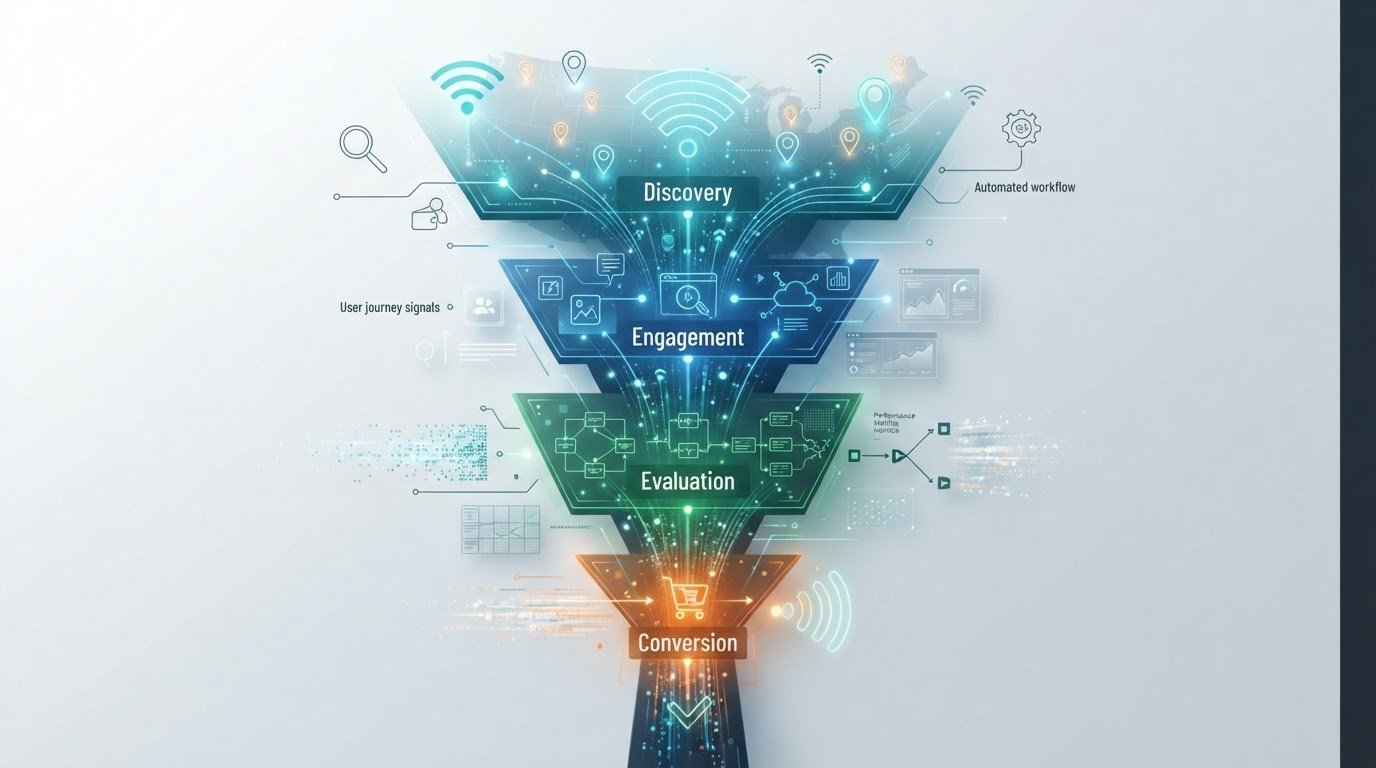
Sales Funnel Stages: How Buyers Move from Awareness to Action
Buyers move from awareness to interest, then evaluate whether an offer fits before taking action. The sales funnel stages explained here show what customers are thinking at each point and what can help them move forward. At the action stage, buyers decide whether to proceed with a purchase.
It’s frustrating when marketing attracts attention but doesn’t turn it into conversations or sales. The gap often comes from treating every prospect the same, even though someone discovering a business needs different information from someone comparing options. The right message, channel, and follow-up can make the next step clearer.
This guide breaks down buyer behavior across the funnel and pairs each stage with useful content and marketing tactics. You’ll see how awareness, interest, evaluation, and action connect, why prospects can stall between stages, and how a defined funnel helps identify where they need more support. The goal isn’t to push every buyer forward on your schedule. It’s to give them relevant reasons to take their next step.
Key Takeaways
- Match awareness content to the problem or need that first brings a potential buyer to your business.
- Help interested prospects compare options by making your value and fit easy to understand.
- At the action stage, make the next step clear and reduce friction that could lead a buyer to abandon the process.
- Track where prospects pause or drop off to see which parts of your funnel need attention.
- Align content and follow-up with buyer intent so each interaction supports a natural next step.
Awareness stage
Awareness begins when a potential buyer recognizes a need, problem, or possible solution. They may not know your business exists and aren’t ready to compare offers. For readers who want sales funnel stages explained through buyer behavior, this first stage is about visibility and relevant messaging. Help prospects connect what they see with the need that brought them to search.
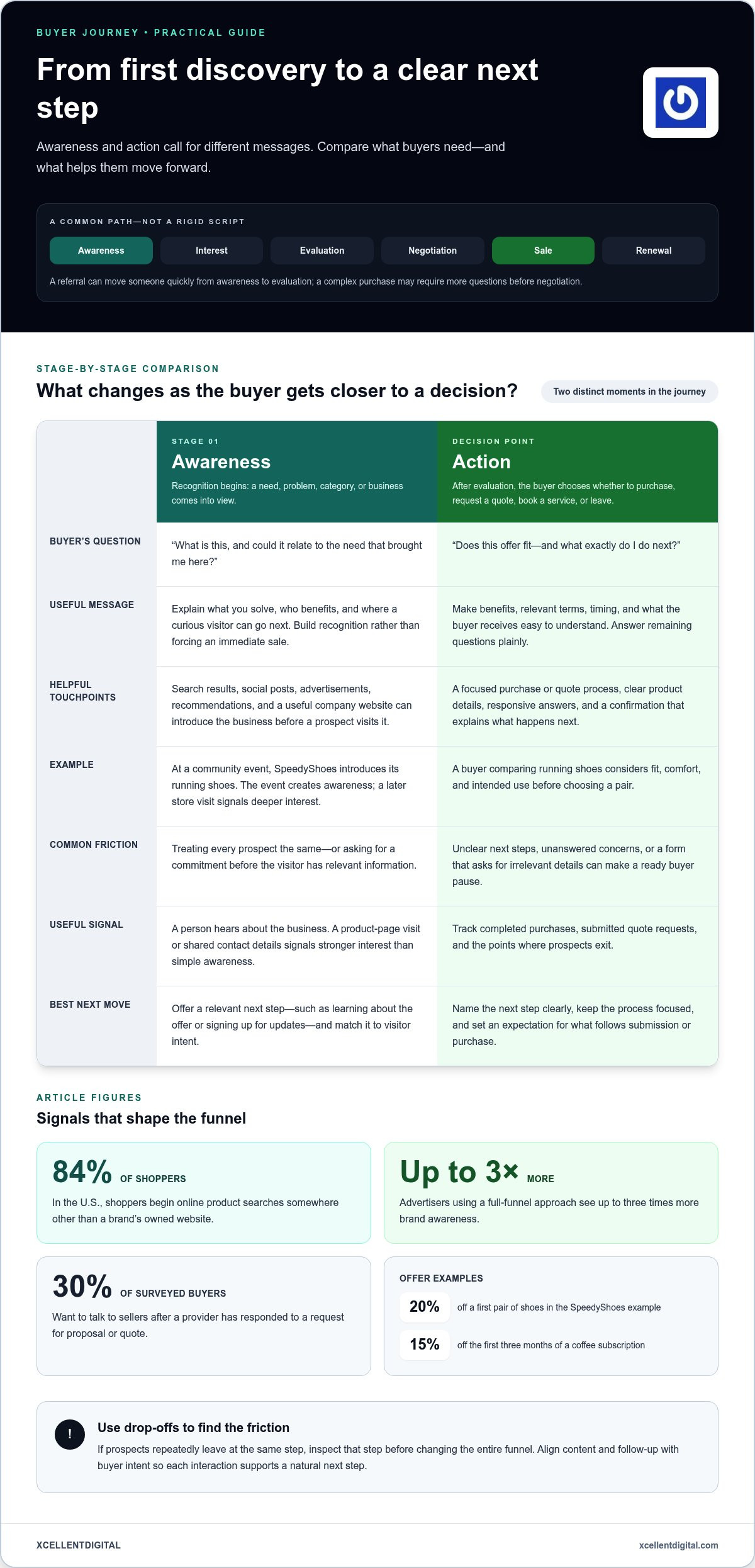
For U.S. businesses, visibility matters across digital channels: 84% of shoppers begin online product searches somewhere other than a brand’s owned website. A prospect could first encounter a business through a search result, social post, advertisement, or a recommendation from friends or family. Awareness can start before someone visits your website or knows the name of a specific product.
Consider SpeedyShoes, a fictional running-shoe retailer. About 100 people attend a community event where the store introduces its shoes, then 20 attendees visit the store to look at them. The event creates awareness; the store visit signals deeper interest. This first interaction should build recognition, not force an immediate sale.
Awareness supports lead generation, but the two aren’t identical. Someone who hears about a business from a friend has become aware; someone who visits a product page or shares contact details shows a stronger signal. Use discovery content to attract the right prospects, then offer a relevant next step, such as learning about your offer or signing up for updates. Match that action to the visitor’s intent.
- Awareness: A prospect first recognizes a need, category, or business.
- Interest: The prospect explores whether an offer could be useful.
- Evaluation: The buyer compares fit, benefits, and alternatives.
- Negotiation: The buyer and seller work through terms or remaining concerns.
- Sale: The buyer completes the purchase.
- Renewal: After the sale, the customer considers continuing the relationship.
These six stages describe a common path, not a rigid script. A referral may move someone quickly from awareness to evaluation, while a complex purchase may involve more questions before negotiation. The National Institute of Standards and Technology (NIST) identifies a company website as a central sales and marketing tool. Make yours useful at the awareness stage: explain what you solve, who benefits, and where a curious visitor can go next.
Full-funnel marketing connects first contact with later decisions instead of treating awareness as an isolated campaign. Advertisers using a full-funnel approach see up to three times more brand awareness. Explaining sales funnel stages through real buyer actions helps connect discovery messaging with the next useful step, then with information that supports later decisions.
Action stage
Evaluation leads to action when a buyer decides an offer fits and chooses what to do next. They may purchase, request a quote, book a service, or leave the process. The difference often comes down to whether the next step is clear and remaining concerns have been answered. A prospect comparing two providers needs a direct path to choose, not another broad introduction to the category.
During evaluation, buyers weigh an offer against alternatives, practical needs, and perceived value. Someone shopping for running shoes might compare fit, comfort, and intended use before choosing a pair. The seller can make the decision easier by explaining the product’s benefits plainly and answering questions without burying important details. Useful support at this point helps customers understand what they’ll receive and what happens after purchase.
Action can stall when the buying process creates unnecessary uncertainty. A form that asks for irrelevant details, unclear next steps, or unanswered questions can make a ready prospect pause. Review the process from the buyer’s perspective: Does the call to action name the next step? Can customers find the information they need? Does the confirmation explain what happens next? Each answer can reveal friction at the end of the pipeline.
- Make the next step specific: Use clear wording such as “request a quote” or “choose a plan.”
- Address a real hesitation: Explain relevant terms, timing, or what the buyer receives.
- Keep the process focused: Ask only for information needed to complete the chosen action.
- Confirm what happens next: Give buyers a clear follow-up expectation after they submit or purchase.
Offers can support action when they fit the buyer and the business. In the SpeedyShoes example, Kathy offers buyers 20% off their first pair. A retail coffee subscription example uses a 15 percent discount for the first three months of a subscription. These examples show how a defined offer can give buyers a timely reason to act. A discount isn’t the only route; clear product details, relevant service information, and responsive answers can also reduce hesitation.
For quote-based buying, the response itself can influence whether a prospect continues. 30% of surveyed buyers want to talk to sellers after a provider has responded to a request for proposal or quote. A prompt, useful response can clarify the proposal and keep relationships moving. The response should connect the buyer’s stated needs with the proposed solution, rather than simply repeating sales messaging.
At this stage, a buyer may complete a purchase or leave the process. Track completed purchases, submitted quote requests, and points where prospects exit. If buyers repeatedly leave at the same step, inspect that step before changing the entire funnel. A focused review of your conversion path can help identify where evaluation gives way to hesitation.
Benefits of a defined sales funnel
A defined funnel gives each prospect a place in the sales process, from first contact through purchase and retention. This structure helps a business focus on its target customers, see where progress slows, and decide what action to take next. Without clear stage definitions, teams can mistake early interest for buying readiness or overlook prospects who need more information.
A marketing funnel generally tracks how people discover and engage with a business, while a sales funnel focuses on their path toward becoming customers. The two overlap, but clear handoffs help marketing attract and nurture prospects while sales supports evaluation and purchase.
B2B and B2C funnels differ in the people involved and the pace of decisions. B2B purchases often require research, evaluation, and agreement among multiple stakeholders, while B2C purchases commonly involve one individual decision-maker. That means a B2B sales process may need content and follow-up for decision-makers, influencers, and users.
Defined stages make performance easier to assess. A business can compare sales ratios and average sales sizes, then identify whether the main issue lies in lead generation, evaluation, or closing. For example, if prospects request proposals but don’t make a decision, the team can review proposal clarity and follow-up instead of changing every campaign.
A clear structure can also help customers move forward more efficiently. When each stage has a defined purpose, teams can provide relevant information instead of repeating generic messages. A full-funnel approach connects awareness with consideration and purchase; advertisers using it see twice the amount of consideration and two times more purchases.
For B2B companies, a defined funnel is especially useful when prospects encounter the business across several channels. Less than 50% of B2B companies selling through just one channel grow market share, compared with 72% of those selling through seven or more channels. A funnel helps teams coordinate those touchpoints and track how they contribute to buyer progress.
Tools can make funnel stages visible and manageable. A customer relationship management system can organize contacts and opportunities; analytics can show where visitors or leads drop off; email automation can support relevant follow-up. Use each tool to answer a practical question, such as which source generated a qualified lead or which stage has stalled.
A defined process can support customer commitment after the first sale, too. For example, a subscription business can track renewal conversations separately from new-customer outreach. In the SpeedyShoes example, the store sees a 30% increase in sales within the first few months after using a defined funnel. That result illustrates how a clear process can turn stage-level insight into focused sales action.
Buyer behavior and stage transitions
Buyers move through a journey as their questions change, from recognizing a need to choosing an option. Track those signals and match each interaction to what prospects are trying to understand.
Needs Discovery and Buyer Education
Needs discovery identifies the buyer’s problem, while buyer education helps them understand its causes and possible solutions. Both shape stage transitions: prospects can’t evaluate an offer clearly until they understand the underlying need. In a business conversation, ask what outcome the buyer wants and what’s blocking progress. Then share information that addresses that specific gap, rather than sending the same material to every contact.
Buyer interest can deepen as the problem becomes clearer. 71% of surveyed buyers want to talk to sellers when looking for new ideas and possibilities to drive stronger business results. That makes useful discovery a two-way exchange: listen for the goal, then explain relevant options without jumping straight to a pitch.
Buyer Personas and Funnel Content
A buyer persona is a practical description of a target customer’s needs, priorities, and decision context. It helps teams create funnel content that reflects why different prospects search, compare, and choose. For example, an online furniture seller serving customers aged 30-40 might explain room fit and delivery details. The persona guides the subject and tone; actual buyer questions should shape the specific message.
Use personas to generate relevant leads, not to assume every person behaves identically. A persona can guide discovery topics, while a prospect’s questions reveal their current stage. For B2B content, whitepapers and case studies can demonstrate expertise and support trust. For a consumer audience, content can focus on personal benefits and practical use.
Buyer Activities Across Stages
Buyer activities are the observable actions that suggest where someone sits in the funnel. A prospect may search for ideas, analyze a problem, compare providers, or request a quote. In surveyed responses, 49% of buyers want to talk to sellers while analyzing a situation and its causes; 54% want to talk while identifying and evaluating possible providers. Those signals call for different conversations.
At the top, answer broad questions with useful education. During evaluation, clarify fit and differentiation. Near the bottom, respond to specific concerns and outline the next step. B2B buyers may need consensus among stakeholders, while a B2C buyer may decide based on personal preferences or immediate benefits. Let the activity, not an assumed timeline, guide follow-up.
Qualifying Leads
Lead qualification assesses whether a prospect’s needs, fit, and readiness align with the offer. To qualify leads during the sales funnel, ask about the problem, desired outcome, decision process, and timing. Then compare the answers with the solution’s audience and capabilities. A request to compare providers signals different readiness from a general question about possible approaches.
Use each conversation to refine the picture, not to force a quick yes. Sales winners are 2.3 times more likely than second-place finishers to understand buyers’ needs. Deep collaboration matters too: 59% of surveyed sellers report collaborating deeply with buyers across the buying process as part of solution crafting. Record useful signals, share relevant answers, and advance the lead when the next step fits.
Content and marketing tactics for each funnel stage
Effective funnel marketing matches each message to the buyer’s immediate question. Someone discovering a problem needs different content from someone comparing a product or service. Use the stage to choose the format, channel, and next step, then align marketing and sales as prospects move toward a purchase.
Awareness: Help unfamiliar prospects recognize a need and understand the problem. A search-friendly article, clear social post, or short explainer can introduce the issue without demanding an immediate conversion. For example, a landscaping company might publish a guide to choosing plants for a shady yard. Focus on the reader’s question, then offer a relevant next step.
Interest: Give curious visitors a useful reason to explore further. A service overview, email series, or practical checklist can show how an approach works. A bookkeeping firm, for example, could explain which records a small business uses to prepare for tax season. Make the value specific, then invite prospects to read a related guide or request more information.
Evaluation: Help buyers compare options and assess fit. Product demonstrations, case studies, comparison pages, and detailed FAQs can address practical concerns. B2B content often benefits from informative, data-driven material such as whitepapers and case studies. During this middle stage, sales and marketing should coordinate: marketing shares what prospects engage with, and sales uses those signals to answer relevant questions.
Action: Make the buying step visible and straightforward. A clear quote request, booking form, or purchase button tells ready buyers what to do. Remove distractions from the process, explain what happens after submission, and make key details easy to find. For example, a service page can place its quote request beside a concise outline of the work included.
Renewal and retention: Continue the relationship after the sale. A follow-up message can answer product questions, share helpful guidance, or invite customer feedback. For a coffee subscription, a renewal reminder could explain how to manage the next delivery. This follow-through supports customer relationships and gives the business useful feedback to improve future messaging.
Review stage performance with one practical question at a time: which content earns attention, which prompts further consideration, and where does conversion stall? Sika’s full-funnel campaign recorded a click-through rate 57% higher than benchmarks, illustrating how connected campaign activity can support engagement. Treat that as an example, not a universal forecast; audience, offer, and execution shape results.
Map one useful content asset to each stage, then make the next step clear. Plan content around your buyer journey to connect discovery, evaluation, and action.
XcellentDigital: Facebook Ads
XcellentDigital helps businesses connect Facebook Ads with the funnel stages buyers move through. If awareness is the gap, ads can introduce your product or service to relevant audiences. If prospects already know your business, campaign messaging can address questions that support consideration and action. Match the ad’s message and next step to buyer intent, then make sure the destination continues that conversation.
Facebook Ads may suit businesses looking to build visibility or introduce a defined offer to potential customers. XcellentDigital also offers Google Business Profile Optimization, Search Optimization, and AI Agents to support other parts of digital marketing and sales. Consider how these efforts connect before adding another campaign. Contact XcellentDigital to discuss how Facebook Ads could fit your funnel.
Turn your funnel into a focused growth plan
Having the sales funnel stages explained gives you a useful starting point. Next, decide what your business needs to improve first. Choose one stage, identify the customer action you want to support, and align your message with the next step. Then review how prospects respond and use what you learn to improve the path.
If attracting the right audience is the priority, Facebook Ads can support awareness. If local visibility or timely follow-up needs attention, Google Business Profile Optimization and AI Agents may fit into the broader plan. XcellentDigital offers these services to help businesses connect marketing activity with their sales process, without treating every challenge as the same problem.
Start with the point where your funnel feels least connected to buyer intent. Contact XcellentDigital to discuss your funnel and explore a practical next step for your business. A clearer path starts with one focused decision, and you can build from there.
Frequently Asked Questions
What are the main stages of a sales funnel?
A common model includes awareness, interest, evaluation, negotiation, sale, and renewal. Some businesses combine or rename stages to reflect how their customers buy. A subscription company, for example, may track onboarding between sale and renewal, while a project-based firm may focus on proposal review and approval. Choose labels your team can apply consistently, then define the customer action that moves an opportunity into each stage.
What happens at each sales funnel stage?
At awareness, a person encounters the business or recognizes a need; interest shows they’re exploring a possible solution. During evaluation, they assess fit, and negotiation addresses terms or unresolved concerns. The sale records a completed purchase, while renewal focuses on continued value. For example, a software company might track a prospect’s demo request separately from a proposal review, making progress easier to interpret.
How do you measure conversion rates at each sales funnel stage?
Divide the number of prospects who complete a stage’s defined action by the number who entered that stage, then express the result as a percentage. Use consistent entry and exit rules across reporting periods. For example, count qualified demo requests that become completed demos, not all website visitors. Track the time period and lead source too, so changes in traffic mix don’t distort comparisons.
What metrics and benchmarks are typical for sales funnel stages?
Useful metrics include stage-to-stage conversion, time spent in each stage, qualified opportunities, deal value, and reasons for lost opportunities. For sales funnel stages explained with measurement in mind, define each stage’s entry and exit criteria before comparing results. There isn’t one benchmark that fits every business model; a local appointment-based company and a long-cycle B2B firm have different buying patterns. Compare similar lead sources, offers, and customer segments.
How do you move leads from awareness to consideration?
Give new prospects a useful next step that answers a question raised by their first interaction. For example, a cybersecurity firm could follow an introductory article with a checklist for reviewing employee access. The checklist should explain the issue without requiring an immediate sales conversation. Then offer a related guide or a way to ask a specific question, and use engagement to shape the next message.
What sales tactics work best at each funnel stage?
Use educational content to earn attention early, then offer focused conversations or demonstrations as prospects show intent. During evaluation, answer objections with evidence tied to the buyer’s needs, such as a relevant case study or product walkthrough. At negotiation, clarify scope and decision steps instead of applying pressure. After purchase, share onboarding guidance and invite feedback. Match the tactic to the buyer’s question, not simply the calendar.
How can businesses identify and fix sales funnel drop-off?
Find the stage where fewer prospects continue, then inspect the specific step they leave behind. Compare records by lead source, device, offer, and customer type to reveal patterns. If mobile visitors abandon a quote form, test whether it’s difficult to complete on a phone. Change one element at a time, such as the form fields or page message, then measure the same stage transition again.












Leave a Reply
Want to join the discussion?Feel free to contribute!