

4 ways to evaluate and improve lead generation results
More calls don’t automatically mean more jobs. For lead generation for a service-based business, there’s no single call or job count that proves success. Measure whether qualified prospects become customers and whether campaign returns justify the investment.
It’s reasonable to want a clear target when you invest in marketing. But call totals can hide spam, poor-fit inquiries, or prospects who never book. A better approach is to connect lead quality to real business outcomes.
This article explains how to assess lead quality, track campaign returns, and use useful educational content to invite prospective customers into a consultation. You’ll also learn what to compare when weighing agency options, so you can choose a lead-generation approach that fits your service business instead of chasing a number without context.
Key Takeaways
- Look beyond inquiry totals: assess whether prospects fit your services, show intent, and turn into revenue.
- Connect campaign activity to booked work and sales, so you can see which efforts are worth refining.
- Use useful educational content to address prospects’ concerns and create a natural path to a consultation.
- Compare agency approaches by how they attract, qualify, and follow up with leads, not just by promised call volume.
1. Evaluating lead quality and revenue reporting
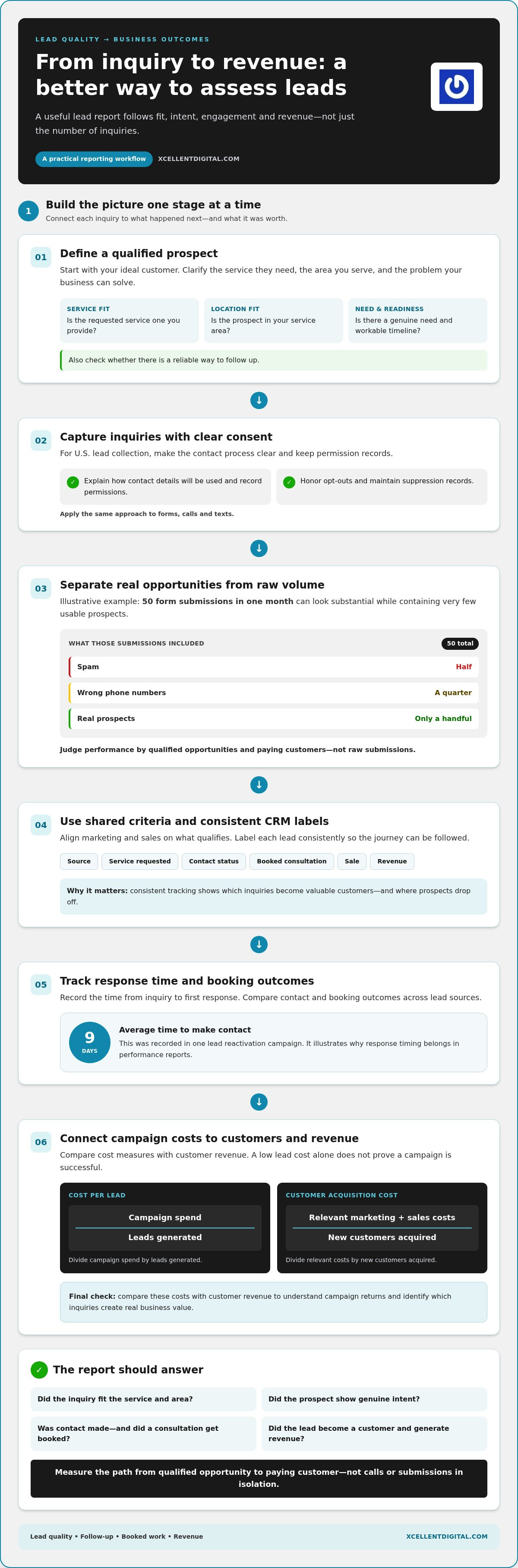
A useful lead report tracks fit, intent, engagement, and revenue, not just inquiry volume. Consider an illustrative service business receiving 50 form submissions in a month: half are spam, a quarter have wrong numbers, and only a handful are real prospects. That’s why advertising performance should be judged by qualified opportunities and paying customers, not raw submissions.
For U.S. lead collection, use clear, consent-based forms, explain how contact details will be used, record permissions, and honor opt-outs. Apply the same approach to calls and texts, and maintain suppression records so opted-out contacts aren’t included in future campaigns.
Define your ideal customer by the service they need, the area you serve, and the problem your business can solve. Use those criteria to assess each inquiry, including whether the person has a genuine need, a workable timeline, and a reliable way to follow up.
Share qualification criteria across marketing and sales, then label each lead consistently in your CRM. Track the source, service requested, contact status, booked consultation, sale, and revenue. This shows which inquiries become valuable customers and where prospects drop off.
Measure cost per lead by dividing campaign spend by the number of leads generated. Measure customer acquisition cost by dividing relevant marketing and sales costs by the number of new customers acquired. Compare these figures with customer revenue to understand campaign returns, rather than treating a low lead cost as proof of success.
Record the time between an inquiry and the first response, then compare contact and booking outcomes across lead sources. In one lead reactivation campaign, the average time to make contact was nine days. That illustrates why response timing belongs in performance reports alongside lead quality.
2. Tracking campaign performance and return on investment
Track each campaign from first interaction through booked work and collected revenue. Use consistent source labels for search, referrals, email, and paid advertising. Then compare qualified leads, appointments, sales, and revenue by channel. A campaign that generates fewer inquiries may still perform better if more prospects become paying customers. For lead generation for service based business campaigns, connect channel reporting to actual sales outcomes.
Set a cost-per-lead target based on what your business can afford to spend to acquire a customer. Compare campaign spend with qualified leads, not every form submission. Channel costs and returns depend on factors such as audience, competition, targeting, and follow-up. To assess ROI, compare campaign-attributed revenue with total costs, including marketing and sales effort.
Plan campaign schedules around your service capacity and sales process. Set a spending limit before launch, then review lead quality and conversion progress at regular checkpoints. Pause or adjust a campaign if it repeatedly attracts poor-fit inquiries or exceeds its limit without generating qualified opportunities. Don’t judge results by clicks alone.
Email nurturing can help prospects who need more time before booking. Build a sequence around practical questions, such as what a service includes, how to prepare, and what affects the recommendation. Segment contacts by service interest and engagement, and stop promotional messages when someone opts out. Use email analytics to compare opens, clicks, replies, and booked consultations.
Business News Daily reported that companies with effective lead nurturing generate 50% more sales-ready leads and do so at a 33% lower cost. Treat those figures as context, not a forecast for your business. Review your own campaign results, message relevance, and follow-up process to identify what moves prospects closer to a sale.
A lead generation for service based business plan should connect campaign, lead status, sales outcome, and revenue in one reporting view. This makes it easier to shift budget toward campaigns producing suitable opportunities and protect spending limits on channels that need adjustment.
Lead generation costs and returns vary with audience, competition, targeting, and follow-up. Set a cost-per-lead target based on what you can afford to spend to acquire a customer. Assess each channel’s ROI by comparing attributed revenue with its total cost, including marketing and sales effort. Judge results by qualified leads and sales outcomes, not clicks alone.
3. Combining educational content with a consultation offer
Useful content gives prospective customers a reason to trust your expertise before they speak with you. A service business can publish blog posts, white papers, webinars, and social posts that explain common problems, decision factors, and next steps. For example, a landscaping company might explain how to compare maintenance plans, then invite readers to discuss their property’s needs.
Build each landing page around one audience need and one clear action. State the service, who it helps, and the problem it addresses. Offer a practical resource, such as a project-preparation checklist, then invite visitors to book a consultation. Keep the form focused on information needed for a useful conversation, such as the service type and preferred contact method.
Make the content and offer work together. A blog post explaining how to prepare for a roof inspection can lead to a consultation about a specific property. A webinar on choosing accounting support can end with an invitation to discuss the reader’s business needs. The offer should feel like a helpful next step, not a sudden sales pitch.
To turn more landing-page visitors into leads, match the headline to the original content or advertisement, explain what happens after someone submits the form, and use a direct call to action. Remove unrelated navigation that distracts from booking, and make contact options easy to find on mobile. Then track visits, form completions, qualified inquiries, and booked consultations to see whether the page creates business value.
Use each inquiry’s source to refine future content. If search visitors engage with a guide but rarely request a consultation, clarify the offer or make the next step more relevant. If webinar attendees book conversations, create follow-up material that addresses their questions. This connects content performance to sales outcomes and defines success beyond page views.
Review the page and its follow-up together. A clear offer can still lose momentum if inquiries receive no useful response, while relevant educational content can build confidence before the first conversation. Improve the full path from source to consultation.
4. Lead generation agency options for service businesses
Agencies may focus on paid advertising, organic search, local visibility, or a coordinated mix. Choose an approach based on your target customers, service area, and ability to follow up. For example, a firm serving nearby customers may prioritize local search, while a specialist serving a broader market may use educational content and targeted social media. For lead generation for service based business, match channel selection to how prospects search and choose.
The best lead-generation tools are the ones your team will use to track inquiries from source to sale. Choose a CRM that records contact details, service interest, campaign source, follow-up status, and booked work. A small business can start with these core functions, then add automation or reporting as its process grows.
Service businesses can generate leads through SEO by building useful pages around the services and locations they actually serve. Whether managing campaigns in-house or working with an SEO agency Dubai, include clear service descriptions, helpful answers to customer questions, and consistent business details so searchers can understand the fit and take the next step.
A Google Business Profile can help local customers discover a business, review its services, and find ways to contact it. Keep service details and contact information accurate, add relevant updates, and respond thoughtfully to reviews to build trust during the search process.
Before choosing, map your current path from search or social media to inquiry, response, and appointment. That simple workflow reveals whether the biggest gap sits in visibility, lead capture, or follow-up. For a practical next step, explore local search optimization as part of a lead-generation plan.
XcellentDigital: Facebook Ads
XcellentDigital offers Facebook Ads for service businesses looking to reach relevant audiences and generate inquiries. This option can fit when your target customers use social media and you want campaign activity tied to lead quality, consultations, and revenue, not impressions alone. Pair advertising with clear service information and a focused next step so prospects know how to respond.
For a broader lead-generation approach, XcellentDigital also offers Google Business Profile Optimization, Search Optimization, and AI Agents. These services support different parts of the customer journey, from local discovery to online engagement. The right focus depends on where prospective customers find you and how your business handles incoming interest.
Contact XcellentDigital to discuss how Facebook Ads can support your lead-generation goals.
Make your next marketing move measurable
Choose one improvement to put into action next: refine your audience, strengthen your offer, or make follow-up easier. Give the change a clear purpose, then use the resulting lead and sales data to guide your next decision. Steady adjustments can make lead generation for a service-based business more deliberate over time.
If you want support connecting marketing activity with stronger lead handling, XcellentDigital offers Facebook Ads, Google Business Profile Optimization, and AI Agents. These services can support customer discovery and the steps that follow an inquiry, in line with your business goals.
Start a conversation about the lead challenges you want to address. Contact XcellentDigital to discuss your leads and explore a practical next step for your business.
Frequently Asked Questions
Do you promise a certain amount of calls or jobs?
A fixed number of calls or jobs shouldn’t be treated as guaranteed. Results depend on factors such as service demand, audience fit, campaign setup, and how inquiries move through your sales process. XcellentDigital offers digital advertising, search optimization, and automation solutions to support lead generation. Set expectations around measurable activity and business goals, then assess progress using actual inquiries and sales.
How to generate leads for a professional service business?
Give prospective clients a useful reason to start a conversation. For example, an accounting firm could publish a guide to organizing records before a consultation, then invite readers to discuss their situation. Make the service and intended audience clear, use a focused contact form, and follow up with relevant information. Tailor each offer to the professional decision the prospect needs to make.
So… What does a reactive lead generation system look like?
A responsive system acts when someone calls, submits a form, or messages the business. It routes each inquiry to the right person, records the channel and requested service, and prompts an appropriate next step. For example, a form asking about commercial cleaning should reach the team handling commercial work, not sit unassigned in a general inbox.
What are the best lead generation strategies for service-based businesses?
The right mix depends on where your customers look for help and how they prefer to choose a provider. A local firm may focus on its Google Business Profile and service-specific search pages, while a specialist could use educational content and targeted ads. Referrals and a reputation program can reinforce trust. Choose strategies that suit your audience and your team’s ability to respond.
How do paid ads compare with referrals, SEO, and social media for service business leads?
Paid ads can put a specific offer in front of a selected audience, while referrals come through personal recommendations. SEO helps people find relevant service information through search, and social media can keep your business visible and share useful material. Each channel supports a different discovery path. Compare them by lead fit, sales outcomes, and how well they reach your intended customers.
What are the steps for building a lead generation funnel for a service business?
Start by defining the service and audience, then create a page or offer that addresses a clear customer need. Bring suitable visitors through search, referrals, social media, or advertising. Give them one simple way to inquire, route each response to the right person, and follow up with relevant information. Track progress from first contact to booked work, then improve the stage where prospects stall.













Leave a Reply
Want to join the discussion?Feel free to contribute!