
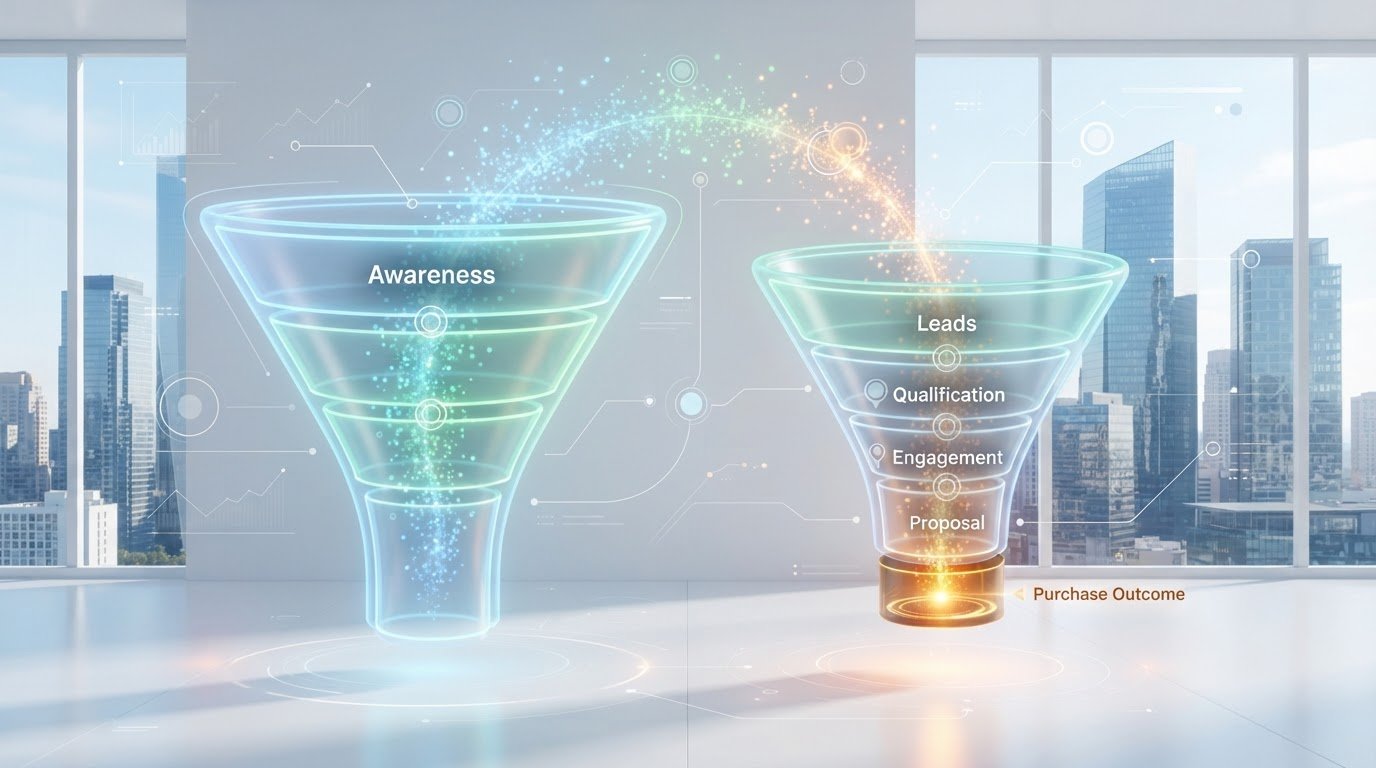
Sales Funnel vs Marketing Funnel: Which Fits Your Goals
The sales funnel vs. marketing funnel isn’t an either-or choice. Marketing attracts and nurtures prospects; sales guides qualified prospects toward a purchase. For most businesses, connecting the two helps prevent leads from getting lost between initial interest and follow-up. Decide where to focus by identifying the point in the customer journey that needs attention.
It’s easy to see the two funnels as competing systems, especially when leads arrive but don’t convert or sales teams lack a steady stream of prospects. Understanding how each funnel works, which metrics reveal progress, and how to align their stages can help you focus on the right business goals. You’ll also see when to prioritize one area and how a connected funnel can give prospects a clearer path from first contact to customer.
Key Takeaways
- Match awareness, consideration, and conversion content to what prospects need at each stage, then track the signals that show whether they’re moving forward.
- Choose a funnel framework that reflects how your customers buy; models such as AIDA, Bowtie, and Flywheel offer different ways to map that journey.
- Use buyer actions and decision timelines to shape lead nurturing, qualification, and the handoff from marketing to sales.
- Align both teams around shared stages, messaging, and reporting so you can spot drop-offs and improve the path to purchase.
What are the most important metrics to track at each stage of your marketing funnel?
Track progress across awareness, consideration, conversion, and retention. Each stage calls for different campaigns, actions, and signals, so measure how prospects move forward instead of relying on a single final sales number.
Marketing Funnel Stages
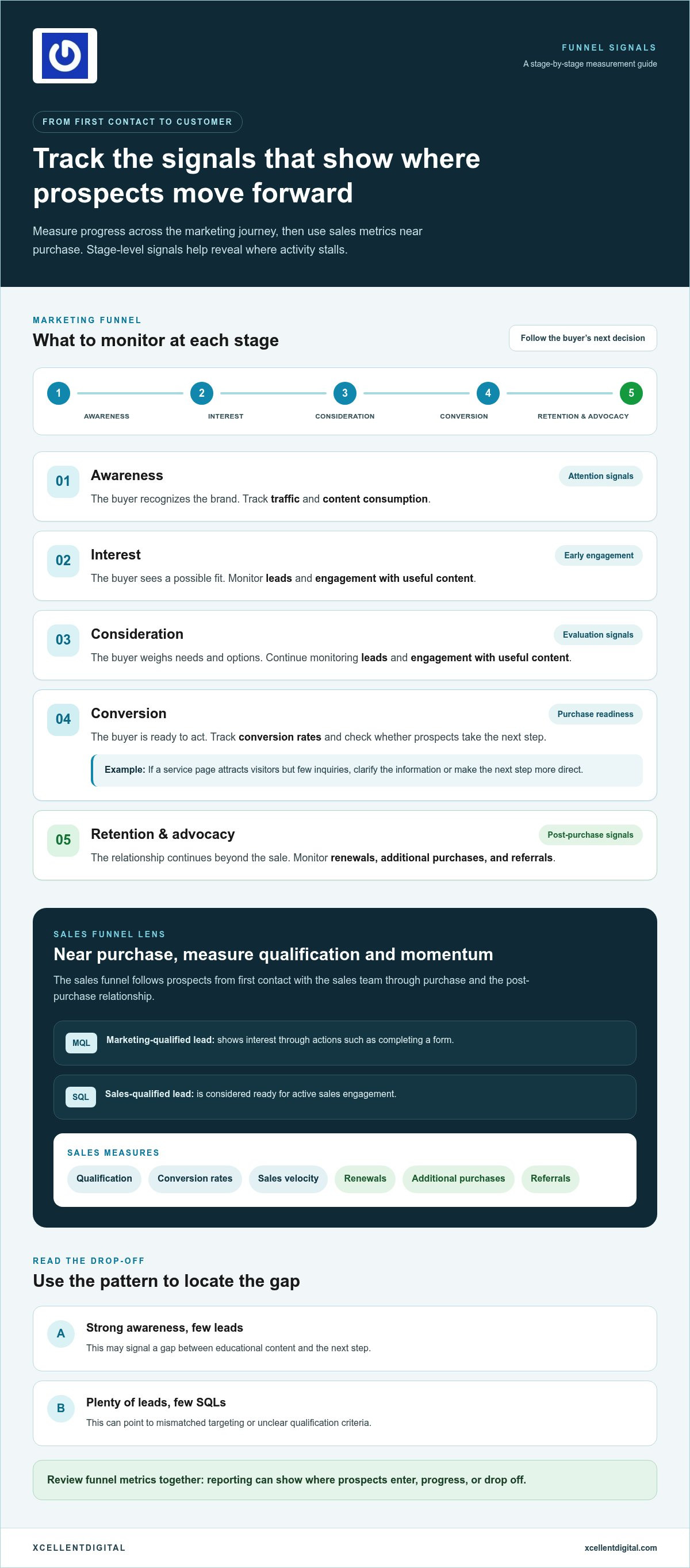
A marketing funnel maps how people move from discovering a brand to making a purchase and potentially becoming repeat customers or advocates. At awareness, a buyer recognizes the brand. Interest means they see a possible fit, while consideration means they weigh their needs and options. At conversion, they’re ready to act. Retention and advocacy follow when customers renew, buy more, or refer others. These stages help you match each message to the buyer’s next decision.
Stage Metrics and Activities
Stage-level metrics show whether campaigns attract attention, build interest, and turn prospects into customers. At awareness, track traffic and content consumption. At interest and consideration, monitor leads and engagement with useful content. At conversion, track conversion rates. For example, if a service page attracts visitors but few inquiries, clarify the information or make the next step more direct. These measures help pinpoint where activity stalls.
The sales funnel follows prospects from their first contact with the sales team through purchase and post-purchase relationship building. In B2B, teams may distinguish marketing-qualified leads (MQLs), who show interest through actions such as completing a form, from sales-qualified leads (SQLs), ready for direct sales attention. Track qualification, conversion rates, and sales velocity near purchase; after the sale, monitor renewals, additional purchases, and referrals.
Review metrics together to understand what is happening at each stage. Strong awareness with few leads may signal a gap between educational content and the next step. Plenty of leads but few SQLs can point to mismatched targeting or unclear qualification criteria. Funnel reporting can show where prospects enter, progress, or drop off. NIST describes marketing efforts as engaging prospects and nurturing them from prospect to long-term client.
Sales funnel vs marketing funnel: Which is the better option?
Marketing focuses on prospects’ interactions with brand content; sales focuses on their interactions with salespeople. The right emphasis depends on your goal, but coordinating both can move prospects toward action.
Funnel Model Frameworks
Funnel frameworks map different parts of the buyer journey and help you choose messaging and metrics that fit your goal. AIDA moves from attention to interest, desire, and action. REAN tracks Reach, Engage, Activate, and Nurture. TOFU/MOFU/BOFU groups activity into top, middle, and bottom stages. The Bowtie extends beyond purchase, while the Flywheel emphasizes ongoing customer momentum. See-Think-Do-Care organizes messages around buyer intent, from early awareness to post-purchase care.
Funnel Differences Across Businesses
Business models shape funnel length, decision steps, and the point where sales becomes active. B2B purchases often involve multiple decision-makers, larger budgets, and vendor comparisons, so teams nurture prospects and qualify leads over a longer journey. B2C journeys are generally shorter and more emotionally driven; a ready shopper may move from awareness to purchase in one session. A company can also run parallel funnels, such as self-service purchasing and sales-led enterprise solutions.
Sales and Marketing Funnel Differences
A marketing funnel covers interactions with a brand, from awareness to conversion and loyalty. A sales funnel focuses on the salesperson-led path from first contact to purchase. Marketing attracts and nurtures prospects; sales qualifies their interest, addresses objections, and guides qualified leads toward a decision. The sales funnel is one part of the wider marketing journey, not a replacement for it. Compare stage-level metrics and handoff points to see which process needs attention.
For a focused view of the sales-led path, explore funnel planning support as a way to connect each prospect’s next action with a clear business goal.
Marketing funnel definition and buyer journey
A marketing funnel models how people interact with a brand, from first awareness through purchase and loyalty. It helps organize campaigns around the buyer journey rather than treating every prospect as ready to buy. Awareness introduces the brand; interest signals a possible fit; consideration is when buyers weigh needs and options; conversion marks readiness to purchase. Loyalty and advocacy extend the journey beyond the sale.
A sales funnel tracks a prospect’s relationship with the sales team, from first contact through purchase and the ongoing client relationship. Its purpose is to move interested people toward a defined next action, such as a purchase or event attendance. The marketing funnel starts earlier, with brand awareness and content interactions. The sales funnel focuses on qualified prospects and conversations closer to a decision. Both describe the same journey from different perspectives.
Lead labels clarify the handoff between marketing and sales. An MQL, or marketing-qualified lead, shows interest through actions such as signing up for a newsletter, submitting a form, or downloading content. An SAL, or sales-accepted lead, has been vetted by sales and is considered ready for further sales attention. An SQL, or sales-qualified lead, is considered ready for active sales engagement. In B2B, teams often distinguish MQLs from SQLs because sales typically becomes active near the funnel’s bottom.
These labels help teams optimize content and handoffs for each buying stage. For example, a newsletter signup can prompt relevant nurturing, while a qualified lead may need a sales conversation about vendor comparisons. A B2C purchase can take hours or days when someone is already shopping. A B2B journey can take days, weeks, or several months, with solution evaluation and multiple stakeholders shaping the decision. Map the actions that signal interest, consideration, and buying readiness, then define what moves each lead forward.
Combining marketing and sales funnels
Leads move toward sales when marketing engagement meets shared qualification criteria. For example, a prospect who requests a service estimate may be ready for direct follow-up, while someone who reads an introductory guide may need more nurturing. Marketing and sales should agree on the signals that distinguish early interest from a qualified opportunity.
Build the handoff around three connected actions: attract prospects through relevant channels, nurture them with content that addresses their pain points, then pass qualified leads to sales. A prospect comparing solutions might receive a useful comparison, while someone requesting a meeting moves toward sales contact. Sales can also share customer questions to help marketing improve future campaigns.
Alignment breaks down when teams define qualified leads differently, use mismatched messaging, or disagree about who owns follow-up. For example, marketing may count a content download as strong engagement, while sales sees no buying intent. Unclear handoffs can leave prospects waiting or expose them to repeated outreach. Shared definitions and a record of each lead’s actions help both teams respond consistently.
Use a shared view of campaign and sales activity. Track where leads enter, which channels attract relevant prospects, how they progress, and where they stop. Then review stalled opportunities together. If prospects engage with awareness content but ignore sales outreach, revisit the transition and message. If sales hears repeated questions about the same pain points, use those insights to strengthen middle-stage content. Marketing can support late-stage nurturing, while sales can surface new lead opportunities.
Combined funnels work best when marketing and sales coordinate around the same strategy, campaigns, and next steps. This gives prospects a connected experience from first engagement through a sales conversation, rather than two disconnected processes. If your handoffs or follow-up stages need a clearer structure, explore sales funnel development to help connect marketing activity with the next sales action.
XcellentDigital: Facebook Ads
XcellentDigital can connect Facebook Ads with the broader path from discovery to inquiry. Use Facebook Ads when you need campaigns to introduce your business to potential customers and guide interested prospects toward a clear next step. Make sure the message, audience, and destination work together, so the ad generates relevant engagement rather than an isolated click.
Funnel alignment also depends on what happens after someone responds. Search Optimization and Google Business Profile Optimization can support discovery through search, while AI Agents can help businesses manage lead interactions. The right mix depends on where prospects enter and what action should follow. Tie each campaign goal to its funnel stage, then assess whether the resulting engagement leads toward a meaningful business outcome.
Contact XcellentDigital to discuss how Facebook Ads can fit into your marketing and sales funnel.
Turn Your Funnel Into a Clear Next Step
A sales funnel vs. marketing funnel comparison is useful only when it helps you make a practical decision. Treat your funnel as a working plan: identify where prospects lose momentum, then focus your next change there. A clearer message, smoother handoff, or more relevant follow-up can make the customer journey easier to navigate.
Start with a simple question: what should a prospect do next, and what will help them do it? Keep that action consistent across campaigns, landing pages, and sales conversations. Then review what happens and adjust based on actual engagement. Progress comes from steady learning, not from choosing a model and leaving it untouched.
If you’re ready to connect your marketing activity with a more purposeful path to action, contact XcellentDigital to discuss your funnel. Take the next step with a clear goal, a practical plan, and room to improve as you learn.
Frequently Asked Questions
How are the funnels similar?
Both funnels organize activity around a prospect’s progress toward becoming and remaining a customer. They give teams a shared way to discuss what a person has done and what useful next step could follow. For example, someone might encounter a brand through an educational webinar, explore its service page, speak with sales, and later receive customer onboarding. Each interaction contributes to a connected experience.
What Is a Marketing Funnel and How Does It Work for Lead Generation?
A marketing funnel guides people from discovering a brand to taking an action that signals potential interest. For lead generation, campaigns attract relevant visitors and offer a useful next step, such as requesting a consultation or downloading a planning checklist. That response gives the business an opportunity to continue the conversation with relevant information. Effective offers match the visitor’s question instead of pushing everyone toward an immediate purchase.
When should you implement full funnel marketing versus focusing on individual funnel stages?
Use full-funnel marketing when your team can coordinate multiple touchpoints and needs visibility across a complex customer journey. For example, a business with educational content, comparison pages, sales conversations, and post-purchase communication can connect those experiences. Focus on one stage when resources are limited or a specific bottleneck needs attention. If prospects visit a landing page but rarely inquire, improve that transition before expanding campaigns elsewhere.
What is a sales funnel?
A sales funnel shows how prospects progress through interactions with a sales team toward a purchase and ongoing customer relationship. Its purpose is to make the next useful sales action clear. For example, after an inquiry, a representative might clarify the prospect’s needs, address a concern, and arrange a product demonstration. The stages and actions should reflect how the business actually sells, not follow a generic template.
What are the stages of a marketing funnel?
Common marketing funnel stages are awareness, interest, consideration, conversion, and then loyalty or advocacy. For example, someone might discover a brand through an educational article, explore service details, compare options, and eventually make an inquiry or purchase. Helpful customer communications afterward can encourage continued engagement. Businesses may label or group these stages differently, so define each one by the buyer’s intent and the action you want to support.
What are the stages of a sales funnel?
A sales funnel commonly moves from initial sales contact through qualification, consideration, purchase, and post-purchase account growth. For example, a sales representative receives an inquiry, learns what the prospect needs, answers questions, and helps them decide whether to buy. After the sale, follow-up can support continued use or identify additional needs. Set clear stage criteria so leads advance because of meaningful progress, not simply because time has passed.













Leave a Reply
Want to join the discussion?Feel free to contribute!