

Build a Predictable Lead Gen Model via Time to Convert
More leads won’t fix an unpredictable pipeline, but understanding how long prospects take to convert can. Build a predictable lead generation model by measuring the time from a prospect’s first meaningful interaction to lead capture or conversion, then use those patterns to improve each step. The goal isn’t to rush every buyer. It’s to make your next move more informed.
You already know that prospects don’t all make decisions at the same pace. But when you can’t see where they engage, pause, or drop off, it’s hard to tell which parts of your lead process need attention. A clear view of conversion timing gives you a practical starting point.
Learn how to track time to conversion, spot engagement and lead-capture gaps, and use what you find to make your pipeline more predictable. We’ll also explore how predictive lead generation can help you focus on stronger prospects and create a steadier path from first interaction to qualified lead, without relying on guesswork alone.
Key Takeaways
- Use past customer and prospect signals to identify which leads are more likely to become qualified opportunities.
- Track the time between meaningful interactions and conversion to find delays or drop-offs in your funnel.
- Make engagement and lead capture easier by matching each next step to the prospect’s needs and readiness.
- Build a repeatable process by setting a clear goal, reviewing lead patterns, and refining your campaigns based on what converts.
Benefits of predictive lead generation
- Use past customer signals to prioritize prospects. Predictive lead generation can combine demographic details, buying behavior, online activity, and social interactions. A scoring model can weigh these signals alongside engagement and customer fit. For example, a prospect who repeatedly engages with relevant content may deserve different follow-up from someone who only visits once. A Forbes Insight survey found 86% of companies using predictive analytics in marketing experienced beneficial operational impacts.
- Compare channels using your own qualified-lead and conversion records. Search, referrals, and social campaigns can become more consistent when you track lead quality and follow-through over time. No channel wins for every business; results depend on audience, offer, follow-up, and measurement. Compare each channel’s qualified leads and eventual conversions, not just its raw inquiry count.
- Compare inbound and outbound by measuring cost and predictability separately. Inbound activity can grow through useful content and search visibility, while outbound depends on targeted prospecting and timely outreach. Neither is automatically cheaper or more predictable. Track spend, qualified leads, conversion timing, and sales outcomes for each, then compare like-for-like periods and audiences.
- Build privacy and consent practices into every US lead workflow. Requirements can vary by state and communication channel, so design collection forms with clear purposes and permission choices. Keep sender information accurate, honor opt-out requests, and limit access to collected data. Review the process whenever you add a channel, form, or audience source.
- Stress-test forecasts before using them to set targets. A forecast can fail when older records contain inconsistent stages, a campaign changes, or engagement no longer reflects buying intent. Compare predicted lead quality with actual sales outcomes, then adjust scoring inputs. For example, if frequent clicks rarely become qualified opportunities, reduce the weight assigned to clicks.
Time-to-conversion measurement
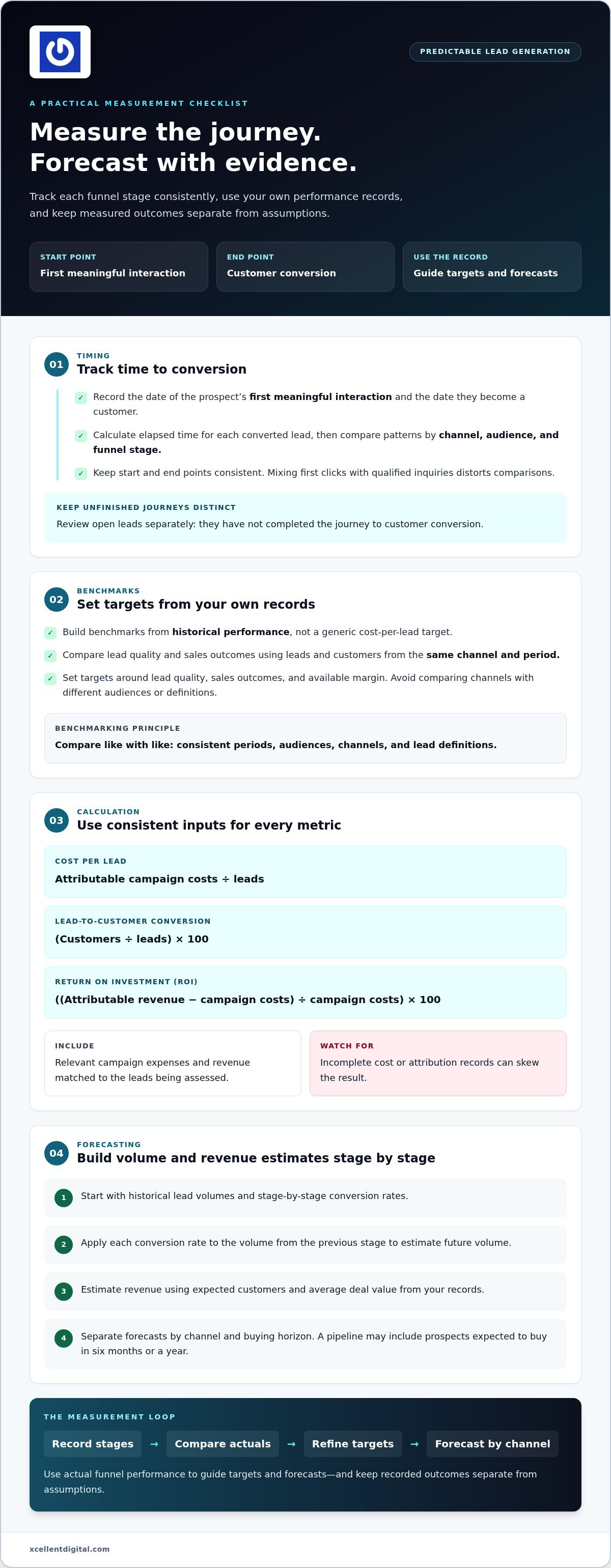
Measure each stage consistently, then use actual funnel performance to guide targets and forecasts. Keep recorded outcomes separate from assumptions.
-
Track Time to Conversion
Record the date of a prospect’s first meaningful interaction and the date they become a customer. Calculate elapsed time for each converted lead, then compare patterns by channel, audience, and funnel stage. Keep the start and end points consistent; mixing first clicks with qualified inquiries distorts the comparison. Review open leads separately because they haven’t completed the journey.
-
Set Cost and Conversion Benchmarks
Build benchmarks from your own historical performance, not a generic cost-per-lead target. Divide attributable lead-generation costs by the number of leads to find cost per lead. To measure lead-to-customer conversion, compare customers with leads from the same channel and period. Set targets around lead quality, sales outcomes, and available margin, and avoid comparing channels with different audiences or definitions.
-
Calculate Costs, Conversion Rates, and ROI
Use consistent inputs for each calculation. Cost per lead equals attributable campaign costs divided by leads; lead-to-customer conversion equals customers divided by leads, multiplied by 100. Calculate ROI as attributable revenue minus campaign costs, divided by campaign costs, then multiplied by 100. Include relevant campaign expenses, and match revenue to the leads being assessed. Incomplete cost or attribution records can skew the result.
-
Forecast Lead Volume and Revenue
Start with historical leads and stage-by-stage conversion rates to estimate future volume. Apply each rate to the previous stage, then estimate revenue using expected customers and average deal value from your records. Separate forecasts by channel and buying horizon; your pipeline may include prospects expected to buy in six months or a year. XcellentDigital’s Sales Funnel Development can help structure the funnel stages and handoffs.
User engagement and lead capture
Use each interaction to make the next step easier. Track engagement through lead capture, not clicks alone.
- Map the path from first visit to inquiry. List key actions, such as viewing a service page, reading a case example, and submitting a form. Check where visitors stop or repeat actions. If prospects read pricing information but leave before contacting you, clarify the next step and make the contact option easy to find.
- Match each call to action to the visitor’s intent. Someone reading an introductory guide may need a useful next resource, while someone viewing a service page may be ready to request details. Keep forms focused on the information your team needs to respond. Avoid asking for extra details that add friction without helping qualify the inquiry.
- Review conversion by audience and readiness. The Do audience, people prepared to act, has an average conversion rate of 2%. Treat that figure as context, then compare your own results by source and action. A high number of page views means little if visitors don’t complete the form or progress to a sales conversation.
- Connect website forms, analytics, and a customer relationship management system (CRM). These tools can bring lead source, interaction timestamps, form details, and status changes into one record. Email automation can then send relevant follow-up based on the action taken. Check that records sync correctly and duplicate submissions don’t create confusing histories.
- Test one engagement change at a time. For example, compare a shorter form with your existing form while keeping the audience and offer consistent. Track submissions, qualified leads, and subsequent sales conversations, not just clicks. Keep the version that improves useful lead capture, and document the change so later results have context.
Intent data can include web browsing behavior, keyword searches, content engagement, and information from third-party data providers. Use these signals alongside tracked actions to understand what may indicate a prospect’s interest, while tying lead capture to meaningful next steps.
A predictive lead scoring model can assign each lead a numerical value based on engagement, demographic fit, and other relevant factors, then group leads into categories such as MQLs, SQLs, and unqualified leads. Use those categories to guide follow-up and check whether they align with qualified inquiries and sales conversations.
How do you build a predictable lead generation system step by step?
- Define the audience and business outcome first. Describe the customer’s needs, buying signals, and reasons to choose your offer. Set one measurable goal, such as increasing qualified traffic year over year. A 15% year-over-year increase can serve as an example target, not a universal benchmark.
- Map the buyer journey from discovery to sale. Name each stage, the action that moves a prospect forward, and the information your team needs. Include different buying timelines: your pipeline may contain prospects expected to buy in six months and others expected to buy in a year.
- Choose channels based on audience behavior and lead quality. Connect each channel to a specific journey stage, such as educational content for early research or a direct inquiry form for ready buyers. In specialized trade industries like tree care, agencies such as Digital Farmers help businesses focus on the specific marketing channels that drive consistent customer inquiries. Record the source of every lead so you can compare qualified opportunities and sales outcomes by channel.
- Build a clear capture and follow-up path. Match each landing page and call to action to the visitor’s intent. Ask only for useful qualification details, then define who reviews each inquiry and what happens next. A lead without an owner can disappear between marketing and sales.
- Set up measurement before launching campaigns. Use consistent lead stages and record source, engagement, qualification, and customer outcomes. Check that your analytics and customer records use the same definitions. This makes it easier to identify where prospects stall and which actions help them progress.
- Review results and adjust one part of the system at a time. Compare qualified leads, conversion patterns, and revenue against your goal. If traffic rises but qualified inquiries do not, revisit audience fit or page relevance before increasing activity. Get support structuring your lead funnel when you need a clearer route from campaign to conversion.
Plan for prospects at different points in their decision process instead of treating every inquiry as equally close to a purchase. Your digital marketing pipeline may include people expected to buy in six months and people expected to buy in a year. Keeping these timelines visible helps teams interpret current activity in context and maintain an appropriate follow-up path for each prospect, rather than judging the system only by immediate conversions. For business owners aiming to strengthen their overall marketing foundation, specialized digital marketing services from AI Asset Man can help build high-value digital assets that support consistent lead generation over time.
XcellentDigital: Facebook Ads
XcellentDigital offers Facebook Ads to help businesses reach potential customers through a measurable campaign path. Use this option when your audience is active on Facebook and you want to connect campaign activity with lead capture and follow-up. Set a clear goal, use a landing page that matches the ad, and track qualified inquiries rather than clicks alone. Review results alongside your time-to-conversion records to see how prospects move from engagement to action. If your campaign needs support beyond paid social, Search Optimization and Pay Per Click can address other ways prospects find your business. Contact XcellentDigital to discuss how Facebook Ads can fit your lead generation approach.
Make your next campaign more intentional
Turn the patterns you’ve measured into a focused test. Choose one audience, one campaign goal, and one result to evaluate. Keep the rest of the process steady while you learn what moves prospects forward. This gives your team a clearer basis for improving a predictable lead generation model without changing several variables at once.
XcellentDigital can support this work through Facebook Ads, Google Business Profile Optimization, and AI Agents. Identify which part of your lead process needs attention first, from attracting prospects to supporting follow-up. A focused conversation can help connect that need with an appropriate marketing approach.
Discuss your lead generation goals with XcellentDigital, and take the next step with a clearer plan.
Frequently Asked Questions
What is a predictable lead generation model?
A predictable lead generation model is a repeatable way to attract, qualify, and track prospects using consistent measures. It helps a business plan activity around observed patterns rather than relying on occasional lead spikes. For example, a team can compare which campaign sources bring inquiries that become customers, then prioritize the sources that fit its capacity and sales goals. Predictability supports planning, not certainty.
Which lead generation channels produce the most consistent results?
No channel is consistently best for every business. Compare search, referrals, and social campaigns using qualified leads and eventual conversions over time, accounting for audience, offer, follow-up, and measurement.













Leave a Reply
Want to join the discussion?Feel free to contribute!