

How to Generate Qualified Sales Leads Online with Content
More leads won’t fix a pipeline full of poor-fit prospects. To learn how to generate qualified sales leads online, define the customers your business can serve best, answer their buying questions with useful content, and use engagement signals to identify who may be ready for a sales conversation. Qualification connects these steps, helping your team focus on prospects with a genuine fit and a clear need.
If you’re attracting interest but not enough sales-ready conversations, the issue may be how you identify and guide potential buyers, not simply how many people visit your website. A clear qualification process helps your team focus on fit, intent, and the next useful step.
This article shows how to map the B2B buyer journey, choose channels, create helpful content for each stage, and tailor calls to action. You’ll see how these pieces work together to turn online attention into better-qualified leads.
Key Takeaways
- Define the customers your business can serve well, then use fit and engagement signals to prioritize promising prospects.
- Map the buyer journey so you can choose channels and create content that answers questions at the right moment.
- Match each call to action to a prospect’s next step, from exploring a solution to starting a sales conversation.
- Use channel performance to guide your strategy, and consider XcellentDigital’s Facebook Ads when paid social fits your lead-generation goals.
2. Customer journey mapping and channel selection
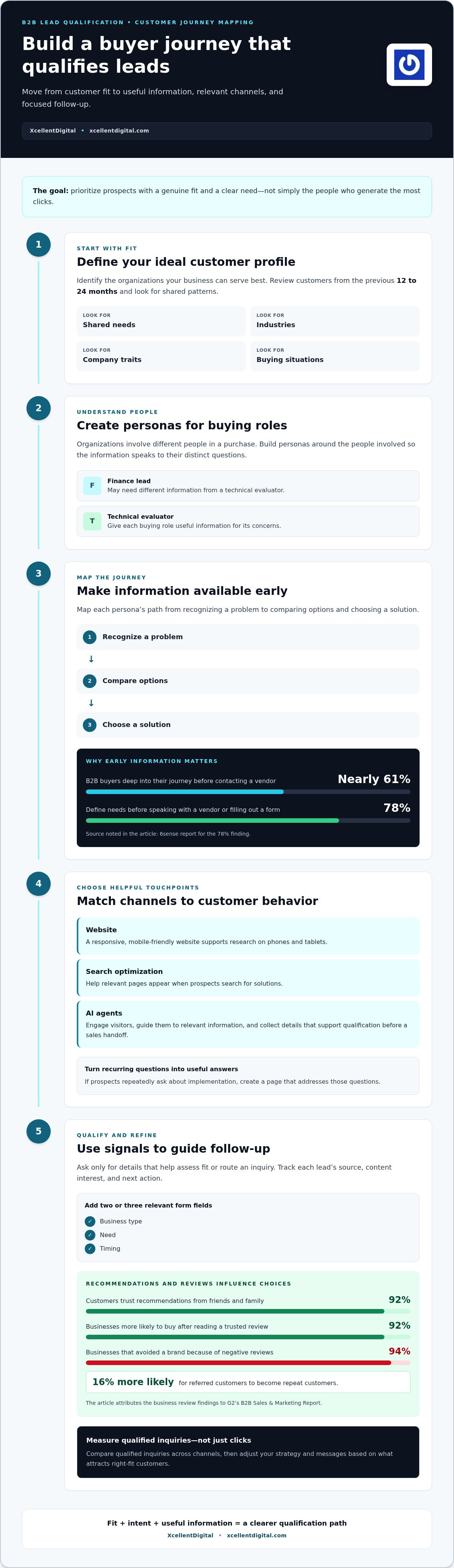
To decide how to generate qualified sales leads online, first define an ideal customer profile (ICP): the organizations your business can serve best. Review customers from the previous 12 to 24 months and note shared needs, industries, company traits, and buying situations. Then create buyer personas for the people involved. A finance lead and technical evaluator may need different information.
Map each persona’s path from recognizing a problem to comparing options and choosing a solution. Nearly 61% of B2B buyers are deep into their purchase journey before contacting a vendor. A 6sense report found that 78% define their needs before speaking with a vendor or filling out a form. Make useful information easy to find early.
Match your channels to customer behavior. A responsive, mobile-friendly website supports research on phones and tablets. Search optimization helps relevant pages appear when prospects look for solutions. AI agents can engage visitors, guide them to relevant information, and collect details that support qualification before a sales handoff.
Use customer conversations to spot recurring concerns. If prospects repeatedly ask about implementation, create a page that answers those questions. Add two or three relevant fields to contact forms, such as business type, need, or timing. Each question should help your team assess fit or route the inquiry.
Referrals and reviews also shape channel choices. 92% of customers trust recommendations from friends and family, and referred customers are 16% more likely to become repeat customers. According to G2’s B2B Sales & Marketing Report, 92% of businesses are more likely to buy after reading a trusted review, while 94% have avoided a brand because of negative reviews.
Track each lead’s source, content interest, and next action. Compare qualified inquiries across channels, then adjust your digital strategy and messages based on what attracts the right-fit customers, not simply the most clicks. A practical plan for how to generate qualified sales leads online measures fit and intent alongside channel activity.
3. Creating useful content for each stage of the buyer journey
Build content around the questions buyers ask before they’re ready to speak with sales. At the awareness stage, explain a costly problem in a blog post or practical guide. During evaluation, offer comparison criteria, implementation details, or a case example. For decision-stage readers, make the next action clear with a demo request or conversation prompt. Each asset should answer a real question, not just fill a publishing calendar.
Search-optimized website content can help relevant pages reach people actively researching a need. Choose one audience question per page, use buyers’ language, and organize the answer with descriptive headings. For example, a guide about choosing scheduling software can explain key capabilities, common trade-offs, and questions to raise with stakeholders. Link related pages so readers can move from basic explanations to more detailed information.
Connect content to an action that suits the reader’s stage. A first-time visitor may want a downloadable planning worksheet; someone comparing solutions may prefer a consultation request. Place the call to action beside the content that earns it, then measure clicks, form completions, and conversion rates for each asset. Use those signals to revise pages and strengthen search optimization. A focused content plan can align these improvements with buyers’ questions.
For example, review one underperforming service page: clarify its answer, add a related guide, and make the next step specific. If you need support shaping that approach, explore search-optimized content strategy.
4. Calls to action tailored to the buyer’s journey
LinkedIn, Google, and Meta ads serve different B2B lead-generation roles. LinkedIn can help companies reach professional audiences and identify potential business prospects. Google can capture active search intent, while Meta can build awareness and reconnect with audiences who have shown interest.
Match each call to action to the visitor’s next decision. Someone discovering a problem may respond to a practical guide; a prospect comparing solutions may want a checklist or case example. A buyer assessing providers can be invited to start a sales conversation. One generic “Contact us” button won’t fit every stage.
Map the journey across platforms before launching campaigns. Identify the question a prospect asks at each stage, where they’re likely to ask it, and what action moves them forward. For example, a search ad can lead to a comparison page, while a follow-up social ad offers a relevant case study. Keep the message consistent, but tailor the action to the content and intent.
Use buyer intent data as a practical signal, not a substitute for qualification. A repeat visit to a pricing or service page, a guide download, or a completed form can indicate stronger interest than a single casual visit. Combine those insights with fit criteria, such as the company’s needs and the problem described, before prioritizing follow-up.
Then test the path. Track ad source, landing-page activity, form completions, and sales conversations. If visitors click but don’t convert, align the page promise and call to action more closely. If prospects complete forms but lack fit, adjust the offer or add a relevant qualification question. A combined 23% of marketing professionals don’t personalize content and messaging across channels, or personalize only minimally. Tailored actions give buyers a clearer next step.
4. Which online channels generate the highest-quality sales leads?
Choose channels by buyer intent, audience fit, and the sales conversations they generate, not traffic alone. Google search can reach prospects actively seeking a solution. Search-optimized pages can answer questions earlier in the research process. For example, a commercial cleaning firm could publish a page for office managers comparing service options, then assess whether inquiries fit its services.
Pay-per-click ads can capture active demand because they appear alongside relevant searches. Visitors arriving through PPC ads are 50% more likely to make a purchase than visitors from organic search. Treat that as a reason to test, not a guarantee of lead quality. Track which search terms bring qualified inquiries, then refine ad copy and landing pages around those needs.
Social platforms can introduce a solution before prospects search for it. 77% of social media marketers say social media marketing effectively influences lead generation. LinkedIn can support professional outreach, while Meta platforms can help present useful content to a broader audience. Compare these sources by fit, follow-up conversations, and sales progression, rather than likes or form submissions alone.
Use a consistent measurement path across channels. Record each lead’s source, the page or offer that prompted action, and whether sales accepts the prospect. A spreadsheet or CRM can reveal whether organic search, paid search, or social generates better-fit opportunities. Review results regularly, and shift effort toward channels producing leads that match your customer profile. If paid and organic traffic arrive without a clear conversion path, develop a sales funnel that connects the source, message, and follow-up. Keep the same qualification criteria across platforms so channel comparisons remain useful. A high click count means little if prospects lack a relevant need or buying role.
XcellentDigital: Facebook Ads
XcellentDigital uses Facebook Ads to put relevant offers in front of potential customers. Turn that attention into a clearer lead path by matching the ad message to a useful landing page, a focused form, and a next step suited to the prospect’s interest.
This approach is useful when your audience is active on Facebook and your campaigns need a stronger connection between targeting, content, and follow-up. Search Optimization can support discovery through search, while AI Agents can help engage prospects and gather information. The right mix depends on how your buyers look for solutions and which actions signal genuine interest.
Ready to refine your online lead generation? Contact XcellentDigital to discuss how Facebook Ads can fit your goals.
Build Your Next Lead-Generation Test
Progress comes from making a focused change and learning from the response. Choose one audience, one offer, and one channel to improve. Define a qualified inquiry before launching, so your team can assess results by fit and sales relevance, not clicks alone.
That’s a practical way to approach how to generate qualified sales leads online: connect the message, the next step, and the follow-up. XcellentDigital offers Facebook Ads, Google Business Profile Optimization, and AI Agents to support different parts of that process. The right starting point depends on where your current lead path needs attention.
If you’re ready to turn your next marketing improvement into a clear plan, contact XcellentDigital to discuss lead generation. Start with the challenge you want to solve, and take the next step with purpose.
Frequently Asked Questions
What is B2B lead qualification?
B2B lead qualification is the process of deciding whether a potential business buyer merits sales attention. It compares evidence about the account and contact with agreed criteria, such as the problem, decision role, and readiness to act. For example, a person researching a solution for a relevant company may qualify for nurturing, while a student researching for coursework does not belong in the sales pipeline.
Why is qualifying leads important?
Qualifying leads helps sales teams focus on opportunities that fit the business instead of treating every inquiry equally. It also gives marketing clearer feedback about which campaigns attract relevant buyers. For example, if a webinar draws many attendees but few target accounts, the team can adjust its promotion or audience criteria. Shared definitions clarify which leads need sales follow-up.
What makes an online sales lead qualified?
An online sales lead is qualified when the available information shows a plausible match between the buyer’s needs and the company’s solution. Look for signals such as a relevant business problem, a suitable organization, an involved decision-maker, and a clear next step. A form submission alone isn’t enough. A prospect seeking help with a problem your business doesn’t solve isn’t a fit.
How do you define an ideal customer profile and lead qualification criteria?
Define an ideal customer profile by examining your strongest customer relationships and identifying traits linked to a good fit. Turn those traits into observable qualification criteria. For example, a software company might prioritize firms using a compatible system and contacts responsible for operations. Agree with sales and marketing on what counts as a strong, developing, or poor-fit lead.
How do you generate qualified leads through SEO and content marketing?
Start with search queries that reveal a business problem your solution addresses, then build pages that answer those questions clearly. Connect educational articles to focused service pages so readers can move from understanding a challenge to assessing their options. Review search queries and conversions together. If a page attracts the wrong audience, refine its topic, examples, and language rather than chasing more visits.
How can you build a landing page and lead magnet that convert qualified prospects?
Give the landing page one purpose: offer a useful resource to a clearly defined buyer. A downloadable project-readiness checklist, for example, should explain what it helps the reader assess and what happens after signup. Keep the form focused on information needed to evaluate fit, such as role or business need. Match the headline to the promotion, then make the follow-up action clear.













Leave a Reply
Want to join the discussion?Feel free to contribute!