

Automated Follow Up for Leads: The 2026 Conversion Checklist
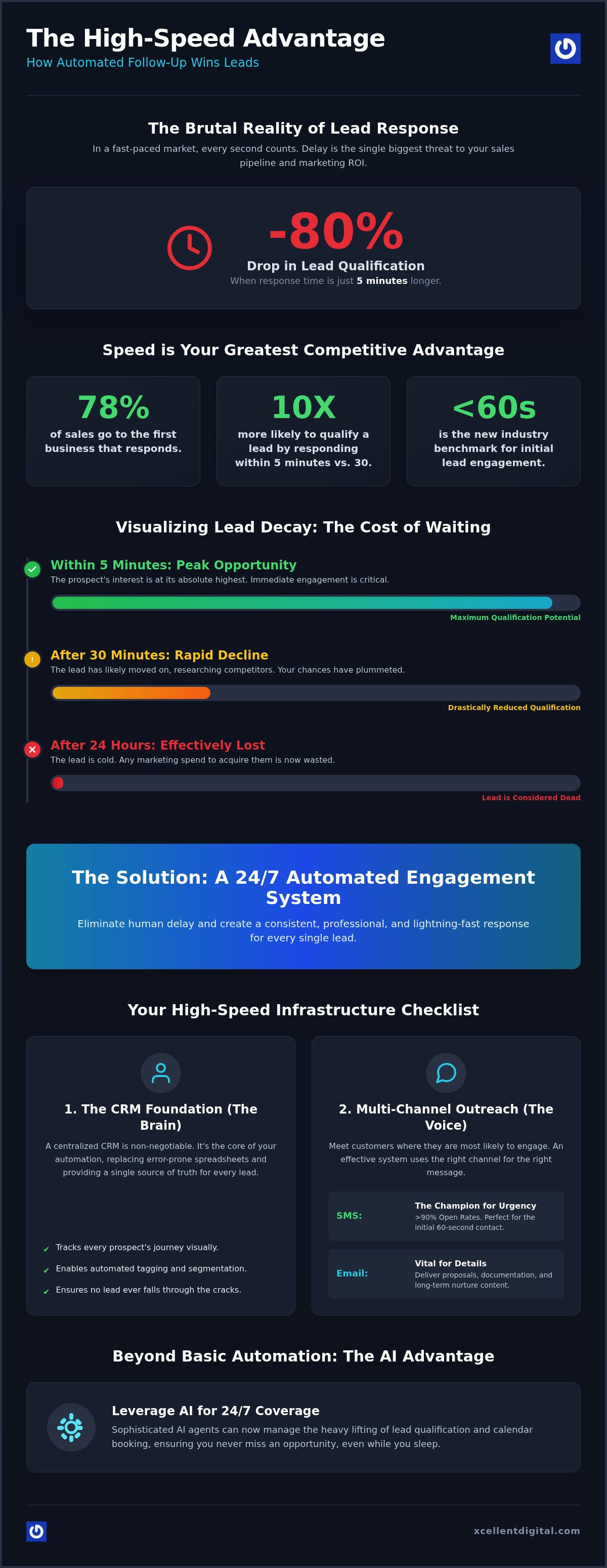
Industry research confirms a brutal reality: waiting just five minutes to respond to a new inquiry can slash your qualification rates by 80 percent. In a fast-paced market, speed is the only currency that truly matters. You need a reliable system for automated follow up for leads to ensure you are the first to the finish line every single time.
It is painful to watch potential revenue vanish because you were stuck in a meeting or on a job site. You are tired of leads going cold and ad spend producing nothing but silence. We are here to fix the leaky funnel. This guide delivers a comprehensive checklist to build a high-speed engagement system that works around the clock, even when you cannot.
We will break down the exact steps to integrate AI agents and lead response automation into your sales process. You will discover how to book more appointments on autopilot and project a professional image that wins trust instantly. It is time to turn your response speed into your greatest competitive advantage and stop losing business to the clock.
Key Takeaways
- Speed is your greatest asset: responding within 60 seconds is the industry benchmark for capturing high-intent prospects before they move to a competitor.
- Build a bulletproof system: using automated follow up for leads eliminates human error and ensures a consistent, professional touchpoint for every inquiry.
- Master the multi-channel approach: integrating SMS, email, and WhatsApp into your workflow meets your customers where they are most likely to engage.
- Leverage AI for 24/7 coverage: sophisticated AI agents now manage the heavy lifting of lead qualification and calendar booking while you sleep.
- Optimize for the long game: use behavioral triggers and A/B testing to transform a basic follow-up sequence into a high-conversion sales engine.
The Psychology of Speed: Why Automated Follow Up for Leads is Mandatory
The five-minute rule isn’t just a suggestion; it’s a survival metric for your business. In a high-speed digital economy, lead decay happens almost instantly. When a prospect reaches out, they are at the peak of their interest and pain. If you don’t catch them in that window, their attention shifts to the next tab in their browser. Relying on manual efforts means you’re gambling with your marketing budget. Every minute of silence is a missed opportunity for a competitor to step in and solve the problem you paid to find.
Consumer psychology has shifted toward instant gratification. Research consistently shows that the first business to respond wins the job 78 percent of the time. This isn’t necessarily because they’re the best or the cheapest; it’s because they’re the most reliable. Speed signals authority. When you use automated follow up for leads, you project an image of a well-oiled machine. You tell the prospect that their time is valuable and that your business is ready to deliver immediately. Manual follow-up simply cannot compete with this level of consistency.
The hidden cost of “ghosted” leads is staggering. Think about your current ad spend. If you’re only reaching half of your leads within the first hour, you’re essentially throwing 50 percent of your budget into the trash. Automation stops the bleeding. It fixes the leaky funnel by ensuring no inquiry ever falls through the cracks because you were stuck in a meeting or driving between job sites.
The Math of Response Times
The numbers don’t lie. A response within five minutes is ten times more likely to result in a qualified lead than a response at the 30-minute mark. By the time 24 hours have passed, the lead is effectively dead. In 2026, the competitive benchmark for speed-to-lead is an engagement time of under 60 seconds. Automation is the only way to hit this target consistently. It eliminates the human delay that naturally occurs during peak business hours, ensuring your response is always the first one the customer sees.
Overcoming the “Impersonal” Myth
Many business owners worry that automation feels cold or robotic. The reality is the opposite. Modern automated follow up for leads uses dynamic tags to insert names, specific services, and even local context into every message. This makes your outreach feel tailored and attentive. We recommend a hybrid approach: use automation to handle the instant response and book the appointment, then bring in the human touch to close the deal. A fast, helpful automated text is always better than a personal phone call that arrives four hours too late.
Infrastructure Checklist: Tools You Need for Effective Automation
You cannot run a high-speed engagement system on manual labor alone. If your follow-up process relies on a human checking an inbox every hour, you have already lost the race to the lead. Building a reliable system for automated follow up for leads requires a robust tech stack that acts as your 24/7 digital sales assistant. This infrastructure ensures that every inquiry is captured, categorized, and contacted within seconds, regardless of the time of day.
The first step is moving away from fragmented tools. When your leads are scattered across email notifications, sticky notes, and Facebook notifications, they inevitably fall through the cracks. You need a unified system that triggers the moment a prospect interacts with your brand. This level of coordination is what separates a struggling business from a market leader.
The CRM Foundation
Spreadsheets are where potential revenue goes to die. They are static, prone to human error, and impossible to automate effectively. A centralized CRM is the “brain” of your operation. It provides a visual pipeline that tracks exactly where every prospect stands in their journey. Essential features must include automated tagging and segmentation, allowing you to send tailored messages based on the specific service a lead requested. Integrating these tools is a fundamental part of a business growth and automation agency framework, ensuring your data flows seamlessly from capture to close.
Communication Channel Selection
Reaching prospects requires a multi-channel approach because every customer has a different preferred way to talk. For service-based industries where urgency is high, SMS is the undisputed champion. Text messages often see open rates higher than 90 percent, making them the perfect tool for that initial 60-second touchpoint. Email remains vital for delivering detailed quotes and long-term nurturing sequences. We also recommend incorporating “Ringless Voicemail,” which drops a professional message into a lead’s inbox without their phone ever ringing. It provides a personal touch without being intrusive.
Compliance is non-negotiable in 2026. Your infrastructure must meet A2P 10DLC standards for SMS and maintain high sender reputation scores for email. If your messages end up in the spam folder, your automation is worthless. A professional Lead Response Automation system handles these technical hurdles for you, ensuring your outreach actually lands. Finally, ensure your system sends instant internal notifications to your sales team. When a lead engages with your automated message, your team needs an immediate alert to jump in and finalize the appointment.
The 3-Stage Follow-Up Workflow Checklist
A single message is a handshake; a workflow is a relationship. To maximize your ROI, you need a systematic approach that covers the entire lead lifecycle. This ensures no prospect is forgotten and every dollar spent on acquisition is put to work. Effective automated follow up for leads relies on three distinct stages that move a prospect from a stranger to a scheduled client.
The goal is simple: maintain momentum. If you let the conversation stall, you lose the lead. By mapping out exactly what happens at each milestone, you remove the guesswork from your sales process and create a predictable engine for growth.
Stage 1: The Instant Engagement
The first 60 seconds are critical. We recommend the “Double Tap”: an immediate SMS for speed and a personalized email for detail. This dual approach ensures you dominate their notifications. If you are running targeted facebook lead ads, your system must trigger this workflow the millisecond they hit submit. Don’t ask them to wait for a call. Direct them to a self-scheduling calendar link immediately. Let them commit while their interest is at its peak.
Stage 2: The Nurture Sequence
Most leads don’t book on the first touch. From days one to seven, your automated follow up for leads should shift to providing value. Share FAQs, expert advice, and case studies that prove your worth. This is the perfect time to leverage online review management software to showcase social proof. Seeing five-star results from people in similar situations builds the trust needed to move them toward a booking. For service businesses, a strong reputation management for service businesses strategy ensures your reviews actively support your nurture sequence by giving prospects the social proof they need to commit. If they remain silent after a week, use a professional “break-up” email. It’s a polite way to close the file, which often triggers a “wait, I’m still here” response from the prospect.
Not every lead is ready today. Stage three focuses on long-term re-engagement over one to six months. Send a monthly “Checking In” message or a relevant industry update to stay top-of-mind. To make this work, you must set up logic gates. If a lead books a call, the system must instantly kill the nurture sequence. There’s nothing more damaging to your professional image than sending a “Why haven’t you booked?” text to someone who just finished a consultation with you. Smart logic ensures your automation remains helpful, not annoying.
Optimizing for Conversion: Advanced Automated Tactics
Basic automation is just the beginning. To truly dominate your market, your automated follow up for leads must become intelligent. It needs to react to what your prospects do, not just what you want them to hear. Advanced tactics move beyond simple time-based delays and into behavioral triggers. When a lead clicks a specific link in your email or watches 75 percent of a testimonial video, your system should instantly pivot. The goal: deliver the exact message they need at the precise moment they show interest.
Don’t ignore the midnight searcher. Many high-value leads are generated outside of standard business hours when your competitors are asleep. Intelligent responses can handle initial qualification questions and offer booking links at 2:00 AM. This ensures you capture the lead while their problem is top-of-mind, preventing them from continuing their search the next morning.
Intelligent Segmentation
Stop treating every lead like a generic number. Effective automation relies on categorizing prospects into “Hot,” “Warm,” and “Cold” buckets based on their engagement metrics. If a lead opens every SMS but hasn’t booked, they need a different hook than someone who has gone silent for three days. You can also use data from facebook ads for local lead generation to pre-segment your audience. By tagging leads based on the specific ad they clicked, your follow-up can speak directly to their unique pain point, whether it is an emergency repair or a long-term installation project. If you want to build a complete top-of-funnel strategy, understanding facebook marketing for local services will help you attract higher-intent prospects before they ever enter your automation workflow.
Performance Tracking and ROI
You cannot improve what you do not measure. While open rates and click-through rates are helpful, the metric that truly matters is “Time to First Appointment.” This is the ultimate test of your follow-up speed. To calculate the ROI of an automated follow-up system, compare the total revenue generated from leads processed by the system against the combined cost of your automation tools and lead acquisition spend. This calculation reveals the true value of every minute saved. If you find “leaks” where leads drop off, use A/B testing to refine your scripts. Change your SMS hooks or email subject lines to see which version drives more clicks. Constant iteration is the only way to maintain a high-conversion engine.
Ready to stop guessing and start converting? Implement a professional Lead Response Automation system today to ensure every lead gets the attention it deserves.
Beyond Basic Automation: Implementing AI Lead Response
Standard auto-responders were the peak of technology five years ago. Today, they are the bare minimum. If your system only sends a static “we will call you back” message, you are still leaving money on the table. Modern automated follow up for leads has evolved into conversational AI. Unlike rigid chatbots that frustrate users with limited menu options; AI agents engage in natural, fluid dialogue. They understand intent, answer complex questions, and move prospects toward a decision without ever sounding like a machine.
This shift allows you to scale your business without the massive overhead of a 24/7 call center. AI agents act as your tireless digital front desk; they handle qualification and booking at 3:00 AM just as efficiently as they do at noon. You can train these agents to mirror your brand personality, acting as a “Local Ally” that builds trust before you ever pick up the phone. It’s about increasing your capacity to handle volume without adding a single person to your payroll. You gain the freedom to focus on high-level strategy while the AI secures the appointments.
The Role of AI Agents
AI agents excel where standard automation fails: objection handling. If a lead asks about specific project timelines or service capabilities, the agent provides accurate answers based on your specific business data. This level of intelligence is particularly powerful when integrated with your google business profile optimization efforts. When local search leads find you on the map, the AI agent can step in to convert that high-intent traffic immediately. Once the lead is qualified and the appointment is booked, the system provides a seamless hand-off to your sales team with a full transcript of the conversation.
Next Steps for Implementation
Transitioning to a high-speed system doesn’t have to happen overnight. Start by auditing your current workflow to identify where you are still manually following up. These gaps are where your revenue is leaking. We recommend starting small by automating your most common lead source first, such as your website contact form or Facebook ads. Once that engine is running, you can expand to other channels to create a unified engagement system.
Don’t let another lead go cold because of a slow response. Ready to stop the bleed and start winning the race to the lead? See how XcellentDigital automates your lead response to turn every inquiry into a booked appointment on autopilot.
Take Control of Your Lead Response Strategy
Speed is the ultimate competitive advantage in 2026. If you aren’t responding within 60 seconds, you are losing revenue to a competitor who is. A robust system for automated follow up for leads ensures your business never sleeps and no prospect falls through the cracks. This is about more than just efficiency; it’s about building trust from the very first interaction. By combining multi-channel infrastructure with the conversational power of AI agents, you build a scalable engine that converts high-intent traffic into loyal clients on autopilot.
Stop letting your hard-earned marketing budget go to waste on slow response times or manual errors. As results-driven automation experts, we specialize in building immediate lead engagement systems and AI-powered sales funnel development that fixes your leaky funnel for good. It’s time to stop chasing prospects and start closing them with confidence. You have the tools and the checklist; now you just need the partner to help you execute.
Book Your Lead Automation Audit with XcellentDigital today to secure your competitive edge. Your future growth is just one automated response away.
Frequently Asked Questions
What is the best automated follow up for leads in 2026?
The most effective systems in 2026 combine immediate multi-channel engagement with conversational AI. You need a platform that triggers SMS, email, and WhatsApp responses within 60 seconds of a lead submission. At XcellentDigital, we focus on Lead Response Automation that doesn’t just send a template but engages in a dialogue. This ensures you’re always the first business to reach the prospect, which is the single biggest factor in winning the contract.
How often should an automated follow-up sequence send messages?
Frequency depends on the stage of the lead. For the first 24 hours, engagement should be high: an instant text, an email at the 30-minute mark, and a follow-up SMS after four hours. Between days two and seven, move to once-daily touchpoints. After the first week, space interactions out to every three to five days. The key is using logic gates to stop the sequence immediately once the lead books an appointment.
Can I use automation for leads coming from Facebook Ads?
Yes, Facebook Ads are one of the primary triggers for modern automation. By connecting your lead forms directly to your CRM, you can launch an automated follow up for leads the moment they hit submit on the platform. This eliminates the delay of manual exports and ensures you catch the prospect while they’re still on their phone. Immediate engagement from Facebook leads can significantly improve your ROI and appointment booking rates.
Is automated lead follow-up considered spam?
Automation isn’t spam if it’s relevant, timely, and compliant with regulations like A2P 10DLC. Spam is unsolicited and generic; effective follow-up is a direct response to a prospect’s request for information. To maintain a professional image, always include a clear opt-out option and ensure your messages provide genuine value, such as answers to FAQs or a link to schedule a consultation. High-quality automation feels like a helpful service rather than an intrusion.
How do I make my automated emails sound more personal?
Use dynamic tags to insert specific details like the prospect’s name, the service they requested, and even the time of day. Beyond simple tags, write your scripts in a conversational, one-to-one style. Avoid corporate jargon and “we-focused” language. Instead, ask open-ended questions that prompt a reply. A short, plain-text email often performs better and feels more personal than a highly designed marketing newsletter with multiple buttons and images.
What is the “Speed to Lead” benchmark for service businesses?
The current gold standard for service-based industries is a response time of under 60 seconds. Research shows that lead decay begins almost immediately; waiting even five minutes can decrease your chances of qualifying a prospect by 80 percent. In a competitive landscape, being the first to respond is often more important than being the lowest price. Automation is the only way to hit this benchmark consistently across every lead source, 24 hours a day.
Do I need a CRM to start automating my lead follow-up?
A centralized CRM is essential because it acts as the brain of your engagement system. Without one, your automated follow up for leads will be fragmented and difficult to track. A CRM allows you to see exactly where each lead is in the sales funnel, automates the hand-off to your sales team, and ensures that follow-up stops once a lead converts. It provides the infrastructure needed to scale your outreach without losing the human touch.
How does an AI lead response agent differ from a standard chatbot?
Standard chatbots follow rigid, pre-defined logic trees that often frustrate users with limited options. AI agents use natural language processing to understand intent and handle complex questions. They can pivot the conversation based on the lead’s response, manage objections, and even book appointments directly into your calendar. While a chatbot feels like a digital form, an AI agent feels like a knowledgeable assistant that’s available to help your customers around the clock.













Leave a Reply
Want to join the discussion?Feel free to contribute!