
Geofencing Marketing for Small Business: 2026 Growth Guide
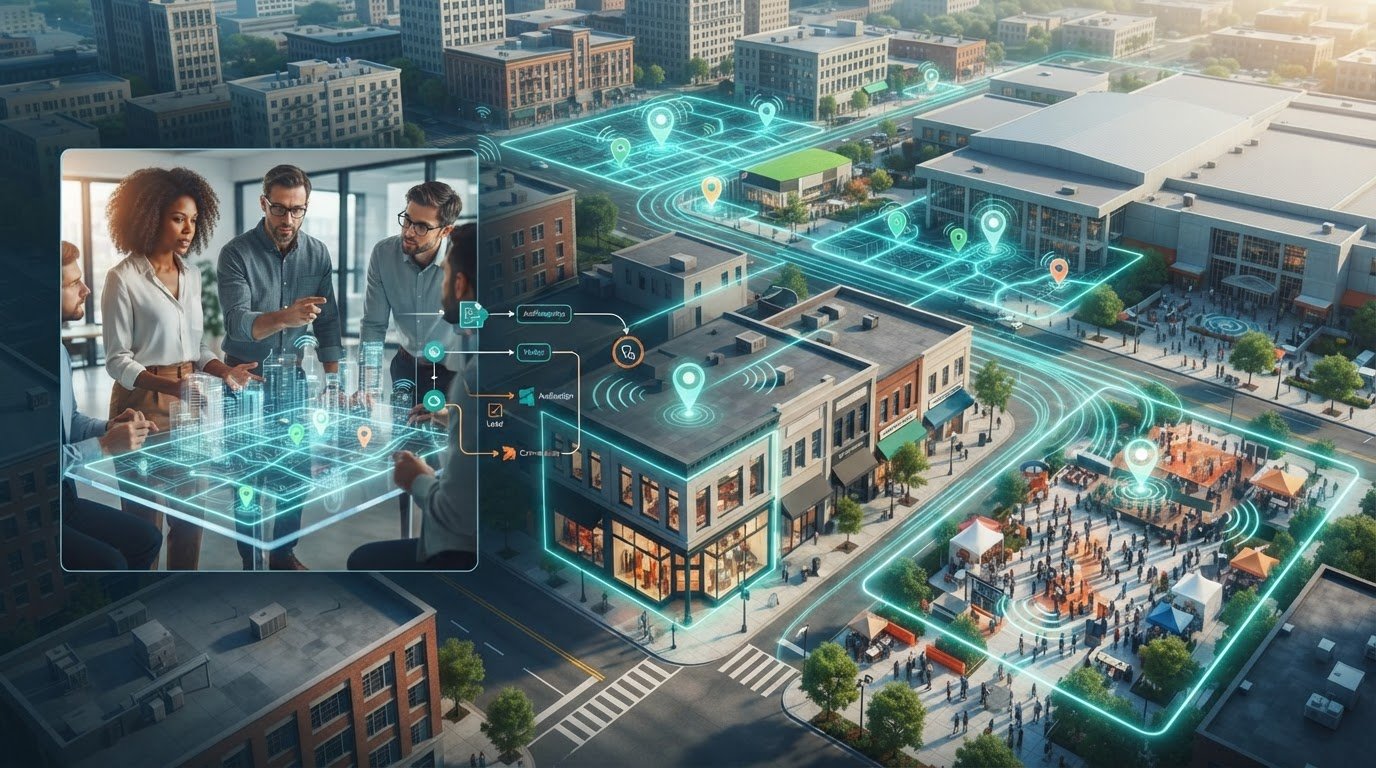
What if your next ad reached people while they were at a competitor’s location or attending an event your ideal customers care about? That’s the practical appeal of geofencing marketing for small business: set a digital boundary around a relevant place, then use location-based advertising to reach eligible mobile users detected there. Instead of treating every online audience as equally local or ready to act, you can focus on places connected to your offer.
If you’ve spent money on broad campaigns only to attract distant leads or receive few inquiries, more precise targeting may be worth testing. Geofencing can focus brand awareness on selected physical locations, but the boundary alone won’t turn interest into a lead. Your message and follow-up matter, too.
This 2026 guide explains how to target competitors, complementary businesses, and events, plus what to consider when choosing a geofence and measuring results. You’ll also see how geofencing can be an entry point to an automated funnel, connecting location-based ads with lead response and sales funnel development. The technology can feel complex, but a focused strategy makes it easier to put to work.
Key Takeaways
- Learn how geofencing marketing for small business uses location signals to reach potential customers near selected places.
- Choose target zones based on customer intent, then focus your campaign on locations more relevant than a broad audience.
- Compare competitor, complementary-business, and event targeting to find opportunities that fit your goals.
- Plan your virtual perimeter around the physical footprint you want to reach, and account for the limits of location-data accuracy.
- Connect geofenced ads to lead response and a sales funnel so interested prospects have a clear next step.
What is Geofencing Marketing for Small Business?
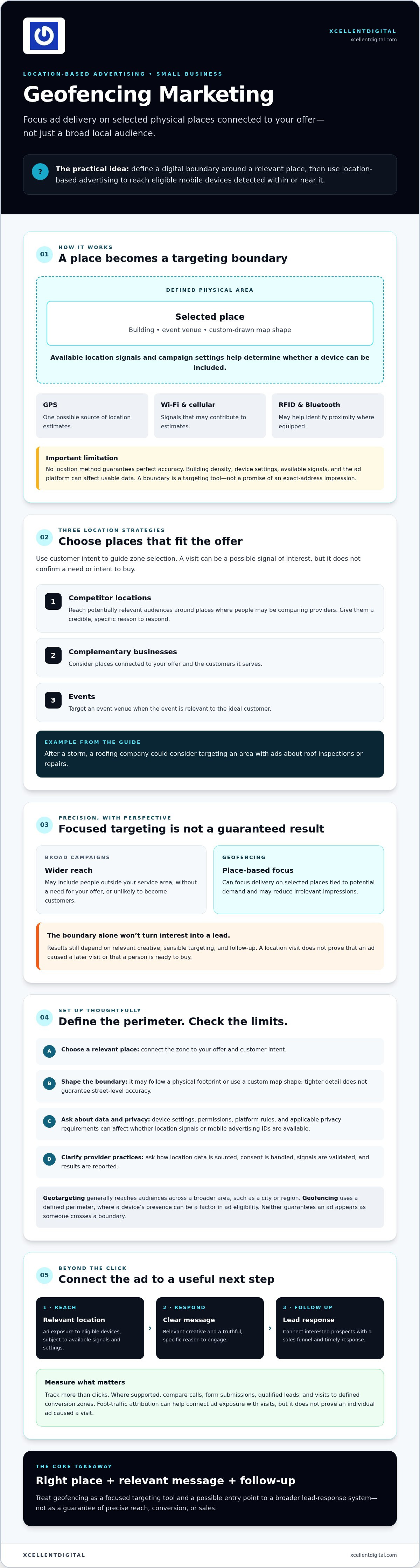
Geofencing marketing for small business uses a virtual boundary around a physical place to help deliver digital ads to eligible mobile devices detected within or near that area. The boundary might follow a building, event venue, or custom map shape. The ad platform uses available location signals and campaign settings to determine whether a device can be included. For a neutral overview of the concept, see What is a Geofence?
Location estimates can draw on GPS, Wi-Fi, and cellular signals. RFID or Bluetooth beacons may also help identify proximity in settings equipped with that hardware. These methods work differently, and none guarantees perfect location accuracy. For example, a roofing company could consider targeting an area after a storm and showing ads about roof inspections or repairs. The campaign still needs a relevant audience, a clear message, and a useful next step.
Marketers can define tighter map boundaries, including custom-drawn shapes, rather than relying only on broad ZIP-code targeting. Greater detail can make a campaign more relevant, but street-level precision isn’t automatic. Building density, device settings, available signals, and the advertising platform can all affect what location data is usable. Treat the boundary as a targeting tool, not a promise that every impression reaches someone at an exact address.
The Difference Between Geofencing and Geotargeting
Geotargeting generally uses location information to reach audiences across a broader area, such as a city or region. Geofencing focuses on a defined perimeter and can make a device’s presence in that area a factor in ad eligibility. It doesn’t guarantee an ad appears the moment someone crosses the boundary. For small businesses, the benefit is focus: spend less effort reaching people outside the places tied to your offer, then measure whether the audience responds.
How Mobile Ad IDs Drive the Technology
Mobile advertising IDs, or MAIDs, are identifiers some advertising systems use to recognize a device for ad delivery and measurement. They are not a person’s name, but that doesn’t make location data automatically anonymous or private. Device settings, permissions, platform rules, and applicable privacy requirements can affect whether location signals or identifiers are available. Before launching, ask your provider how its data is sourced, how consent is handled, and what privacy practices apply.
“Blue Dot” usually refers to the location marker people see in a map app. It can illustrate estimated device location, but it isn’t a guarantee of advertising accuracy or a special geofencing standard. Ask how the campaign validates its location signals and reports results. A capable partner can manage the technical setup, making geofencing an entry point to a broader lead response and sales funnel rather than a disconnected ad tactic.
The ROI Advantage: Why Precision Beats Broad Targeting
Broad campaigns can reach people outside your service area, with no need for your offer, or who are unlikely to become customers. Geofencing marketing for small business can narrow the audience by focusing ad delivery on selected places connected to potential demand. It may reduce irrelevant impressions, but it can’t guarantee that everyone reached is ready to buy. Results still depend on relevant creative, sensible targeting, and follow-up.
That precision can matter to service firms as much as retailers. A business with a considered, higher-value purchase may want to reach potential customers while they’re evaluating providers, not only when they search online. Someone visiting a competitor’s location might be comparing options, though a visit alone doesn’t confirm their needs or intent to buy. Treat it as a possible signal, then give the audience a credible reason to respond.
Targeting Intent Over Keywords
A search can show what a person is looking for in that moment. A physical visit can offer a different clue about what they may be considering. Intent-based geofencing uses visits to selected locations as a signal for reaching potentially relevant audiences with timely advertising. For example, a service firm could test a campaign around competitor locations, then compare qualified inquiries with results from broader targeting. Keep the message truthful and specific. The FTC’s truth-in-advertising rules are a useful reference for making claims you can support.
Measure more than clicks. Where the platform supports it, track visits to defined conversion zones alongside calls, form submissions, and qualified leads. Foot-traffic attribution can help connect ad exposure with physical visits, but it doesn’t prove that an individual ad caused a visit. Use these signals together to assess performance, adjust the audience, and decide whether the campaign is earning its place in your budget.
Scaling Nationally with Localized Precision
Service firms operating across multiple markets can apply a consistent strategy to selected locations in each market, then tailor target zones and messages to local conditions. Keep the brand voice and offer recognizable while making each campaign relevant to its audience. Start with a manageable test, review lead quality and conversion-zone activity, and expand based on evidence rather than assumptions.
Geofencing can be the entry point to a broader system. Connect ad engagement with lead response and sales funnel development so interest has a next step. For ideas on coordinating growth across markets, explore small business digital growth strategies. XcellentDigital can help manage the technical complexity of geofencing and lead response automation, so business owners can keep their attention on operations.
3 Core Geofencing Strategies for Maximum Impact
Geofencing works best when each perimeter has a clear purpose. For service firms, that might mean reaching potential customers comparing providers, connecting with event attendees, or reminding existing customers about your business. Choose a strategy based on the audience and the next action you want, then judge it by lead quality, not just ad views.
The Art of Competitor Conquesting
Competitor conquesting places a virtual boundary around rival locations so eligible visitors can become part of an ad audience, subject to the platform’s capabilities and privacy rules. A visit doesn’t prove someone is unhappy or ready to switch. Avoid guessing at their pain points. Instead, explain what your business genuinely offers, such as a clear process or a distinct service benefit. Test the message and track qualified responses. This approach can help you compete for attention, but it doesn’t guarantee fast market-share gains.
Build the campaign around the customer’s decision stage: show a concise offer or useful next step, then connect responses to lead follow-up. For instance, a professional service firm might invite prospects to request an assessment rather than rely on a vague “choose us” message. Keep claims supportable and the offer relevant to the audience.
Event-Based Geofencing for B2B and Services
Trade shows, conventions, and industry gatherings bring together people with shared interests, making them potential audiences for timely campaigns. Align ads with event dates and hours, and match the message to what attendees may be evaluating. If the platform supports audience retargeting, ask how long event-based audiences remain available; a 30-day follow-up window isn’t universal. Some platforms may also support lookalike audiences based on a suitable high-value audience, but availability and audience rules vary. Review this geofencing strategy reference as a starting point, then confirm available campaign options with your advertising provider.
Retention and Complementary-Location Fencing
Loyalty fencing can remind existing customers about your business when they’re near your office or another relevant location. Keep the message helpful and don’t assume every nearby customer needs an offer. Proximity fencing reaches potential customers around complementary businesses. A mortgage broker, for example, might consider relevant real estate offices. Choose locations because they connect to a real customer journey, not simply because they’re busy.
For geofencing marketing for small business, start with one audience and a measurable next step. Compare results before adding more fences. XcellentDigital can help connect geofencing with lead response automation and sales funnel development through its geofencing marketing support.
The Technical Blueprint: Setting Up Your Virtual Perimeter
You don’t need a large IT department to plan a geofencing campaign. Start with a clear audience, a useful message, and a way to judge results. These steps keep the setup focused on your business goal:
- Choose target zones. List competitor locations, events, or relevant business hubs connected to your ideal customers. Prioritize places with a clear reason for your audience to be there.
- Set the boundary. A radius of 100 to 500 feet can be a starting range for testing, but the right size depends on the location, available signals, and campaign platform. Use a tighter boundary where practical, and check whether it includes the audience you want.
- Build the creative. Prepare concise display or social ad creative that connects the location to a relevant offer and a clear next step.
- Define a conversion zone. Decide what counts as a result, such as a website inquiry, call, or visit to a selected physical location. Confirm how your provider measures it and what attribution can and can’t show.
- Launch and optimize. Monitor engagement and lead quality. Adjust the audience, boundary, or message based on evidence rather than changing everything at once.
Choosing the Right Ad Platforms
Facebook and Instagram may be useful channels for location-informed campaigns, depending on available targeting options and how the campaign is set up. Confirm with your provider which platforms can use your chosen location audience; don’t assume they all support the same geofencing features. For a practical overview of Facebook advertising for local businesses, read this Facebook Ads guide for local business. You can also coordinate location-based campaigns with a pay-per-click strategy, including PPC for contractors, to support different points in the customer journey.
Creative That Converts
Use a location signal only when it’s accurate and appropriate. Phrases like “Visiting [Industry Event]?” can make an ad feel timely, while “Right around the corner?” should appear only when it truthfully reflects the business and offer. Give people one clear next step, such as requesting information or viewing a relevant service page. Test static and video formats if your platform supports both, then compare meaningful outcomes, not just views.
Geofencing marketing for small business works best when targeting, creative, and measurement connect. To discuss campaign planning, explore XcellentDigital’s geofencing support.
Beyond the Click: Integrating Geofencing with AI Lead Automation
An ad impression isn’t a lead. A location-based campaign can attract attention, but prospects may move on if the next step is hard to find or nobody responds to their inquiry. For geofencing marketing for small business to contribute to sales, connect the campaign to a clear path from response to follow-up to appointment.
A device entering a geofence doesn’t automatically give your business a person’s contact details. A prospect becomes a lead when they take an action, such as submitting a form or calling. Once they do, lead response automation can help acknowledge the inquiry, collect relevant information, and route it for follow-up according to your process. AI agents can support those steps, but configure a handoff to a person for questions or situations that need human judgment.
Instant Engagement with Lead Response Automation
Owners and teams can be busy serving customers, which can leave a new inquiry unanswered. An automated first response can confirm receipt and explain what happens next, while a high conversion sales funnel can guide prospects toward booking or another appropriate action. Avoid assuming faster responses will produce a particular conversion lift. Track response times, qualified inquiries, and appointments to understand what improves your results. Explore this business growth and automation framework for more on connecting marketing with follow-up.
Make each touchpoint useful, not repetitive. A simple sequence might acknowledge the request, answer common questions, and invite the prospect to schedule or speak with your team. Set timing, messaging, and handoff rules to fit your staffing and customer expectations. Automation should support your team, not imply round-the-clock availability unless you can provide it.
Closing the Loop with Reputation Management
After a completed service, invite the customer to share an honest review through an appropriate follow-up. Don’t assume that crossing a location boundary proves a purchase or qualifies someone for a review request. Keep the invitation neutral and follow the platform’s policies. A well-maintained Google Business Profile can help potential customers find accurate business information and evaluate your reputation as they consider reaching out.
Geofencing is an entry point, not the whole sales engine. XcellentDigital connects geofencing with AI lead response and sales funnel development to help manage the technical pieces. Explore XcellentDigital’s geofencing and automation services.
Turn Precise Targeting Into Steady Growth
Geofencing marketing for small business can help focus advertising on relevant physical locations, but the boundary is only the starting point. Choose target zones with a clear purpose, create messaging that fits the audience, and measure meaningful outcomes such as qualified inquiries and visits to conversion zones.
Follow-through matters. Connect geofencing to lead response automation and a sales funnel so interested prospects have a clear path toward taking action. For a step-by-step approach to making sure each handoff is working, review this high-conversion sales funnels checklist for small businesses. XcellentDigital brings together geofencing, funnel development, and AI-powered lead response to help manage the technical complexity while you focus on operations. Track results against your goals, refine what isn’t working, and build on what does.
Ready to make your location-based campaigns more purposeful? Contact XcellentDigital to discuss a geofencing strategy and how a connected approach could support your growth.
Frequently Asked Questions
Is geofencing marketing legal and compliant with privacy laws in 2026?
Geofencing can be used for advertising, but compliance depends on how location data is collected, used, and shared, as well as the laws that apply to your audience and campaign. Requirements can vary by state and change over time. Ask your advertising provider how it sources location data, handles consent and opt-outs, and protects information. Before launching, review current requirements with qualified legal counsel, especially if your campaign uses precise location data.
How much does geofencing marketing cost for a small business?
There’s no single price for geofencing marketing for small business. Total spend can depend on the advertising platform, audience size, locations, ad format, campaign management, and any platform minimums. Ask providers to separate media spend from management or technology fees, and confirm whether a minimum budget applies. Request a written plan that explains expected deliverables and how results will be measured. Compare proposals based on fit and transparency, not just the lowest quoted amount.
What is the minimum radius for an effective geofence?
There isn’t one minimum radius that works for every location or platform. A small boundary may suit a distinct venue, while a larger or custom-drawn shape may be more practical for a complex site. Accuracy depends on available location signals, device settings, and the provider’s data. Start with the physical footprint you want to reach, ask how the platform handles boundaries, and test before expanding. Don’t treat a radius as a guarantee of exact-location targeting.
Can I use geofencing to target my competitors’ customers?
You can use competitor-location targeting where your advertising platform and provider support it, but a location visit doesn’t identify someone as a competitor’s customer or prove they’re ready to switch. It also doesn’t give you their identity or contact details. Use a truthful ad that explains your own value and offers a clear next step. Then measure qualified responses and follow platform rules and applicable privacy requirements. Treat conquesting as an audience strategy, not a guaranteed way to win customers.
Do people need to have their GPS turned on for geofencing to work?
Not always. Depending on the technology and campaign setup, location signals may come from GPS, Wi-Fi, or cellular data, and some environments use other tools such as Bluetooth beacons. Whether a device can be included depends on its settings, permissions, available signals, and the advertising platform. Ask your provider which sources it uses and how it checks location quality. No method guarantees that every device inside a boundary will be detected or eligible to receive an ad.
How do I measure the ROI of a geofencing campaign?
Measure outcomes connected to your business goals, not clicks alone. Track campaign spend alongside inquiries, calls, qualified leads, booked appointments, and, where supported, visits to a defined conversion zone. Ask how the provider attributes visits and what limitations apply; an attributed visit doesn’t prove an ad caused it. Compare results with your baseline and assess lead quality and sales outcomes. Use those findings to refine the audience, message, and follow-up process.
Does geofencing work for service-based businesses without a storefront?
Yes. A storefront isn’t required because a campaign can target relevant locations such as competitor sites, industry events, or complementary business hubs. A service firm can direct people to a form, phone call, or another digital next step instead of relying on walk-ins. Define what counts as a qualified inquiry and make sure your follow-up process is ready. Geofencing can attract attention, but it won’t supply contact information unless a prospect chooses to respond.
How is geofencing different from Facebook’s standard location targeting?
Standard location targeting generally reaches an audience associated with a selected geographic area, depending on the platform’s options. Geofencing focuses on a defined perimeter and uses location signals as part of ad eligibility or audience creation. Features vary by platform and provider, so confirm what Facebook Ads can support for your campaign before planning around a specific fence. In either case, location targeting doesn’t guarantee that every person in an area sees your ad.












Leave a Reply
Want to join the discussion?Feel free to contribute!