

Automated Sales Funnel Development: The Complete 2026 Strategic Guide
Ad clicks don’t generate revenue; responsive conversion systems do. If you’re pouring marketing budget into paid traffic only to watch high-intent prospects leak away before booking an appointment, you know how frustrating the drop-off can be. When follow-up lags, eager buyers move straight to faster competitors, leaving your sales reps buried under manual outreach to unqualified tire-kickers. True pipeline growth requires modern automated sales funnel development: building an infrastructure that connects advertising directly to instant, structured qualification.
You shouldn’t have to choose between burning out your sales team and losing qualified deals to delayed response times. This strategic guide shows you how engineered automated sales funnels eliminate lead drop-off, optimize speed-to-lead across digital channels, and scale conversions around the clock without extra manual overhead. We’ll examine the technical architecture, conversational AI agents, and CRM workflows required to transform fragmented campaigns into a unified, predictable customer acquisition engine.
Key Takeaways
- Master modern automated sales funnel development by shifting from static, leaky landing pages to dynamic, event-triggered prospect journeys.
- Discover how conversational AI agents and instant response workflows capture high-intent buyers before competitors can react.
- Compare rigid, off-the-shelf SaaS template builders against custom API-driven architectures built for high-speed performance and reliable conversion tracking.
- Execute a structured deployment framework that unites paid ad traffic, automated pre-qualification, and direct CRM calendar bookings.
- Eliminate manual prospecting drain by filtering out unqualified tire-kickers and delivering sales-ready opportunities directly to your team.
What Is Automated Sales Funnel Development in 2026?
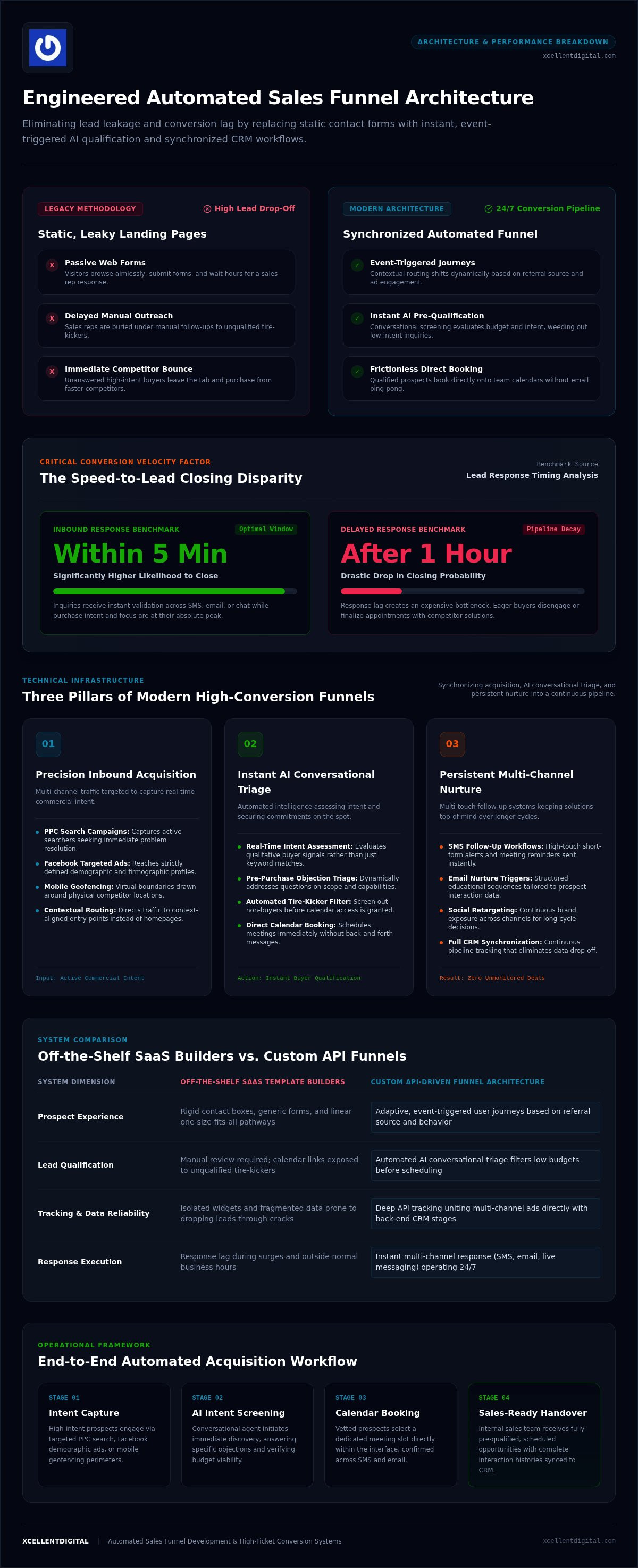
Modern automated sales funnel development is not about slapping an email capture box onto a generic web page. It is the deliberate engineering of a self-operating customer acquisition pipeline. Decades ago, the traditional marketing model mapped out a simple linear progression from awareness to purchase. Today, buyer intent is fragmented, dynamic, and impatient. Static websites ask visitors to browse aimlessly, submit passive web forms, and wait hours for a sales rep to reach out. When you rely on that outdated process, prospects simply bounce to the next tab.
In contrast, an engineered automated funnel operates as a synchronized conversion system. It connects targeted traffic directly to event-triggered journeys, filtering inquiries and initiating conversations without manual intervention. By blending behavioral data, immediate qualification, and conversational technology, an automated funnel works continuously. Your business captures demand and schedules qualified appointments at scale, day or night.
Moving Beyond Static Landing Pages to Dynamic Journeys
Static landing pages create friction. When high-value prospects hit a rigid contact form, conversion rates plummet because generic forms fail to answer pressing questions in real time. Dynamic funnels solve this problem by adapting to user behavior on the spot:
- Contextual pathways: The user journey shifts based on referral source, ad copy, and specific interaction points.
- Intelligent qualification: Automated screening logic weeds out low-budget inquiries and tire-kickers before they ever reach your calendar.
- Frictionless scheduling: High-intent buyers are guided directly toward booking a dedicated meeting with your team.
The Role of Speed-to-Lead in Modern Pipeline Growth
Speed wins deals. Reaching an inbound prospect within five minutes makes a deal significantly more likely to close than waiting even an hour. Yet manual outreach workflows guarantee response lag, especially during high-traffic surges or outside standard business hours. Relying on humans to comb through inboxes is an expensive bottleneck.
Strategic automated sales funnel development eliminates this delay completely. By deploying intelligent lead response automation, your system instantly acknowledges inbound inquiries across SMS, email, and live messaging. Prospects receive immediate validation, answers to primary qualification criteria, and confirmed bookings while their buying intent is at its peak.
Core Components of High-Conversion Automated Sales Funnels
A high-performing funnel is not a single tool. It is an interconnected conversion system where acquisition, qualification, and relationship management operate in lockstep. Many software providers treat conversion as nothing more than an isolated live chat widget or an internal task board. Real-world sales acceleration requires much more. A modern sales funnel must tie multi-channel ad delivery directly to automated qualification and back-end pipeline tracking. When each moving part communicates seamlessly, leads no longer slip through technical cracks.
Executing end-to-end automated sales funnel development requires synchronizing three vital operational pillars. Here is how high-converting systems unite inbound intent with immediate conversion actions:
Precision Inbound Acquisition: Ads, Search, and Geofencing
Targeted traffic drives the entire funnel engine. Running Pay Per Click search campaigns captures prospects actively seeking immediate solutions, while high-converting Facebook Ads target defined demographic profiles. Layering geofencing marketing for small business lets you draw digital perimeters around specific physical locations, delivering pinpoint ads to people visiting relevant venues or competitor hubs. Traffic routing logic then steers these visitors to custom, context-aligned entry points instead of a generic homepage.
Instant AI Lead Response and Conversational Triage
Inbound inquiries demand instant attention. Modern conversational AI agents handle prospect triage the moment someone opts in, asking targeted discovery questions and answering detailed pre-purchase objections naturally. Because these agents assess intent rather than scanning for basic keywords, they separate serious buyers from casual browsers. Qualified leads are directed straight into automated calendar booking, securing sales calls without back-and-forth email tag.
Persistent Multi-Channel Lead Nurturing Workflows
Most prospects need time before making high-ticket purchasing decisions. Automated nurture sequences keep your brand top-of-mind across SMS, email, and social retargeting without relying on your sales reps to remember manual follow-ups:
- Behavior-triggered messaging: Sends relevant case studies based on which resources the prospect viewed.
- Cross-channel balance: Blends high-open SMS messages for urgent scheduling reminders with detailed emails for deeper proof.
- Automated re-engagement: Triggers internal sales notifications the moment a dormant contact returns to your site.
Every response, click, and interaction logs straight into your centralized CRM. If you want an acquisition engine configured to capture and close prospects around the clock, exploring specialized sales funnel development can turn scattered traffic into an organized, predictable booking system.
Custom Funnel Architecture vs. Off-the-Shelf SaaS Builders
Every growing business eventually faces a platform crossroad: rent a generic, drag-and-drop template builder or invest in a custom conversion stack. Off-the-shelf SaaS platforms promise plug-and-play simplicity. For basic lead capture, they work fine. But as paid advertising budgets expand and operational requirements grow more complex, these closed systems hit a conversion ceiling. True automated sales funnel development requires an architecture designed around your specific sales cycle, not the technical limits of a shared software platform.
Evaluating your options comes down to an objective assessment of speed, ownership, and technical flexibility. Here is how off-the-shelf builders compare to custom-engineered conversion systems.
Limitations of Template-Based Funnel Builders
Template builders prioritize ease of use for the mass market over raw conversion performance. That trade-off introduces three significant operational risks:
- Code bloat and latency: Visual page builders inject heavy scripts and styling files that slow down mobile page load times. Every extra second of latency directly inflates paid ad bounce rates.
- Restricted integration logic: Pre-built platforms often limit webhook flexibility and API triggers, preventing conversational AI agents from accessing deep customer records or performing multi-step lead triage.
- Platform vulnerability: Hosting your critical sales pipeline on shared third-party servers means platform outages immediately shut down your ad traffic, burning your ad spend while prospects see error screens.
Engineered Automation Stacks: Flexibility, Attribution, and Speed
A custom-engineered conversion architecture separates front-end presentation from back-end automation. This headless approach gives you total data control and superior execution speed. Lightweight front-ends deliver near-instant loading on mobile devices, keeping prospective buyers engaged from the first click.
Behind the scenes, direct server-side API connections pass clean attribution data directly into your CRM. Rather than guessing which ad campaign produced a closed deal, your attribution remains accurate despite tightening browser privacy controls. Custom logic branching lets you tailor lead qualification dynamically; if your calendar is full, your automated sales funnel development stack can automatically raise qualification thresholds or route inquiries to waitlists. You end up owning an enterprise-grade digital asset rather than renting space in a restricted ecosystem. Applying a structured approach to conversion rate optimization for funnels at this stage ensures your custom architecture consistently converts at its highest potential rather than leaving revenue on the table.
How to Plan and Deploy an Automated Sales Funnel
Launching a high-performing conversion engine requires a structured deployment roadmap. Rushing campaigns live before your back-end automation is dialed in leads to lost ad spend and dropped opportunities. A methodical rollout eliminates technical friction, aligns your marketing assets with real sales activity, and protects prospective buyers from falling through the cracks. Here is the four-phase framework required for successful automated sales funnel development.
Mapping Buyer Triggers and Conversion Gateways
Start by auditing where your prospects historically drop out of your sales process. Are they bouncing from your form, ignoring initial emails, or ghosting booking links? Once you isolate those points of friction, design your conversion gateway to meet their exact level of intent:
- Targeted entry points: Match ad creative directly to dedicated, problem-specific landing interfaces.
- Progressive disclosure: Gather essential contact info first, then ask qualifying questions step by step.
- Value-first positioning: Offer direct answers, pricing insights, or case studies before demanding a full appointment commitment.
Configuring Multi-Channel Speed-to-Lead Workflows
Next, engineer your engagement protocol to trigger the moment an opt-in occurs. Set up automated two-way SMS messaging to open an immediate dialogue with the lead. Pair this with conversational AI agents capable of confirming project details, handling preliminary questions, and sending direct scheduling links.
Build safety nets directly into the workflow. If an inquiry meets predefined VIP criteria or asks a question that requires human expertise, your automation should trigger an instant notification to your team. Your staff steps in seamlessly without the prospect ever sensing a clunky handoff.
Auditing Data Hygiene and Attribution Tracking
Before launching ad traffic, test the entire ecosystem end to end. Verify that server-side tracking pixels pass accurate event data back to your advertising channels to support algorithmic optimization. Confirm that contact records, tags, and stage updates populate your CRM without data formatting errors.
Submit simulated test leads across multiple mobile operating systems and browsers. Watch how the messages fire, test calendar bookings, and ensure reminder sequences work smoothly. If you need an acquisition system built from the ground up to capture and qualify buyers instantly, partner with XcellentDigital to build your automated funnel and scale your client pipeline with precision.
Scaling High-Ticket Conversions with XcellentDigital
High-ticket acquisition isn’t solved by stringing together disconnected software tools. Sustainable pipeline growth demands the seamless alignment of compelling messaging, laser-focused paid media, and intelligent conversion automation. When any single piece fails, your cost per acquisition spikes and valuable opportunities slip away. XcellentDigital bridges this gap by engineering end-to-end automated acquisition systems built specifically for growing businesses ready to scale.
Instead of forcing your business into rigid, cookie-cutter templates, we engineer bespoke growth infrastructure. Our systems unite high-intent customer acquisition with real-time lead response automation, ensuring no prospective buyer is left waiting.
Turnkey Funnel Architecture Backed by Specialized Automation
Building an effective conversion pipeline requires specialized technical execution. We handle the entire build from initial blueprint to final live launch:
- Targeted traffic integration: We align high-performing Facebook Ads, targeted Pay Per Click campaigns, and localized geofencing marketing for small business to feed qualified buyers directly into custom landing environments.
- Conversational AI agents: Our systems deploy intelligent AI Agents that engage inbound prospects in seconds, qualifying leads and answering critical questions on the spot.
- Unified CRM scheduling: Direct calendar integrations route pre-vetted prospects straight to your team, keeping sales reps focused entirely on closing high-value deals.
Continuous Funnel Optimization and Revenue Growth
Deployment is just the starting line. True automated sales funnel development requires continuous data refinement to maintain peak performance. We analyze every stage of your conversion pipeline, testing headline messaging, interface layouts, and automated follow-up cadences to consistently lift conversion rates.
Clean server-side attribution ensures you always know which traffic sources and creative angles generate closed revenue. That transparency eliminates marketing guesswork, allowing you to invest ad spend with complete confidence. Stop letting manual response bottlenecks and fragmented software drain your pipeline. Partnering with a dedicated growth ally transforms your digital marketing into a scalable, high-converting customer acquisition engine.
Transform Your Pipeline into a High-Speed Conversion Engine
Relying on manual follow-up workflows and disconnected marketing tools costs you qualified buyers every single day. Sustainable revenue growth demands engineered automated sales funnel development: a conversion infrastructure that bridges targeted paid advertising directly to conversational AI qualification. By eliminating speed-to-lead bottlenecks and filtering out unqualified tire-kickers instantly, you protect your ad spend and deliver pre-vetted, sales-ready opportunities straight to your sales team.
XcellentDigital brings a proven national track record of designing custom customer acquisition pipelines for ambitious service enterprises. Our full-stack integrations unite targeted advertising, instant AI lead response, and automated calendar scheduling into a single, cohesive engine. Stop letting high-intent prospects slip away to faster competitors. Scale Your Pipeline with XcellentDigital’s Automated Funnel Systems and build an acquisition asset that drives predictable revenue around the clock.
Frequently Asked Questions
What is automated sales funnel development?
Automated sales funnel development is the process of engineering a self-operating customer acquisition pipeline that captures, qualifies, and schedules prospects without manual staff effort. Instead of relying on passive static forms, an automated funnel synchronizes targeted traffic, conversational qualification, and automated CRM routing. The goal is simple: eliminate lead drop-off and convert cold ad clicks into confirmed sales appointments around the clock.
How quickly should an automated sales funnel respond to new inbound leads?
Inbound leads should receive an initial response within two minutes of submitting an inquiry. Research shows contacting prospects within five minutes dramatically increases your chance of closing the sale compared to delayed outreach. Deploying automated response workflows ensures high-intent buyers receive instant SMS or conversational engagement while their buying urgency is highest, long before a competitor can step in.
Can automated sales funnels integrate directly with our existing CRM platform?
Yes, an engineered funnel integrates directly into your existing CRM through secure APIs and webhooks. Every prospect touchpoint, conversational qualification note, and scheduled appointment syncs automatically to your contact records in real time. This gives your sales team full visibility into buyer intent and paid traffic attribution without requiring tedious manual data entry or jumping between disconnected software platforms.
Will conversational AI response feel impersonal or robotic to high-ticket clients?
Not when configured correctly. Modern conversational AI agents understand context and nuanced buyer intent rather than following rigid, robotic scripts. They answer complex questions, address initial objections, and collect essential project parameters in a helpful, natural tone. High-ticket clients appreciate getting clear, accurate guidance immediately instead of waiting days for an email reply or sitting on hold.
What is the difference between a website and an automated sales funnel?
A website acts as a digital storefront offering broad company information, service lists, and multiple navigation paths. While professional solutions like web design Columbus Ohio establish vital brand identity and broad online reach, an automated sales funnel is engineered with a single goal: guiding visitors through a structured conversion sequence. By removing confusing navigation and focusing attention on a specific call to action, funnels consistently produce higher conversion rates than multi-page corporate websites.
Paid channels provide targeted inbound fuel for your conversion system. Running Pay Per Click and Facebook Ads captures active search intent, while geofencing targets prospects in precise physical locations. Instead of sending this paid traffic to an unfocused homepage, automated sales funnel development routes each audience segment directly to context-matched landing environments and instant AI qualification workflows.
How long does it take to build and deploy a custom automated sales funnel?
Deploying a custom automated funnel typically takes between two and four weeks, depending on technical complexity and integration requirements. This timeframe includes auditing buyer triggers, designing high-speed conversion interfaces, connecting conversational AI agents, and integrating your CRM. Rigorous testing across devices and browsers ensures every workflow, pixel, and calendar link operates flawlessly before paid traffic goes live. For organizations seeking specialized expertise in building high-converting web assets and automated follow-up systems, visit Amadeus Avleka.













Leave a Reply
Want to join the discussion?Feel free to contribute!