

Conversion Rate Optimization for Funnels: The High-Yield Framework
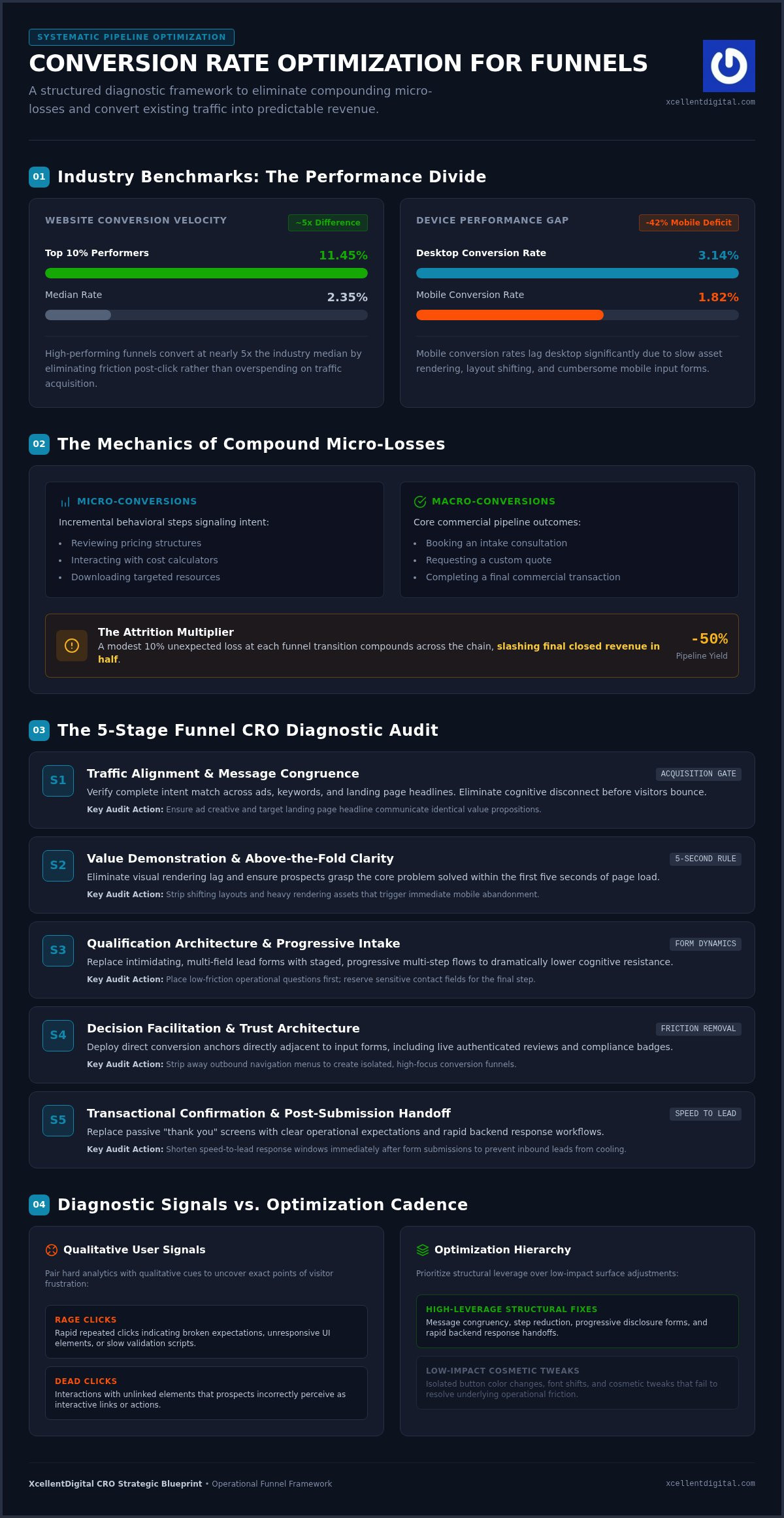
The top 10% of websites convert at 11.45%, which is nearly five times higher than the median rate of 2.35%. If you aren’t seeing those numbers, you already know the frustration. You pour hard-earned budget into paid ads, only to watch qualified prospects bounce before filling out a form or go cold before your sales team can follow up. True conversion rate optimization for funnels isn’t about tweaking button colors. It’s about systematically eliminating friction points after the click, where disconnected tracking and delayed outreach quietly drain your bottom line.
You don’t need a larger ad budget to drive more revenue; you need a tight operational system that captures and converts the interest you already have. In this guide, you’ll master a repeatable framework to audit, diagnose, and optimize every stage of your sales pipeline for maximum lead-to-revenue performance. We’ll examine the exact diagnostic steps, practical benchmarks, and automated backend adjustments that turn raw clicks into predictable, closed-won deals.
Key Takeaways
- Apply structured conversion rate optimization for funnels to eliminate compounding micro-losses across every step instead of overspending on ad traffic.
- Deploy a standardized five-stage diagnostic audit to uncover hidden message mismatch and friction points from ad click to checkout.
- Pair hard quantitative analytics with qualitative user signals, such as rage clicks and dead clicks, to pinpoint why prospects abandon your pages.
- Shorten your speed-to-lead response window immediately after form submissions to prevent warm inbound leads from going cold.
- Establish a disciplined testing cadence that prioritizes high-leverage structural adjustments over low-impact cosmetic tweaks.
Deconstructing the Modern Funnel: Where Most Conversions Vanish
Most underperforming marketing campaigns don’t suffer from a traffic shortage. They suffer from compound micro-losses. As defined by Conversion rate optimization (CRO), the process focuses on increasing the percentage of visitors who complete a desired action. When applied to multi-step user journeys, effective conversion rate optimization for funnels represents the systematic elimination of friction across every progressive touchpoint. Evaluating an isolated landing page rate gives an incomplete picture; real business growth depends on holistic throughput velocity from the initial click down to closed revenue.
The Anatomy of Funnel Attrition
Funnel drop-off happens in stages. First, an ad makes a bold promise, but the landing page delivers a mismatched headline. The prospect experiences cognitive disconnect and bounces. Next comes micro-commitment friction. When an early-stage visitor faces a seven-field form demanding intrusive details, cognitive load overwhelms initial interest. They leave. Understanding these leak points requires separating your metrics into two distinct categories:
- Micro-conversions: Incremental actions signaling intent, such as reviewing pricing structures, engaging with an interactive calculator, or downloading a resource.
- Macro-conversions: Core commercial outcomes that directly fuel sales pipelines, such as booking an intake consultation, requesting a custom quote, or completing a transaction.
Every tiny hesitation at a micro-step kills the macro-outcome before the prospect ever reaches your sales team.
The High Cost of the Broken Funnel
A leaky funnel is expensive. Minor percentage drops at each step compound quietly, causing customer acquisition costs to spike. Consider a typical journey: paid search ad to landing page, landing page to lead capture, and lead capture to scheduled call. If you lose 10% more prospects than expected at each transition, your pipeline doesn’t shrink by 10%. The loss multiplies across the chain, slashing your final conversions in half.
Pouring more budget into Pay Per Click campaigns or Facebook Ads under these conditions won’t solve the issue. In fact, scaling traffic into an uncalibrated pipeline merely burns capital faster. The solution requires fixing the underlying plumbing first. Align message intent, strip away unnecessary form fields, and establish instant response mechanisms to turn existing traffic into profitable pipeline growth.
The 5-Stage Funnel CRO Audit Template: A Systematic Diagnostic Framework
Most CRO tool tutorials focus on tracking platform settings rather than practical strategy. To diagnose pipeline leaks accurately, you need an operational framework that inspects friction from ad click to final sale. Successful conversion rate optimization for funnels treats the entire path as a unified customer journey map, systematically auditing message coherence, user friction, and backend throughput.
Stage 1 & 2: Traffic Alignment and Value Demonstration
Start where your prospects arrive. Stage 1 verifies message congruence between your traffic sources and your destination pages. Your ad creative, search intent, and primary headline must match perfectly. If a visitor clicks an ad promoting “automated pipeline solutions” and lands on a generic homepage, they leave immediately. Mobile conversion rates in 2026 trail desktop by 42% (1.82% versus 3.14%), largely due to slow asset rendering and shifting layouts. Stage 2 eliminates visual lag and clarifies your above-the-fold value proposition so prospects grasp what you solve within five seconds.
Stage 3 & 4: Qualification and Decision Facilitation
Next, audit the mechanics of your decision architecture. Stage 3 restructures mid-funnel intake forms. Replace sprawling, intimidating lead forms with progressive multi-step flows. Ask low-friction operational questions first, reserving sensitive contact fields for the final screen. Stage 4 builds immediate trust directly beside those form inputs by deploying high-impact social proof:
- Live review widgets and authenticated client feedback
- Industry credentials and compliance certifications
- Dedicated distraction-free layouts with outbound navigation menus stripped away
Stage 5: Transactional Confirmation and Expectation Setting
Finally, inspect the critical post-submission handoff. Stage 5 replaces passive “thank you” pages with structured operational roadmaps. Tell new prospects precisely when and how your team will engage. Embed dynamic calendar widgets on confirmation screens to convert raw form submissions into confirmed discovery calls instantly. Implementing these systems is a core methodology of a modern business growth and automation agency, bridging the gap between web design and measurable pipeline yield.
If managing multi-stage audits feels complex, partnering with the specialists at XcellentDigital can help you identify post-click leaks and implement automated conversion architecture that drives measurable growth.
Quantitative Data vs. Qualitative Behavior: Pinpointing Exact Drop-Off Triggers
Quantitative data tells you where prospects abandon ship; qualitative behavior reveals why. Executing high-yield conversion rate optimization for funnels requires pairing both methodologies. A sudden drop-off on an intake page might stem from poor value messaging, or it could simply be a broken mobile script that freezes the submit button. Tracking both data layers removes the guesswork and exposes the exact obstacles stalling your pipeline throughput.
Quantitative Tracking: Metrics That Actually Matter
Track step-to-step completion velocity instead of fixating solely on broad landing page percentages. Monitor the exact time users spend progressing between stages. Segment your drop-off reports by device type, screen resolution, operating system, and browser to isolate technical barriers. Implement granular custom event tracking on critical interaction points:
- Call-to-action button clicks and validation errors
- Video view duration and milestone drop-offs
- Accordion toggles, pricing calculators, and FAQ expansions
Front-end qualification directly impacts your numbers. If you run paid social campaigns, explore our analysis of targeted facebook lead ads to diagnose whether misaligned targeting parameters are dumping low-intent clicks into your pipeline before the funnel even starts.
Qualitative Diagnostics: Reading Real Prospect Behavior
Visual behavior diagnostics provide the human context behind analytic charts. Heatmaps reveal whether visitors actually scroll down to consume your case studies, guarantees, and client proof. In many cases, the persuasive evidence your sales team relies on sits completely unseen below the fold.
Session recordings provide undeniable proof of user frustration. By reviewing sessions where prospects abandoned the funnel mid-stride, you can pinpoint specific behavioral friction markers:
- Rage clicks: Rapid, repetitive clicks on unresponsive buttons or non-clickable images
- Dead clicks: Taps on design elements that mimic interactive links, creating user confusion
- Mouse thrashing: Erratic, sweeping cursor movements indicating navigation disorientation
Combine these observations with form analytics to spot the precise input field where visitors pause and exit. If a required phone number field triggers 60% of your drop-offs, testing an optional format or delaying that question solves the issue instantly. For a structured approach to closing these gaps, review our high conversion sales funnels checklist to identify which handoffs in your pipeline need immediate attention.
Accelerating the Conversion Window: Why Speed to Lead Seals the Leaky Funnel
A landing page submission is merely an initial milestone; sales conversations finalize true funnel ROI. Traditional UX discussions treat form completion as the end of the line, but real revenue lives or dies in the minutes immediately following that click. True conversion rate optimization for funnels extends past visual design into automated backend response. If your team takes hours or days to follow up with inbound inquiries, you are actively leaking the very pipeline you spent marketing dollars to build.
The Five-Minute Rule and Intent Decay
Lead responsiveness decays rapidly. When prospects fill out an intake form, their attention is fully focused on solving their problem right then. Within five minutes of submitting, their willingness to engage is at its peak. Wait thirty minutes, and that prospect has opened three competing tabs, resumed a work meeting, or forgotten submitting the request entirely. Delaying outreach drops qualification rates dramatically and hands your pipeline directly to faster competitors.
Sealing this post-click gap requires immediate, automated engagement. Instant SMS confirmations, automated direct transfers, and immediate confirmation emails establish operational authority the second an inquiry arrives. When running targeted traffic campaigns, such as those detailed in our guide to facebook ads for local lead generation, combining front-end intent with rapid backend response turns casual curiosity into locked appointments. For businesses focused on reaching high-intent local audiences, geofencing marketing for small business offers a complementary strategy to target prospects at competitor locations or relevant events before they even reach your funnel.
Integrating AI Agents into the Conversion Architecture
Relying on manual staff response creates inevitable coverage gaps. Prospects submit forms late in the evening, over weekends, and during midday peak workflow hours. Conversational AI agents solve this bottleneck by stepping in instantly to bridge the gap between interest and scheduling.
- Instant inquiry triage: Answering immediate prospect questions and validating project requirements within seconds of form submission
- Automated pre-qualification: Filtering out low-intent submissions before routing high-value prospects directly onto sales team calendars
- Unified CRM synchronization: Logging conversational context into central databases so sales reps enter calls fully briefed
Instead of watching warm leads grow cold in a crowded inbox, upgrade your pipeline with modern automation. Discover how our Lead Response Automation and AI Agents can transform your website inquiries into real-time booked sales conversations today.
Building an Iterative Optimization Engine: Testing, Refining, and Scaling
Random button color experiments won’t scale your business. True conversion rate optimization for funnels demands a disciplined, hypothesis-driven testing engine focused on high-leverage structural adjustments. When you systematically audit your leak points and validate solutions against strict data criteria, small incremental wins compound into massive revenue shifts.
Hypothesis Formulation and Prioritization
Every test must begin with a clear, evidence-based hypothesis. Instead of guessing what might work, build your tests directly from the quantitative drop-offs and qualitative recordings you gathered during the diagnostic phase. Prioritize your testing backlog using the ICE scoring model:
- Impact: How dramatically will this change increase conversion volume if successful?
- Confidence: How strongly does our behavioral data support this specific solution?
- Ease: How fast and resource-efficient is this variation to build and deploy?
Structure each test around a declarative formula: “By modifying [specific step or element], we expect [quantifiable metric shift] because qualitative recordings revealed [specific user objection or friction point].” Direct your earliest tests toward heavy-hitting factors like restructuring core value offers, aligning headline promises with source search intent, or simplifying multi-step intake fields. Before finalizing your testing priorities, cross-reference your funnel structure against the 2026 small business checklist for building high conversion sales funnels to ensure each stage is set up to move prospects forward without unnecessary friction.
Execution Discipline and Scaling Wins
Disciplined execution separates high performers from teams running chaotic experiments. When deploying split tests, isolate traffic cleanly. Avoid launching concurrent marketing changes or switching paid ad targets mid-experiment, which can distort your baseline metrics. AI-driven testing platforms reach statistical significance 31% faster on average than legacy split-testing tools, but you must still collect adequate sample size before declaring a winner.
Once a test variant proves superior, record the outcome in a shared repository detailing the test duration, sample size, and psychological trigger that moved the needle. Then, roll out those proven messaging frameworks across your search and paid social campaigns. Navigating these split-testing protocols requires consistent technical oversight. Collaborating with a specialized small business digital growth agency helps maintain testing cadence, ensuring your sales pipeline continually refines and scales without burning internal resources.
Transform Your Sales Pipeline Into a Predictable Revenue Engine
Scaling revenue doesn’t require doubling your advertising spend. Sustainable growth begins when you plug the operational leaks that cause qualified prospects to slip through the cracks. Mastering structured conversion rate optimization for funnels means auditing every micro-commitment, pairing hard behavioral analytics with qualitative session recordings, and engaging inbound inquiries the moment they raise their hand.
When you unite multi-channel traffic across PPC and paid social with rapid backend follow-up, your entire pipeline becomes resilient and profitable. You eliminate wasted ad spend, accelerate sales response times, and create clear operational pathways that turn cold traffic into committed buyers. Don’t let high-intent prospects stall in disconnected tools or slow response queues. Take control of your pipeline metrics and turn your marketing traffic into high-converting sales funnels with XcellentDigital today.
Frequently Asked Questions
What is conversion rate optimization for funnels and how does it differ from single-page CRO?
Single-page CRO focuses on maximizing conversions on one isolated page, such as a standalone landing page or checkout screen. In contrast, conversion rate optimization for funnels evaluates throughput across the entire customer lifecycle. It identifies compound attrition from ad click to landing page, qualification form, calendar booking, and backend sales outreach, ensuring prospects don’t leak between transition points.
What is considered a good benchmark conversion rate across a multi-step sales funnel?
Across the web, the median website conversion rate sits around 2.35%, while top-decile performers achieve rates reaching 11.45%. For a multi-step lead generation funnel, aim for a 15% to 25% click-to-lead rate on dedicated landing pages. From there, target a 40% to 60% transition rate from initial lead capture to a scheduled sales discovery call.
How much traffic is necessary before running statistically valid funnel A/B split tests?
You generally need at least several hundred unique conversions per variation to establish statistically reliable conclusions. If your funnel processes under 1,000 monthly visits, quantitative split tests take months to reach significance. In low-traffic scenarios, prioritize qualitative diagnostics like user session replays, direct customer feedback, and major structural offer improvements rather than small split tests.
Where do most service business funnels experience their steepest conversion drop-off?
The steepest drop-off typically happens during the mid-funnel qualification handoff. Prospects frequently abandon lengthy, complex intake forms that demand intrusive contact details upfront. The second major leak occurs immediately after submission, where passive confirmation pages fail to provide dynamic calendar booking, letting hot intent cool down before sales teams engage.
Can conversion rate optimization reduce our overall customer acquisition costs?
Yes. By increasing the percentage of visitors who become paying clients, conversion rate optimization for funnels directly lowers your customer acquisition cost without requiring additional ad spend. Doubling your end-to-end funnel throughput effectively halves your acquisition costs across paid channels like Pay Per Click and Facebook Ads, making your marketing budget significantly more profitable.
How does speed to lead impact overall funnel conversion rates?
Response speed makes or breaks funnel throughput. Contacting a warm inbound prospect within five minutes yields drastically higher engagement rates than reaching out after thirty minutes. Once a prospect leaves your site, their attention scatters to competing tabs and daily distractions. Automated workflows and conversational AI agents preserve buyer momentum by initiating dialogue immediately.
What software tools are essential for conducting a comprehensive funnel conversion audit?
A complete diagnostic stack requires quantitative analytics, qualitative tracking, and automation tools. Google Analytics 4 tracks quantitative drop-off milestones across funnel steps, while tools like Microsoft Clarity or Hotjar capture session recordings, heatmaps, and rage clicks. Finally, integrate CRM and automated lead response platforms to measure post-submission follow-up speed and pipeline closing rates accurately.













Leave a Reply
Want to join the discussion?Feel free to contribute!