

High-Conversion Sales Funnels: The 2026 Small Business Checklist
What if the problem isn’t a lack of leads, but what happens after they arrive? When prospects stop responding, marketing and sales can feel disconnected, and it’s hard to tell where interest fades. High conversion sales funnels make the next step clear at every handoff, from a first click or search to a sales conversation.
You’re right to expect more than a steady stream of inquiries. A funnel should help the right prospects find relevant information, understand what to do next, and move forward without unnecessary friction. Use this checklist to spot gaps, make each step clearer, and prioritize changes based on observable customer behavior, not guesswork.
We’ll look at how prospects enter your funnel, what they encounter on the way to a sale, and how follow-up can support their next move. You’ll also learn what to check when leads stall, so you can find the handoff that needs attention and build a more connected path from first interaction to sale.
Key Takeaways
- Trace a prospect’s path from first discovery to decision, allowing for different routes and return visits.
- Use this checklist to spot friction in your messaging, trust signals, accessibility, follow-up, and next steps.
- Build high conversion sales funnels by making each handoff clear and relevant to the prospect’s needs.
- Compare observable signals at each stage to find where prospects stall instead of relying on one headline metric.
- Choose one funnel gap to address, review the evidence, and measure again before adding tools or automation.
High-Conversion Sales Funnels Start With a Clear Customer and Outcome
Leads can arrive from search, advertising, or a referral and still have no obvious next step. Prospects may browse, submit an inquiry, or ask a question, then stall because the path forward isn’t clear. Start by defining who the funnel is meant to help and what action would move that person closer to a decision.
A sales funnel is the sequence of steps that guides a potential customer from first becoming aware of a business to making a decision about whether to buy. It may include discovery, information gathering, an inquiry, follow-up, and a purchase or other decision. This model connects to the broader purchase funnel, but a practical funnel should reflect how your own customers explore and choose.
A funnel isn’t a single channel, campaign, or landing page. Search optimization or paid advertising can attract prospects; a campaign can deliver a specific message; and a landing page can support one step. The funnel is the connected journey across those touchpoints, including what happens after someone responds. In high conversion sales funnels, conversion means the next meaningful action, not necessarily an immediate purchase. That action might be reading a relevant service page, asking a question, or booking a sales conversation.
Who is the funnel designed to help?
Define the intended prospect by their need, level of interest, and reasons for hesitating. Someone actively comparing providers may be ready to discuss requirements, while someone researching a problem may first need useful information and evidence that your business can help. Treating both people the same can create friction: one gets too little direction, while the other gets a premature sales push.
Check your assumptions against real customer questions and sales conversations. What prompted people to reach out? What information did they need before moving forward? Where did uncertainty surface? Use those answers to shape messages and next steps, rather than relying only on what the business assumes prospects want.
What should a sales funnel accomplish?
Give each stage one measurable objective. Make the goal specific to the prospect’s next step:
- Discovery: attract relevant visitors through search or advertising.
- Consideration: help them understand the service and decide whether it fits their need.
- Inquiry: make it straightforward to ask a question or express interest.
- Follow-up: respond with information that matches the inquiry and clarify what happens next.
- Decision: make the choice and any next steps clear.
Clear expectations reduce avoidable uncertainty, but they don’t guarantee a sale. Set objectives you can observe, then use what prospects do and ask to refine the journey.
Map the Sales Funnel From First Discovery to a Confident Decision
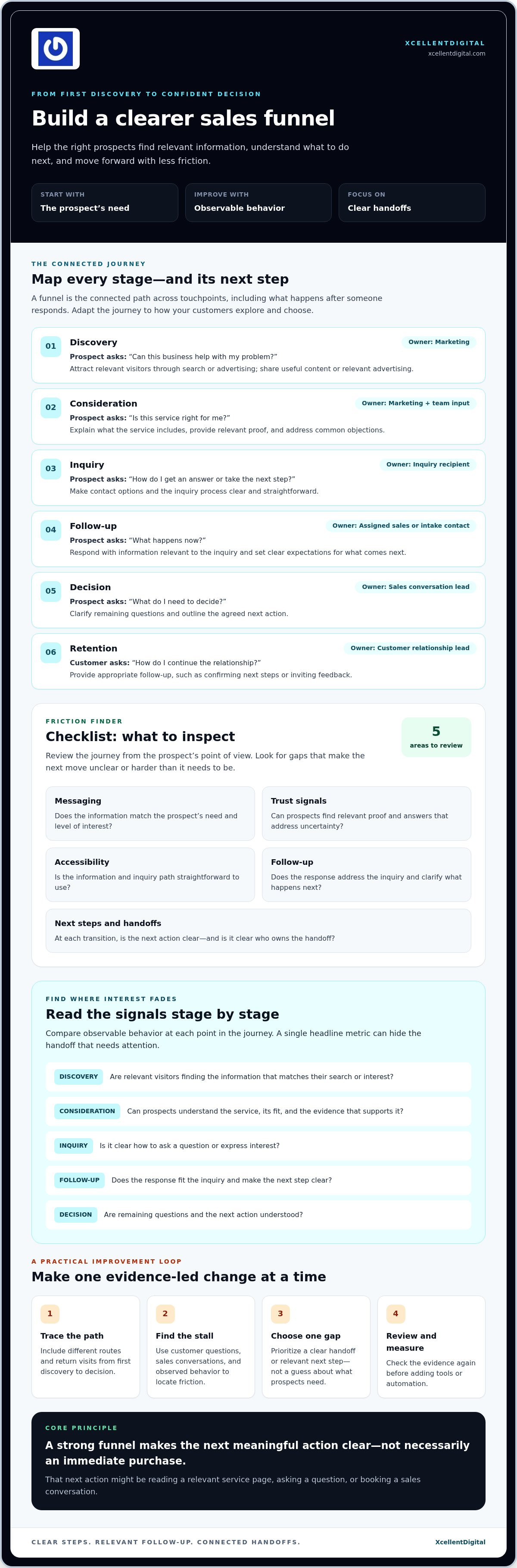
A useful funnel map shows more than the order of steps. It connects what a prospect needs to know with the next action your business wants them to take, and identifies who owns each handoff. Use this practical conversion funnel map to see where customer interest moves forward or stalls.
Start with the stages below. Adapt the messages and owners to your business, then check whether each handoff happens as intended.
- Discovery: “Can this business help with my problem?” Share useful content or relevant advertising. Owner: marketing.
- Consideration: “Is this service right for me?” Explain what the service includes, provide relevant proof, and address common objections. Owner: marketing, with input from sales or service staff.
- Inquiry: “How do I get an answer or take the next step?” Make contact options and the inquiry process clear. Owner: the person assigned to receive new inquiries.
- Follow-up: “What happens now?” Respond with information relevant to the prospect’s question and set clear expectations for the next step. Owner: the assigned sales or intake contact.
- Decision: “What do I need to decide?” Clarify any remaining questions and outline the agreed next action. Owner: the person guiding the sales conversation.
- Retention: “How do I continue the relationship?” Provide appropriate follow-up after the decision, such as confirming next steps or inviting feedback. Owner: the team member responsible for the customer relationship.
What should happen at each funnel stage?
Keep the message aligned with the prospect’s intent. Someone arriving through a search for a specific service may want direct service details, while someone seeing an ad may need more context first. At consideration, make proof and answers easy to find. At inquiry and decision, remove ambiguity: explain what information to provide, who will respond, and what the prospect can expect next.
These stages aren’t always a straight line. A prospect may revisit service information after an inquiry, compare options, or pause before deciding. Let people return to useful content without making them restart the process. For high conversion sales funnels, connected messages and clear ownership matter as much as individual pages or campaigns. A business growth and automation framework can help businesses consider how connected processes support consistent follow-up.
Where can prospects lose momentum?
Test the handoffs from the customer’s point of view. Does an ad promise something the landing page doesn’t explain? Is the call to action vague, or does the form ask for details before the prospect understands why they’re needed? After an inquiry, check whether replies are delayed, customers must repeat information, or no one clearly owns the next step. Document each gap before adding tools. If you need help assessing how your funnel stages fit together, explore sales funnel development.
Use This High-Conversion Sales Funnel Checklist to Find Friction
A useful funnel audit follows the prospect’s experience across stages, from the first message they see to the follow-up after they reach out. More leads won’t automatically fix a weak funnel. If a page is confusing or inquiries go unanswered, extra traffic may only send more people into the same roadblock.
Review one path at a time, such as a specific ad and its landing page or a search result leading to an inquiry form. Don’t change every page, message, and process at once. A focused review makes it easier to identify what’s causing friction and whether a change helped.
For each item, mark Pass, Needs attention, or Not applicable. Add a brief note about what you observed, especially when an item needs attention.
Check the message, offer, and landing experience
- Message relevance: Does the ad or search result match the destination page and speak to the intended prospect’s need? If an ad promises help with a particular service, the page should explain that service rather than send visitors to a vague overview.
- Clarity: Can a visitor quickly understand the service, whether it may fit their situation, and what to do next? Look for unclear eligibility details or calls to action that don’t explain what happens after a click.
- Accessibility: Test the page on a phone as well as a computer. Check that text is readable, contact options work, and the form asks only for information needed at that point. A long form may discourage someone who only needs to ask an initial question.
Check trust, qualification, and follow-up
- Trust: Are claims supportable, and is customer proof relevant to the service being considered? Remove or update statements that don’t help a prospect make an informed decision.
- Qualification: Does the form collect only details needed to respond or assess fit? If a question doesn’t serve either purpose, consider whether it belongs later in the conversation.
- Follow-up: Is someone responsible for receiving, assigning, responding to, and tracking each inquiry? Check for repeated questions, missing context, and unclear expectations about what happens next.
- Handoff: Does the next message match what the prospect just did? A person requesting service details needs a relevant response, not a generic follow-up that makes them repeat their request.
Use the review to identify one specific gap, not to label the whole funnel a failure. High conversion sales funnels are built by making each handoff easier to understand and act on. Fix the clearest point of friction first, then reassess the same path before moving to another.
Measure Funnel Performance Before You Choose What to Fix
A single headline metric can hide the real problem. More website visits don’t tell you whether those visitors inquire, and a healthy number of inquiries doesn’t show whether they’re qualified or becoming customers. Track movement between stages to see where the journey slows down, then investigate that handoff before choosing a fix.
Start with signals you can reliably observe, such as visits, inquiries, qualified leads, appointments, and completed sales where applicable. Define each stage consistently: decide what counts as a qualified lead and record it the same way each time. Google Analytics 4 or CRM records can help, but only when events, lead statuses, and sources are configured appropriately. Attribution also has limits. A prospect may discover you through one channel and return through another, so recorded source data may not capture every influence on a decision.
Which signals help identify a funnel bottleneck?
Compare like with like. Review consistent time periods or campaigns, and note changes in the audience, offer, or follow-up process that could affect results. Use this table to turn a signal into a question worth investigating, not an instant diagnosis.
| Funnel stage | Observable signal | Possible issue | Follow-up question |
|---|---|---|---|
| Discovery | Visits or ad clicks | Traffic may not match the intended audience | Did the message attract people looking for this service? |
| Consideration | Relevant page visits or continued engagement | The page may not answer key questions | Does the content match the entry message and visitor intent? |
| Inquiry | Form submissions or calls recorded | The next step may be unclear or hard to complete | Can visitors easily understand how to make contact? |
| Qualification | Inquiries that meet your fit criteria | Audience, offer, or criteria may be misaligned | Are the criteria clear and applied consistently? |
| Decision | Appointments or completed sales, where applicable | Follow-up or decision steps may be unclear | What questions or delays appear before a decision? |
Prioritize possible fixes by customer impact, supporting evidence, and effort. A confusing inquiry step backed by repeated customer questions may deserve attention before a minor page detail. High conversion sales funnels improve through informed adjustments, not assumptions about one number.
How should a business test improvements?
When practical, change one meaningful element at a time. Write down the hypothesis, baseline, timeframe, and outcome before drawing conclusions. For example: “If the inquiry page explains what happens after submission, more visitors may complete it.” Avoid treating a short-term change as proof if traffic sources, audience, or offer shifted at the same time. If Facebook Ads bring prospects into your funnel, use this Facebook Ads lead generation guide to consider the entry point alongside what happens next.
For help turning funnel evidence into a focused improvement plan, explore sales funnel development.
Turn the Checklist Into a Practical Funnel Improvement Plan
A funnel audit is useful only if it leads to a clear next step. Keep the plan focused: choose one customer path, use evidence to identify a gap, make a targeted change, then check whether the experience improved. High conversion sales funnels aren’t built by adding every available tool. They’re built by connecting useful messages to reliable follow-through.
What should a business improve first?
- Choose one funnel path. Select a specific route, such as a search result leading to a service page and inquiry, or an ad leading to a contact form. Keep the review narrow enough to follow from start to finish.
- Document the problem. Look for evidence in customer feedback, inquiry records, or stage-by-stage performance. Write down what prospects seem to struggle with, such as unclear service information or confusion about who will respond.
- Fix one gap. Repair broken contact paths and clarify inquiry ownership before adding complexity. If prospects can’t submit a working form or their inquiry has no clear owner, extra tools won’t solve the underlying process issue.
- Measure again. Set a review date and decide in advance what evidence would indicate progress. That might be fewer reports of confusion, more completed inquiries, or clearer records of how leads move to the next step.
Keep essential process improvements separate from optional technology. Clear messaging, working contact options, and an agreed follow-up process are foundations. If you want to see how customer-centric campaigns can align these touchpoints to drive revenue growth, learn more about strategic marketing and sales integration. Automation may help with repeatable tasks, but it shouldn’t hide gaps in ownership or customer communication.
When might expert support or automation help?
Different channels support different parts of the journey. Advertising can introduce relevant prospects to an offer, while search optimization can help people find information when they’re looking for a solution. A reputation program can support trust as prospects assess whether a business feels credible. Check that each channel’s message leads into a customer experience that delivers on its promise.
Consider expert support when coordinating channels, follow-up, and reporting becomes difficult. Lead response automation or AI agents may help manage parts of follow-up, but they need human oversight and testing. Confirm that responses are accurate, relevant, and appropriate to the inquiry, and give prospects a clear way to reach a person when their needs don’t fit the automated path.
If you’d like help assessing what your funnel needs next, explore XcellentDigital’s marketing and automation support.
Make Your Next Funnel Improvement Count
A stronger funnel doesn’t require rebuilding everything at once. Choose one customer path, use real behavior and feedback to identify a friction point, then make one focused change and review what happens. That steady approach turns high conversion sales funnels from an abstract goal into a practical process your team can refine.
Keep the customer’s next step at the center. Make sure your marketing brings relevant prospects into a clear journey, and that someone owns the handoff when they reach out. Tools can support the process, but clear messaging, reliable follow-up, and useful measurement come first.
XcellentDigital offers sales funnel development alongside advertising, search optimization, and lead response automation for businesses across the United States. If you’re ready to review where your marketing and follow-up could work together more effectively, contact XcellentDigital to discuss your funnel.
Start with one gap. A clearer path forward is within reach.
Frequently Asked Questions
What makes a sales funnel high-converting?
A sales funnel is more likely to convert when each step gives the right prospect relevant information and a clear next action. High conversion sales funnels also connect marketing messages to the actual service experience, make it easy to inquire, and provide dependable follow-up. Review customer questions and behavior to find friction, then improve one evidence-backed issue at a time. No funnel can guarantee a particular conversion rate or sales result.
What are the stages of a sales funnel?
A service sales funnel commonly moves through discovery, consideration, inquiry, follow-up, decision, and retention. A prospect might first find your business through search, review service information, ask a question, and decide whether to proceed. These stages are a useful map, not a rigid sequence: prospects may return to earlier information, compare options, or pause before deciding. Adapt the stages to how customers actually find and choose your service.
How do I know where my sales funnel is losing leads?
Compare observable movement between stages, such as visits, inquiries, qualified leads, appointments, and completed sales where relevant. A drop between a service page visit and an inquiry, for example, may warrant checking whether the contact step is clear and functional. Confirm that tracking definitions are consistent, then compare similar periods or campaigns. Use customer feedback and sales records to investigate possible causes before deciding that a metric alone proves the problem.
Can automation improve sales funnel conversions?
Automation can support repeatable follow-up tasks, such as acknowledging an inquiry or routing it to the right person, but it doesn’t automatically fix an unclear message or poor handoff. Test automated responses for accuracy, relevance, and appropriate timing. Make it easy for a prospect to reach a person when their question needs judgment or falls outside the normal process. Treat AI agents and lead response automation as tools to evaluate, not guaranteed conversion solutions. For additional guidance on structuring sustainable online systems and marketing automation, learn more about Frank Novak.
What should a sales funnel checklist include?
A useful checklist reviews whether messages match their destination pages, service details are clear, and trust signals are relevant and supportable. Check mobile access, working contact options, and whether forms request only necessary information. Then examine inquiry ownership, follow-up, and the clarity of each next step. Assess one customer path at a time, record what needs attention, and use the findings to choose a focused improvement rather than changing everything at once.
How often should I review my sales funnel?
Review your funnel on a consistent schedule that fits your inquiry volume and ability to gather meaningful evidence. Also reassess it after a significant change to an ad, service page, form, follow-up process, or audience. Avoid reacting to a small fluctuation without context. Compare equivalent periods and note what changed, then decide whether the evidence points to a real handoff issue or reflects differences in traffic or customer intent.
Do I need paid ads to build a high-conversion sales funnel?
No. Paid ads can bring targeted prospects into a funnel, but they’re not required to build one. Search optimization, referrals, and other existing discovery paths can also introduce potential customers to your business. Focus first on making the journey clear for the audience you already reach. Consider advertising when you can define who you want to attract and ensure the destination page and follow-up match the ad’s promise.













Leave a Reply
Want to join the discussion?Feel free to contribute!