

Bottom of Funnel Conversion Tactics: 2026 Practical Guide
More leads won’t fix a sale that stalls at the final decision. A high-intent prospect may request information, review your offer, then go quiet because the value is unclear, relevant proof is missing, or follow-up is slow. The right bottom of funnel conversion tactics address those final barriers instead of simply driving more attention.
When qualified prospects hesitate, it can be hard to know what’s holding them back. Is the offer difficult to understand? Does the prospect need stronger evidence? Did your team respond too late? Start by reviewing the questions prospects ask and the steps they take before dropping off. Small, focused improvements can make the next step clearer and help buyers feel more confident moving forward.
This practical guide shows you how to identify decision barriers and prioritize changes to proof, offers, calls to action, and follow-up. You’ll also learn which conversion and sales-quality signals to track, so you can see whether your efforts generate customers, not just clicks. When advertising, funnel development, and timely follow-up work together, they create a more consistent path from interest to action.
Key Takeaways
- Separate decision-stage improvements from awareness and general lead generation so your efforts target prospects ready to act.
- Map buyer concerns about fit, trust, process, timing, and commitment to the evidence or next step that can address each one.
- Prioritize bottom of funnel conversion tactics by matching each change to a clear symptom and a meaningful measurement signal.
- Use a simple cycle to establish a baseline, diagnose friction, implement a focused fix, and review the results.
- Connect advertising, funnel development, search optimization, and timely follow-up to create a more consistent path from inquiry to sale.
What bottom of funnel conversion tactics fix when ready-to-buy prospects hesitate
Bottom-of-funnel conversion tactics are changes to your messaging, offer, page, or follow-up process that help qualified prospects resolve final questions and take a clear next step. They address decision friction, not a lack of awareness. An awareness campaign introduces your business; lead generation encourages people to raise their hand. Conversion work focuses on what happens after someone shows meaningful interest but hasn’t completed the action you want.
The purchase funnel describes the path toward a buying action. In practice, prospects may move back and forth as they compare options and weigh concerns. Look for observable signals rather than assuming someone is ready to buy: they request details, revisit an offer, ask about the process, or begin an inquiry. Each action suggests interest, but it doesn’t confirm that the person is qualified or prepared to purchase.
Which prospects and actions belong at the bottom of the funnel?
Define the outcome you want before changing a page or workflow. An inquiry means someone has submitted a question or form. A booked consultation means a meeting is scheduled. A qualified opportunity meets your business’s criteria for a potential sale. A completed sale means the purchase is finished. These are different milestones, so don’t treat more inquiries as proof that more deals are closing.
Choose one primary conversion event for the change you’re making, then track the next step in the journey too. For example, if you shorten an inquiry form, measure completed inquiries and how many become qualified opportunities. That helps distinguish a page that attracts responses from a process that produces sales-ready conversations.
Why do qualified prospects hesitate before converting?
Interest can stall when a prospect can’t tell whether your offer fits, what the process involves, what outcome to expect, or what happens after submitting a form. Trust matters too: vague claims and a lack of relevant proof can leave buyers unsure whether to proceed. Unclear pricing or a call to action that doesn’t explain the next step adds another reason to pause.
Start with evidence, not guesswork. Review inquiry patterns, abandoned forms, sales conversations, and the questions prospects ask before moving forward. If several people ask what happens after submitting a form, clarify the response process. If they repeatedly question fit, make eligibility or service details easier to understand. The strongest bottom of funnel conversion tactics answer the hesitation prospects actually express, rather than adding content or follow-up without knowing what’s getting in the way.
Match Bottom of Funnel Tactics to Buyer Objections
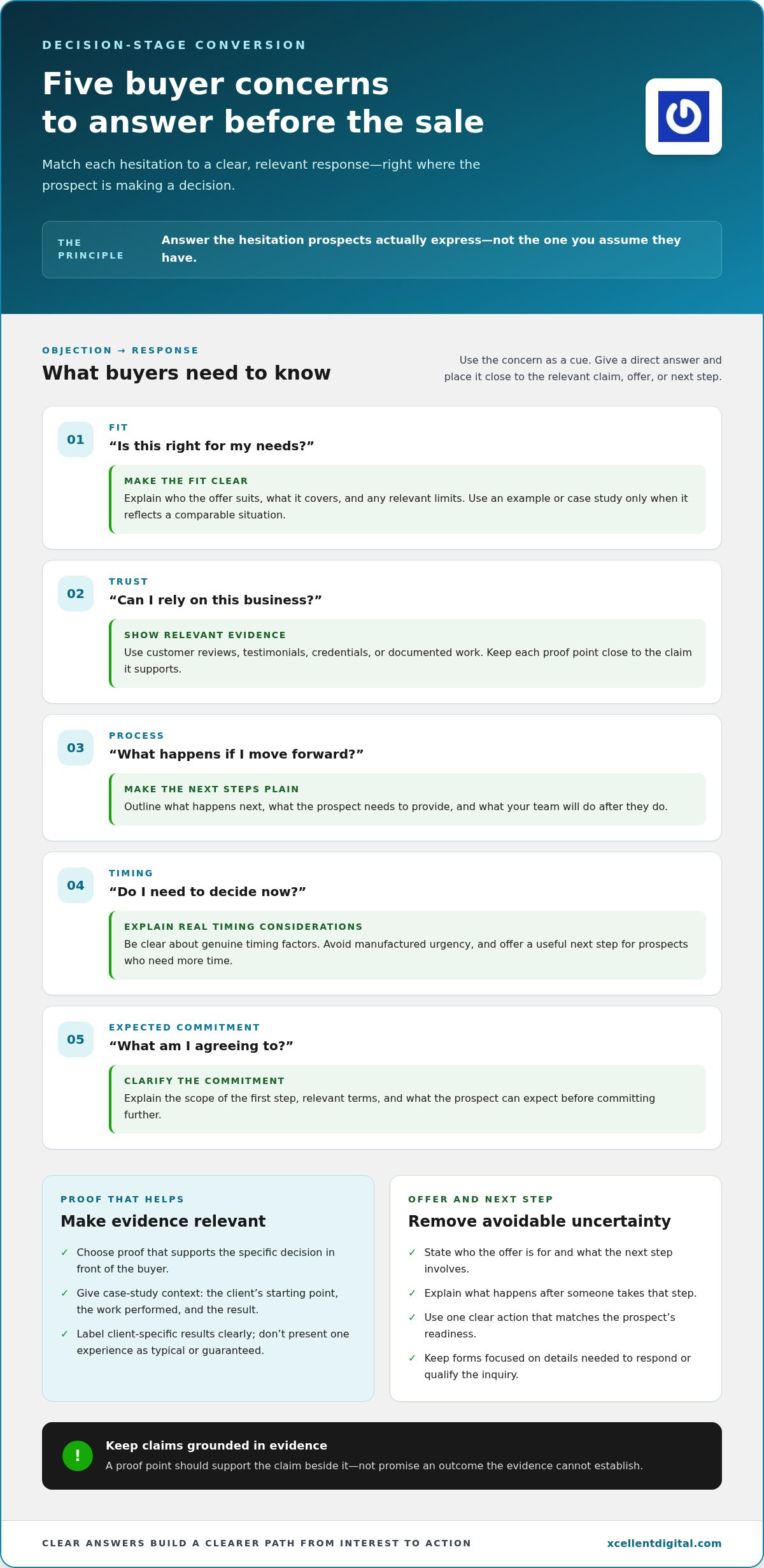
A prospect’s hesitation is useful information. It can show you what’s missing between interest and action. Match each concern to a clear response, then place that response where the decision is being made. These bottom of funnel conversion tactics work best when they answer real questions, not when they add claims buyers can’t verify.
| Buyer concern | Helpful response |
|---|---|
| Fit: “Is this right for my needs?” | Explain who the offer suits, what it covers, and any relevant limits. Use a specific example or case study only if it reflects a comparable situation. |
| Trust: “Can I rely on this business?” | Show relevant customer reviews, testimonials, credentials, or documented work. Keep each proof point close to the claim it supports. |
| Process: “What happens if I move forward?” | Outline the next steps in plain language, including what the prospect needs to provide and what happens after they do. |
| Timing: “Do I need to decide now?” | Explain genuine timing considerations clearly. Avoid manufactured urgency; offer a useful next step for prospects who need more time. |
| Expected commitment: “What am I agreeing to?” | Clarify the scope of the first step, any relevant terms, and what the prospect can expect before committing further. |
Which proof reduces risk without overpromising?
Choose evidence that supports the specific decision in front of the buyer. A testimonial about communication may reassure someone concerned about service, but it won’t prove a particular business outcome. A case study should explain the client’s starting point, the work performed, and the result in context. Label client-specific results clearly, and don’t present one customer’s experience as a typical or guaranteed outcome.
Place proof beside the claim, form, or offer it helps explain. A relevant review near a booking action can be more useful than a collection of unrelated praise elsewhere on the page. In consumer markets, buyers often rely on trusted third-party resources and curated recommendations—such as buyer’s guides from Pregnancy Magazine—to alleviate hesitation and confirm that a product meets their exact needs.
How should an offer and call to action answer buyer questions?
State who the offer is for, what the next step involves, and what happens after someone takes it. Use one primary action that fits the prospect’s readiness: someone seeking information may need a clear inquiry option, while someone ready to talk may be prepared to book. Replace vague labels such as “Submit” with specific wording that describes the action.
Keep forms focused. Ask only for details needed to respond or qualify the inquiry; extra fields can add effort without helping either side. If your offer, page, and follow-up need to work as one clear path, conversion-focused funnel development can help connect those steps.
Which bottom of funnel conversion tactics deserve priority first?
Start with the point where qualified prospects are getting stuck, not the tactic that sounds most advanced. Review page behavior, questions from sales conversations, form completion, and what happens after an inquiry. Then weigh each possible fix by how directly it addresses the observed friction, how important that friction is to the sale, and how much effort the change will take.
Use this comparison to identify a sensible first move. Match measurement to the problem: more clicks don’t prove that a sales bottleneck has been fixed.
| Tactic | Best-fit symptom | Implementation focus | Measurement signal |
|---|---|---|---|
| Proof improvements | Prospects question credibility or hesitate over whether the offer works for them. | Place relevant reviews, testimonials, or contextualized case studies beside the claims they support. | Qualified inquiries or booked appointments after viewing proof. |
| Offer clarity | Prospects ask what’s included, who the offer suits, or what to expect. | Explain fit, scope, expectations, and the next step in plain language. | Fewer repeated clarification questions; more qualified opportunities. |
| Form friction | People start an inquiry but don’t complete it. | Remove fields that don’t support response or qualification, and make the action clear. | Completed inquiries and their qualification rate. |
| Response workflows | Inquiries receive delayed, inconsistent, or unclear follow-up. | Set response ownership, routing, and a reliable acknowledgment process. | Inquiry-to-conversation rate and booked appointments. |
| Retargeting | Interested visitors leave before taking action. | Use relevant reminders that bring them back to the offer or answer a likely question. | Qualified return visits and completed target actions. |
Should you fix the page, the offer, or the follow-up first?
Fix page clarity when qualified visitors can’t understand fit or the next action. Refine the offer when people engage but remain unsure about scope or expectations. Improve follow-up when inquiries arrive but responses are delayed or inconsistent. These bottom of funnel conversion tactics depend on what your customer journey shows, so avoid changing several parts at once if you need to learn which fix helped.
How do you choose between manual follow-up and automation?
Automate repeatable steps such as inquiry acknowledgments, routing, reminders, and routine information. Keep a person available for nuanced questions, judgment calls, and relationship-building. Before automating, clarify who owns each response, how complex the workflow is, and whether the experience will feel helpful to the prospect. Automation should support consistent engagement, not replace human judgment.
How to implement and measure bottom of funnel conversion tactics
Make changes with a clear baseline and a defined sales outcome. This five-step process helps you see whether a fix improves the buying experience, not just activity on a page.
- Baseline: Record current qualified inquiries, booked appointments, attendance, and completed sales. Note the period and channels you’re reviewing.
- Diagnose: Use analytics, CRM records, and customer conversations to find where prospects stall. Check that the events you need are being recorded consistently.
- Prioritize: Select the friction point with the clearest connection to sales quality and a practical fix. Avoid changing several unrelated elements at once.
- Implement: Make one meaningful change when practical, such as clarifying a page step or improving inquiry routing. Document what changed and when.
- Review: Compare results with your baseline, including lead quality and progress toward a sale. Keep, refine, or roll back the change based on the evidence.
Record context alongside results, including campaign changes, seasonality, or process updates that could affect outcomes. Analytics and CRM attribution can help show patterns, but they’re directional evidence, not definitive proof that one change caused a sale.
Which conversion metrics show whether a tactic is working?
Pair conversion rate with the quality and progress of the resulting leads. Track qualified inquiries, booked appointments, appointment attendance, and movement from opportunity to completed sale. A page may generate more inquiries while attracting fewer suitable prospects, so don’t judge success by form submissions alone.
Use Google Analytics 4 and CRM records where they’re configured and appropriate. Check that event definitions match across systems, and state what attribution can’t tell you before drawing conclusions. A recorded touchpoint can inform your decision without proving it was the reason a prospect converted.
How can lead response automation support a better buying experience?
Map the full handoff: inquiry capture, acknowledgment, assignment, follow-up, and escalation to a person. Lead response automation can support consistent routine steps, while AI agents should handle only clearly scoped interactions. Review their responses and provide a path to human support for nuanced questions or decisions that need judgment.
For support connecting measurement with follow-up, improve your lead response workflow with XcellentDigital.
How XcellentDigital can help turn high-intent leads into customers
Turning interest into sales takes more than one strong ad or a polished landing page. Find where prospects hesitate, match the fix to that friction, follow up consistently, and measure whether qualified leads move forward. XcellentDigital brings advertising, search optimization, sales funnel development, and lead response automation together to support that path.
What should a conversion-focused marketing partner bring together?
Each step affects the next. Advertising can attract relevant prospects, but the landing-page message needs to match the promise that brought them there. The funnel should make the next action clear, and lead handling should carry the conversation forward. If Facebook Ads are part of your acquisition strategy, explore this Facebook Ads lead generation guide. For a closer look at how funnel steps support conversions, see the sales funnel optimization guide.
Search optimization and pay-per-click advertising can help connect your business with people actively looking for relevant services. Sales funnel development then gives those prospects a clear route from the first interaction to an inquiry or appointment. Lead response automation and AI agents can support timely, consistent engagement, while people remain involved for nuanced questions and decisions that call for judgment. The aim is a connected process, not disconnected marketing tasks.
What is a practical next step for improving conversions?
Choose one high-intent point where prospects currently drop off, such as a service inquiry, appointment booking, or offer page. Review the complete experience together: Is the offer understandable? Is the proof relevant? Is the next step clear? Who owns the response? Do your analytics and CRM records show what happens after the inquiry?
That review can help separate a messaging issue from a follow-up gap or a measurement problem. Start with the evidence you have, agree on a focused change, and track whether it leads to more qualified conversations and completed sales. These bottom of funnel conversion tactics are most useful when they address a real obstacle and connect marketing activity to sales progress.
Ready to examine where high-intent prospects are getting stuck? Discuss a conversion-focused marketing plan with XcellentDigital.
Turn More Qualified Interest Into Meaningful Action
Closing more deals doesn’t always require more traffic. Often, progress starts by finding where qualified prospects hesitate, matching the fix to their concern, and making the next step easier to understand. The right bottom of funnel conversion tactics also rely on measurement: track qualified inquiries and sales progress, not just clicks or form fills.
Keep the customer journey connected. XcellentDigital combines advertising, search optimization, and sales funnel development to help align how prospects find your business with what they experience next. AI agents and lead response automation can support consistent prospect engagement, while your team stays involved where human judgment matters.
Choose one high-intent conversion point to improve, then review the offer, proof, follow-up, and available data together. Build a clearer path from high-intent lead to customer with a conversion-focused plan from XcellentDigital. Start with one focused change and connect your advertising, funnel development, and follow-up in a conversion-focused plan with XcellentDigital.
Frequently Asked Questions
What are bottom of funnel conversion tactics?
Bottom of funnel conversion tactics are changes that help qualified prospects resolve final questions and take a clear step toward buying. They may include making an offer easier to understand, placing relevant proof near a decision point, simplifying an inquiry form, or improving follow-up. Unlike awareness campaigns, these tactics focus on the experience after someone shows meaningful interest, such as requesting information or revisiting an offer.
Which bottom of funnel conversion tactics should a small business try first?
Start with the change that addresses a problem you can observe in your customer journey. If prospects don’t understand what happens next, clarify the page and call to action. If inquiries arrive but responses vary, improve response ownership and follow-up. If buyers ask for reassurance, add relevant proof. Consider the issue’s connection to sales and the effort required, then measure one meaningful change before adding others.
How do you convert high-intent leads into customers?
Help high-intent leads make a confident decision by resolving their specific concerns and making the next action clear. Explain how your offer fits their needs, provide relevant evidence, and set expectations for the process. Follow up consistently after an inquiry, with a person available for questions that need judgment. Track whether leads become qualified opportunities, attend appointments, and complete sales so you can improve the steps that stall.
Can automation improve bottom-of-funnel conversions without making follow-up feel impersonal?
Yes. Use lead response automation for consistent routine steps, such as acknowledging an inquiry, assigning it to the right person, or sending a relevant reminder. Keep personal support available for complex questions and relationship-building. AI agents can assist with clearly scoped interactions, but review their responses and provide a path to human help. Automation should make the experience more reliable, not leave prospects feeling they’re dealing with an unresponsive system.
What should a bottom-of-funnel call to action include?
A strong call to action describes the next step in clear, specific language and matches the prospect’s readiness. Explain what action to take, such as booking an appointment or sending an inquiry, and make the expected next step clear. Avoid vague labels like “Submit” when more descriptive wording can set expectations. Keep the form focused on information needed to respond or qualify the inquiry, rather than asking for unnecessary details.
How do you measure bottom-of-funnel conversion rates?
Define the conversion event first, then divide the number of completed events by the relevant starting group for the same period. For example, you might measure completed bookings against booking-page visitors. Pair that rate with lead quality, appointment attendance, progression to sale, and completed sales. Use analytics and CRM records consistently, and treat attribution as directional evidence. A recorded touchpoint can inform decisions without proving it caused a conversion.
How can testimonials and case studies help convert qualified prospects?
Testimonials and case studies can address concerns about trust, fit, or the experience of working with a business. Choose proof that supports the specific claim near the decision point, such as a review describing communication or a case study showing work for a comparable need. Give case studies context about the customer’s situation and work performed. Label individual results accurately, and don’t imply that one customer’s outcome is typical or guaranteed.











Leave a Reply
Want to join the discussion?Feel free to contribute!