

Increasing Inbound Lead Quality: A Practical Guide for 2026
What if more inquiries aren’t the answer? If your team is busy chasing contacts who never become real opportunities, increasing inbound lead quality starts with connecting marketing signals to a clear picture of who fits your business. A crowded inbox can look like momentum, but form fills alone don’t show whether prospects have a need you can meet, fit your services, or intend to move forward.
It’s frustrating when marketing counts a campaign as a win while sales sees a queue of poor-fit leads. The fix isn’t always to add more form questions or screen prospects out sooner. First, agree on what makes a lead useful, apply the criteria consistently, and track which sources lead to meaningful sales conversations.
This guide explains how to define lead quality using observable fit and intent signals, compare acquisition channels by downstream outcomes, and improve qualification and follow-up without adding unnecessary friction. You’ll see how targeting, capture forms, sales handoffs, and feedback work together, so your team can make better decisions with the leads already coming in.
Key Takeaways
- Define a qualified lead using practical signals, including business fit, intent, contactability, and ability to serve.
- Align marketing and sales on one shared definition before changing campaigns or judging performance.
- Compare paid social, paid search, organic search, referrals, and inbound calls by qualified opportunities and sales feedback, not inquiry volume alone.
- Improve increasing inbound lead quality by testing audience targeting, offer clarity, and form questions without adding unnecessary friction.
- Use existing CRM and analytics data to review outcomes regularly and make improvements repeatable.
Increasing inbound lead quality starts with fit, not more form fills
A busy inquiry pipeline can still leave a sales team short on real opportunities. The disconnect often starts when every submission is treated as equally valuable. A more useful approach is to check whether the prospect has a need your business can serve, shows a reason to act, can be contacted, and has a realistic path to becoming a customer. Those signals make lead quality actionable, rather than just a label in a report.
Qualification should help your team prioritize and respond appropriately, not screen people out based on assumptions. A job title that doesn’t match a narrow template or a budget a prospect hasn’t discussed may not tell you enough. Use information tied to the actual sale, then let a conversation fill in what a form can’t reveal.
What makes an inbound lead qualified?
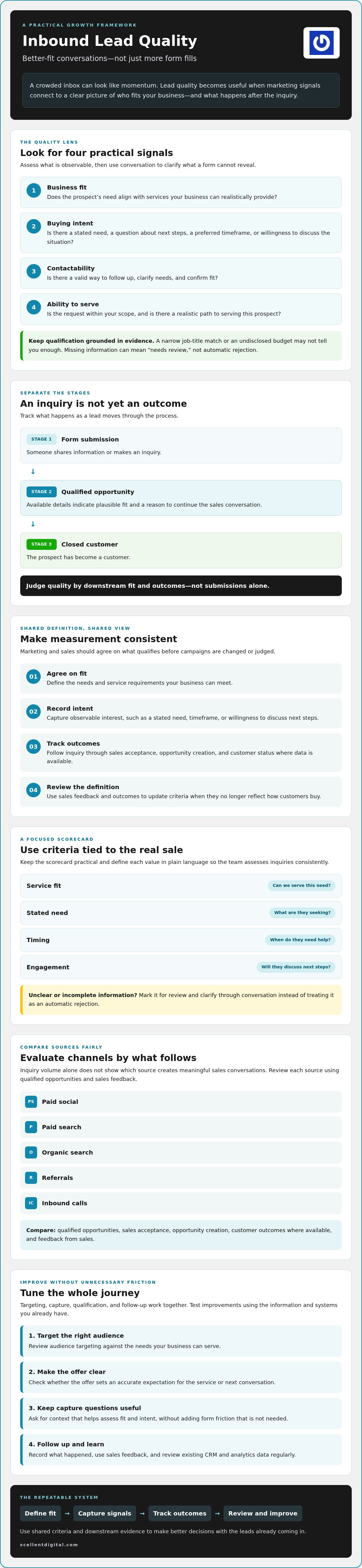
Separate business fit from buying intent. Fit means the prospect’s needs align with what your business can serve. Intent means there’s evidence they’re considering action, such as describing a current need, asking about next steps, or sharing a preferred timeframe.
Look for observable signals: the service they’re seeking, whether the request is within your scope, how soon they need help, and whether they’re willing to discuss their situation. Contactability matters too. A valid way to follow up gives your team a chance to clarify needs and confirm fit. The right criteria depend on your business model and sales process. A considered purchase may need more conversation than a straightforward service request.
Apply these judgments through a consistent process. Lead management covers the broader work of handling inquiries as they move through a business. Lead quality improves when teams use that process to capture useful context, follow up, and record what happened, rather than relying on a form score alone.
Why lead volume can hide quality problems
More inquiries can mean more chances to find customers, but they can also take time away from prospects your team is better placed to serve. A request outside your scope may need a polite response, while an incomplete inquiry might become a strong opportunity after one clarifying question. Don’t treat either as automatically worthless. Record the outcome so you can spot patterns and adjust your criteria based on evidence.
Keep these stages distinct:
- Form submission: Someone shares information or makes an inquiry.
- Qualified opportunity: The available details indicate a plausible fit and a reason to continue the sales conversation.
- Closed customer: The prospect has become a customer.
Lead quality is judged by downstream fit and outcomes, not submissions alone. That distinction gives marketing and sales a more useful basis for deciding what to improve next.
How to define and measure inbound lead quality consistently
Once you know what a promising inquiry looks like, make that definition usable across marketing and sales. Without shared rules, one team may count a form fill as a win while another values only a sales-ready conversation. Align on what qualifies before adjusting campaigns. Otherwise, you risk optimizing for a number that doesn’t reflect business value.
Use a simple cycle to make increasing inbound lead quality measurable:
- Agree on fit: Define which needs and service requirements your business can realistically meet.
- Record intent: Capture observable signs of interest, such as a stated need, timeframe, or willingness to discuss next steps.
- Track outcomes: Follow leads from inquiry through sales acceptance, opportunity creation, and customer status where the data is available.
- Review definitions: Check sales feedback and outcomes, then update criteria when they no longer reflect how customers actually buy.
Build a practical lead qualification scorecard
Keep the scorecard focused on a small set of criteria tied to your actual ideal customer profile. For example, assign clear values for service fit, stated need, timing, and engagement. Define each value in plain language so different team members assess the same inquiry consistently. Add a “needs review” status for missing or unclear information. An incomplete record shouldn’t become an automatic rejection.
Monitor several measures together. Qualified-lead rate and sales acceptance can show whether inquiries meet the agreed criteria. Opportunity creation and eventual customer outcomes reveal what happens further down the funnel. Treat these as different signals: early indicators can show changes sooner, while later outcomes take longer to develop. No single rate is a universal benchmark. Interpret each against your sales process, lead sources, and past performance.
Connect marketing data to sales outcomes
In your CRM, record the source, campaign, qualification status, and sales disposition using consistent options. A disposition might show that an inquiry was a fit, outside scope, not ready, or unreachable. Compare like-for-like time periods and relevant lead sources, and give later-stage outcomes time to mature before drawing conclusions. For more ideas on sales and marketing alignment, explore proven strategies to improve lead quality.
Start with the data you already collect. If source tracking or sales feedback is missing, fix that foundation before adding another tool. XcellentDigital’s digital marketing and automation services include search optimization, paid advertising, sales funnel development, and lead response automation. Learn more about XcellentDigital’s marketing and automation services.
Compare inbound channels by qualified opportunities, not raw lead count
The channel that brings in the most inquiries isn’t automatically your strongest source. To see what’s working, compare how well each source attracts prospects who fit, show intent, and progress into qualified opportunities. Include sales feedback too: a source may generate fewer leads but more useful conversations.
What each lead source can reveal
Search inquiries can signal an active need, but the search terms and requested service still need to fit your business. Paid social, including Facebook Ads, can introduce an offer to people who aren’t actively searching. Organic discovery, referrals, and inbound calls can also bring valuable prospects, but none is best for every business by default.
| Lead source | Potential signal | What to check |
|---|---|---|
| Paid social | Interest sparked by an offer or message | Audience fit, offer relevance, and sales acceptance |
| Paid search | Search activity related to a current need | Query relevance, service fit, and opportunity creation |
| Organic search | Discovery through useful content or search results | Landing-page match, inquiry context, and downstream outcomes |
| Referrals | An introduction from an existing contact or customer | Fit, expectations, and whether the prospect is ready to talk |
| Inbound calls | Direct interest expressed in a conversation | Reason for calling, service fit, and agreed next step |
These are clues, not guarantees. Audience, offer, landing page, and sales follow-through all shape a channel’s results. If you’re assessing paid social, this Facebook Ads local lead generation guide can help you consider how campaign setup connects with lead quality.
Use attribution without overstating certainty
Capture source details and UTM parameters consistently where your analytics setup supports them, then connect those records to qualification and sales outcomes. Compare similar time periods and sources, and check that your team uses the same labels. For example, “paid search” shouldn’t mean one campaign in one report and all search advertising in another.
A prospect may discover your business through organic search, return after seeing an ad, then call. That’s an assisted conversion: one interaction helped along the decision, even if another was the final step before contact. Don’t assign all the credit to a single touchpoint when your records show multiple meaningful interactions. A clearer view of the full path makes increasing inbound lead quality more practical: refine channels based on qualified opportunities, not just the easiest number to count.
Improve lead quality with better targeting, capture, and qualification
Make changes in sequence. If you adjust targeting, form questions, and follow-up all at once, you won’t know which change affected lead quality. Start with the people you want to reach, then check whether the offer and capture process attract the right inquiries. Increasing inbound lead quality is a steady cycle of testing and learning, not a reason to add friction everywhere.
- Tighten audience fit: Focus campaigns on people whose needs match the services you can deliver.
- Clarify the offer: Explain what’s included, who it’s for, and what the prospect can expect next.
- Refine the form: Ask only for details that help assess fit or prepare for a useful first conversation.
- Review sales dispositions: Check why leads progress, stall, or fall outside your scope, then adjust the weakest part of the path.
Make targeting and offers more specific
Use language that reflects real customer needs and the services your business actually provides. Clear details can help a prospect decide whether an offer fits before submitting an inquiry. For paid social, compare the message and audience with the responses sales receives. The Facebook Ads guide for local businesses offers further context for thinking through campaign choices. If the gap appears across several steps, review your sales funnel to identify where the journey may need refinement.
Reduce friction while collecting useful information
Every question should help with qualification, routing, or the first sales conversation. A question about the requested service or timing may provide useful context. A long form full of details the team won’t use can discourage suitable prospects. After submission, explain the next step and what response to expect. Review lost and disqualified leads regularly to spot patterns in audience, offer, or messaging.
Follow-up matters, but automation should support judgment, not replace it. A response workflow can acknowledge an inquiry, capture key details, and help route it to the right person. Let your team review unclear or unusual situations rather than forcing every prospect through the same scripted path. Test one change at a time, then compare qualification results and sales feedback.
Want to refine targeting, capture, and follow-up as one connected process? Explore XcellentDigital’s digital marketing and automation services.
Turn lead-quality improvements into a repeatable growth system
Lead quality isn’t a one-time campaign fix. Keep a regular review rhythm so you can spot changes in source quality, qualification outcomes, and sales feedback before teams drift back to counting submissions alone. Start with the CRM and analytics data you already have. If source labels, outcomes, or handoff notes are inconsistent, improve those first. Adding tools won’t resolve unclear definitions.
A focused 30-day cycle gives your team a manageable way to learn. Keep the scope narrow and document what changed, so you can connect results to the test rather than guess.
- Week one: Agree on qualification criteria with marketing and sales. Use available CRM and analytics data to establish a baseline, noting gaps instead of filling them with assumptions.
- Weeks two and three: Test one change at a time, such as adjusting audience targeting, clarifying an offer, or refining a capture form. Keep other parts of the process steady where practical.
- Week four: Compare qualified outcomes with the baseline, gather sales feedback, and decide what to keep, revise, or test next.
Repeat the cycle. Some sales outcomes may take longer to appear, so treat early results as directional and revisit them as more information comes in. The aim of increasing inbound lead quality is a reliable learning loop, not a quick win at any cost.
Know when outside support can help
Consider expert support if campaign sources are hard to trace, teams use different definitions of a qualified lead, or sales feedback rarely makes its way back to marketing. These gaps make it difficult to tell whether targeting, the offer, the funnel, or follow-up needs attention. Start by identifying where the handoff or measurement breaks down.
XcellentDigital’s digital growth services include Facebook Ads, Pay Per Click, Search Optimization, Sales Funnel Development, AI Agents, and Lead Response Automation. These services can support connected improvements across targeting, search, funnel stages, and follow-up. AI agents and automation can help apply agreed response steps consistently, while people review exceptions and use judgment when a prospect’s situation needs context. No tool replaces clear criteria or useful sales feedback.
Ready to make your lead-quality process more consistent? Discuss your lead-quality goals with XcellentDigital and explore which part of your marketing-to-sales process to improve first.
Build a Better Lead Pipeline, One Improvement at a Time
Increasing inbound lead quality doesn’t require chasing every new tactic. Start with a shared definition of a good-fit prospect, then judge channels by qualified opportunities and sales feedback rather than inquiry volume alone. Make targeted changes to your audience, offer, forms, and follow-up, and review what happens next. That steady feedback loop helps marketing and sales focus on the signals that support business growth.
The process works best when each part connects: targeting sets expectations, capture gathers useful context, and follow-up helps turn interest into a meaningful conversation. XcellentDigital’s services span digital advertising, search optimization, and sales funnel development, with AI agents and lead response automation available to support consistent workflows. The right approach depends on your goals and how your team currently manages inquiries.
Ready to identify what’s holding your lead pipeline back and choose a practical next step? Talk with XcellentDigital about improving your inbound lead quality. Start by discussing your goals and identifying one part of your marketing-to-sales process to improve.
Frequently Asked Questions
What is inbound lead quality?
Inbound lead quality is how well an inquiry matches your business and its potential to become a useful sales opportunity. Consider whether the prospect has a need you can serve, shows interest in taking action, can be contacted, and has a realistic path to moving forward. A form submission alone doesn’t confirm quality. These signals help your team prioritize follow-up while leaving room to clarify incomplete information through a conversation.
How do you measure the quality of inbound leads?
Measure quality by tracking what happens after an inquiry, not just how many arrive. Agree on a shared qualified-lead definition, then monitor qualified-lead rate, sales acceptance, opportunity creation, and customer outcomes where available. Be clear about each metric’s denominator, such as qualified leads divided by all inquiries. Early indicators can flag changes sooner, while later outcomes take more time. Compare results with your own baseline, not a universal benchmark.
Can increasing lead quality reduce the number of leads?
Yes, increasing inbound lead quality can coincide with fewer inquiries if clearer targeting or offer details discourage poor-fit submissions. That isn’t automatically a problem. Check whether the remaining leads fit your services, receive sales follow-up, and progress into opportunities. If volume falls but qualified outcomes don’t improve, review whether the changes added unnecessary friction or narrowed the audience too far. Use sales feedback alongside counts to judge the tradeoff.
How can I tell which marketing channel generates the best leads?
Compare channels by the share of inquiries that meet your qualification criteria, become sales-accepted, and create opportunities. Record source and campaign details in your CRM, then compare similar time periods and allow time for longer sales journeys to develop. Sales feedback adds context to the figures. A source that starts the journey may assist a later conversion, so avoid giving one touchpoint all the credit when several interactions played a role.
Do longer lead forms improve lead quality?
Not necessarily. A longer form can collect helpful details, but questions that don’t affect qualification, routing, or the first sales conversation may create friction without adding value. Ask for information your team will actually use, such as the service needed or relevant timing, and explain what happens after submission. Review incomplete forms and sales outcomes after making changes. If useful prospects stop submitting, shorten or revise the questions.
Can AI help qualify inbound leads without losing the personal touch?
Yes. AI agents and lead response automation can support consistent initial responses, collect basic context, and route inquiries according to agreed criteria. Keep people involved when a request is unclear, unusual, or needs judgment. Treat automated classifications as helpful signals, not final decisions. Clear response language and an easy path to speak with a person can help preserve a considerate experience while your team uses automation to organize follow-up.













Leave a Reply
Want to join the discussion?Feel free to contribute!