

Roofing SEO: A Practical Guide for Contractors in 2026
More website traffic won’t help if it never turns into estimate requests. Effective roofing search engine optimization connects the searches homeowners make with clear information about your services, evidence of your work, and an easy next step. If you’re unsure which SEO tasks to tackle first, don’t chase every tactic at once. Build a focused path from search to a relevant page, then make it simple for a potential customer to contact you.
Visibility matters, but rankings alone don’t fill the schedule. Your website, Google Business Profile, reviews, and lead response all shape what happens after someone finds you. This guide shows you how to strengthen those pieces in a useful order, improve your website and profile, and create content for homeowners comparing roofing contractors.
Search visibility can also work alongside reputation management, paid campaigns, and follow-up automation. As modern search evolves toward AI-driven answers and generative engines, strategies from specialists like YourProfitWeb can help position contractors prominently across newer AI search platforms. The goal is a practical strategy that helps the right people find your business, understand what you offer, and take action.
Key Takeaways
- See how roofing search engine optimization can support local visibility and qualified inquiries when it’s connected to useful content and a clear website experience.
- Learn how organic results, paid search, and map results differ, and how each can play a distinct role in reaching potential customers.
- Prioritize service pages, helpful resources, and trust signals that answer real homeowner questions instead of publishing thin pages for keyword variations.
- Follow a practical sequence to review your online presence, improve key pages and business information, and track search activity alongside inquiries.
- Create a clearer path from search to lead with focused landing pages, easy contact options, consistent follow-up, and complementary marketing efforts.
What Roofing Search Engine Optimization Covers, and Why Leads Matter
Roofing search engine optimization helps a contractor appear in relevant unpaid search results and makes the website more useful to people deciding whether to inquire. It includes helping search engines understand the business and giving potential customers clear, relevant information once they arrive. The goal isn’t traffic for its own sake. It’s to attract people looking for services the business actually provides and make it easy for them to take the next step.
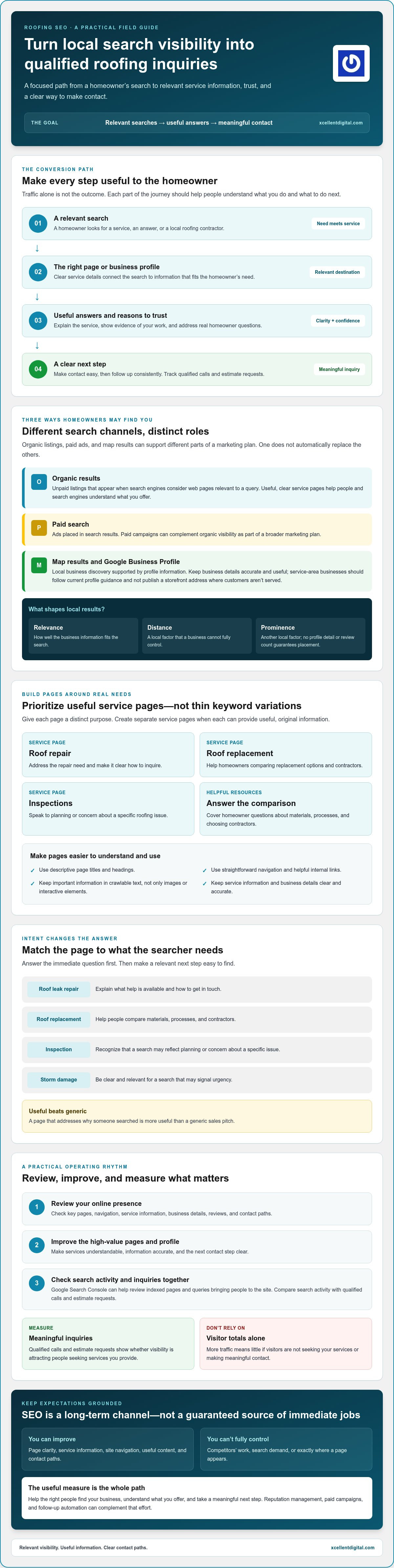
Keep the main search channels distinct. Organic results are unpaid listings that appear when search engines consider web pages relevant to a query. Paid search places ads in search results. Map results surface local businesses, often with information from their business profiles. These channels can support different parts of a marketing plan; one doesn’t automatically replace the others. A service-area business should provide accurate, useful information and follow current profile guidance. Don’t publish a storefront address where customers aren’t served.
Local visibility matters because a search for a nearby roofing service has a different context from a general research query. For a neutral introduction to local search engine optimization, see how local signals distinguish location-focused search from broader SEO. For a contractor, the practical question is whether the searcher’s need matches the services, information, and business details presented online.
How roofing customers use search before contacting a contractor
A person searching for roof leak repair may want to understand what help is available and how to get in touch. Someone researching replacement may be comparing materials, processes, and contractors. Inspection searches can reflect planning or concern about a specific issue, while storm-damage searches may signal urgency. Each query has a different intent. Answer the immediate question first, then make the next step clear. A generic sales pitch is less useful than a page that addresses the reason someone searched.
What roofing SEO can, and cannot, promise
Contractors can improve page clarity, service information, site navigation, and contact paths. They can’t control competitors’ work, search demand, or exactly where a page appears. SEO is a long-term channel, not a guaranteed source of immediate jobs. Measure its value through relevant inquiries, such as qualified calls and estimate requests, rather than visitor totals alone. A rise in traffic means little if visitors aren’t seeking services the business offers or don’t make meaningful contact.
How Google Search and Local Visibility Shape Roofing SEO
Search engines need to find, access, and understand your pages before those pages can help a potential customer. Clear navigation, crawlable content, and useful information about your services give Google stronger context than a collection of disconnected pages. For foundational guidance, Google’s SEO Starter Guide explains how to make a site easier for search engines to understand and for people to use.
Organic website results point to relevant pages; Google Maps and Business Profile visibility help people discover local businesses. These appearances work differently, so roofing search engine optimization should account for both rather than treating one as a substitute for the other. Google describes local results in terms of relevance, distance, and prominence. Accurate service information can support relevance, while distance and prominence depend on factors a business can’t fully control. No profile detail or review count guarantees a particular placement.
How a roofing website helps search engines understand your services
Organize the site around services people actually seek. Create distinct pages for repair, replacement, inspections, and other offerings when each page can provide useful, original information. Use descriptive page titles and headings, straightforward navigation, and internal links that help visitors and search engines move between related content. Keep important details in crawlable text, not only in images or interactive elements. Google Search Console can help you review which pages are indexed and what queries bring people to the site.
How Google Business Profile supports roofing discovery
Keep the profile accurate and complete. Choose an appropriate primary category, describe the services offered, maintain current hours and contact details, and add authentic photos that represent the business. Ask customers for honest feedback and respond professionally. Accurate information and genuine engagement can strengthen trust, but they don’t guarantee rankings.
If your business travels to customers and doesn’t serve them at its address, follow Google’s current service-area business eligibility and address guidelines. Don’t present an unstaffed or customer-inaccessible location as a storefront. Review the Google Business Profile optimization guide for a closer look at profile improvements. Roofing companies looking to coordinate profile work with broader search optimization can also explore XcellentDigital’s search and profile marketing support.
Which Roofing SEO Pages and Trust Signals Deserve Priority?
Build the site around the decisions roofing customers need to make. A service page should explain what the service covers and what happens next. An educational article should answer a specific question. Trust signals should help visitors assess whether the business is credible. These assets work together, but they aren’t interchangeable. Start with the services you provide and the questions customers ask, not a long list of keyword variations.
- Service pages: Explain the scope, process, and next step for work the company actually performs.
- Educational resources: Answer research questions about maintenance, material choices, warning signs, or preparing for an inspection.
- Proof elements: Show authentic reviews, accurate credentials, clear policies, and representative project examples.
Useful roofing search engine optimization gives each page a distinct purpose. Creating near-identical pages that only swap terms such as “roof repair” and “roofing repair” can leave customers with little new information. Before publishing, ask whether the page will help someone understand a service or make a more informed decision. If not, improve an existing page instead.
Build roofing service pages around real customer needs
Give each core service its own page when there’s enough useful information to make it distinct. On a replacement page, explain the general process and common questions customers may want to ask. For inspections, describe what the service includes without promising findings or outcomes. Use familiar roofing terms, and explain specialized terms in plain language. Include project examples only when they’re accurate, authorized, and representative of completed work.
Use content and reputation to earn trust
Plan educational content around genuine homeowner concerns, not a publishing quota. An article about spotting possible roof damage, comparing material options, or preparing questions before a project can help readers understand what to consider. Invite honest feedback consistently, without pressuring customers or shaping reviews to show only positive experiences. Respond professionally, and make sure photos, credentials, and policies are current and verifiable.
These fundamentals apply across service businesses, though the questions and proof that matter vary by trade. For a broader comparison, see the 2026 HVAC SEO guide, then keep your roofing content grounded in roofing services and customer needs. As you decide which services and audiences to prioritize, the U.S. Small Business Administration’s guidance on how to grow your business can also support wider planning. Use that direction to shape useful pages, not to justify thin content aimed at every possible search.
How to Put a Roofing SEO Plan into Action and Measure Progress
Make improvements in a deliberate order, then measure whether they’re attracting the right people. Before changing anything, record a baseline for key search queries, landing pages, website inquiries, and booked estimates. This gives you a comparison point later and helps distinguish meaningful progress from ordinary fluctuations.
- Audit the basics. Check whether important pages are indexed, the site works well on mobile, pages load reliably, links work, and contact options are easy to find. Review service pages for accuracy, usefulness, and duplicate content.
- Prioritize pages. Improve the pages tied to real services and customer needs first. Clarify what each page offers, fill important information gaps, and make the next step easy to understand.
- Improve local information. Check business details, service information, and contact data for accuracy wherever they appear. Keep your website and business profile aligned.
- Publish useful content. Add resources that answer relevant roofing questions, and link them to the service pages they support. Focus on clear answers, not publishing for volume.
- Review results and adjust. Compare performance with your baseline, identify what’s improving, and choose the next priority based on evidence.
What to audit before changing the website
Look for blocked or unindexed pages, broken links, mobile usability problems, slow-loading pages, and confusing routes to contact the business. Google Search Console can help review indexing and search performance. Google Analytics 4 can help assess on-site activity when it’s configured and appropriate. Use both as diagnostic tools, not as a substitute for checking whether pages answer customer questions.
Which SEO metrics connect visibility to roofing leads
Separate visibility measures from business outcomes. Impressions, clicks, queries, and rankings show how people encounter your site. Calls, form submissions, qualified inquiries, and booked estimates show whether that attention is becoming useful demand. Agree with your team on what counts as a qualified lead, then review inquiry quality alongside traffic. A rise in clicks without relevant calls or forms may point to a mismatch between the search, the page, and the service.
Review results over consistent reporting periods, while accounting for competition, site condition, available resources, and how consistently changes are implemented. There’s no fixed timeline or guaranteed ranking outcome. Paid search can provide another route to visibility while organic work develops. See this PPC guide for contractors for ways the channels can work together.
Need help turning your baseline and priorities into a focused plan? Explore search optimization support from XcellentDigital.
How to Turn Roofing SEO Visibility into a Reliable Lead-Generation System
A search result earns attention. A clear service page, easy contact options, and consistent follow-up determine what happens next. Map the journey: someone finds a relevant page, understands the service, contacts the business, answers a few qualifying questions, and receives follow-up about an estimate. If any step is confusing or inquiries go unanswered, visibility alone won’t create a dependable flow of opportunities.
Match each marketing channel to its role. Organic search can help people discover useful service and educational pages over time. Paid search can provide another route to visibility for selected queries. Reputation management supports trust as prospects compare businesses. These efforts can reach customers at different decision stages, but they work best when landing pages and lead handling are ready for the interest they generate.
When to manage roofing SEO in-house or seek agency support
In-house work can make sense when your team has the skills, website access, and time to maintain improvements consistently. Agency support may help when you need specialized expertise or a clearer work plan—for assistance with strengthening your web presence, check out Local Point Marketing. Either way, ask how recommendations are explained and how reporting connects search activity to qualified inquiries, not just rankings. Clarify who owns the website, accounts, and content, and be wary of guaranteed rankings or results that aren’t backed by transparent reporting.
Connect search visibility with prompt lead response
Set a defined process for new calls and forms: acknowledge the inquiry, capture the details your team needs to assess fit, route complex questions to staff, and track estimate follow-up. AI agents and lead response automation can support parts of this workflow, such as acknowledging an inquiry or organizing its information. They shouldn’t replace human judgment about roofing needs, service suitability, or estimates. Decide which questions require a person and make responsibility for follow-up clear.
Before choosing an in-house approach or marketing partner, use this checklist:
- Roofing experience: Can they explain how their recommendations fit roofing customers and services?
- Transparent reporting: Will you see the work completed and how inquiries are measured?
- Realistic expectations: Do they discuss uncertainty and avoid ranking guarantees?
- Defined responsibilities: Is it clear who manages website access, content, lead routing, and follow-up?
Strong roofing search engine optimization is one part of a connected lead-generation system, not a shortcut around clear communication and follow-through. If you’re assessing how search and lead handling could work together, talk with XcellentDigital about roofing lead generation.
Turn Search Visibility into Steady Progress
Roofing search engine optimization works best as a connected system, not a race for rankings. Make it easier for search engines to understand your services, then give homeowners useful pages and clear reasons to trust your business. Keep local information accurate, and measure progress by relevant inquiries and booked estimates, not traffic totals alone.
Most importantly, close the gap between discovery and follow-up. Clear contact options, a defined response process, and consistent lead tracking help your team understand whether visibility is creating real opportunities. Organic search can build a lasting source of discovery, while paid campaigns and reputation management support other points in a customer’s decision process.
You don’t need to tackle every SEO task at once. Start with the pages and contact paths that matter most, establish a baseline, and improve with purpose. If you’re ready to shape those priorities into a practical lead-generation plan, talk with XcellentDigital about roofing lead generation. With a clear plan and steady follow-through, your online presence can become a stronger path to the right customer conversations.
Frequently Asked Questions
What is roofing search engine optimization?
Roofing search engine optimization helps a roofing company appear in relevant unpaid search results and helps its website turn visits into inquiries. The work may include improving service pages, site structure, useful content, and local business information. The aim isn’t simply to attract more visitors. It’s to help people looking for services the company provides find clear answers and a straightforward way to get in touch.
How long does SEO take to work for a roofing company?
SEO takes time, and there’s no reliable fixed timeline for rankings or inquiries. Progress depends on factors such as the website’s current condition, competition, the work involved, and how consistently improvements are made. Establish a baseline before making changes, then review relevant queries, landing-page activity, and qualified inquiries over time. Treat SEO as a long-term marketing channel, not a guaranteed way to generate immediate jobs.
How much does roofing SEO cost?
There isn’t one standard price for roofing SEO. Costs depend on the scope of work, competition, website condition, and level of ongoing support. Compare proposals by what they include, who completes the work, how progress is reported, and whether inquiry quality is considered alongside search visibility. Be cautious of guaranteed rankings or unclear deliverables. Ask a provider to explain its recommendations and how you’ll evaluate them.
Can SEO help a roofing company get more local leads?
Yes, SEO can help potential customers discover relevant roofing services through organic search and local results. Results depend on factors such as the searcher’s location, the relevance of the business information, competition, and the usefulness of the website. Support visibility with accurate profile details, service-specific pages, clear contact options, and a process for tracking calls and forms. Measure qualified inquiries, not just visits or ranking changes.
What pages should a roofing company have on its website?
Start with clear pages for each core service the company actually provides, such as roof repair, replacement, or inspections. Add useful resources that answer customer questions about maintenance, materials, warning signs, or preparing for a project. Include trust-building information, such as authentic reviews, accurate credentials, clear policies, and authorized project examples. Each page should have a distinct purpose and make the next step easy to find.
Does a roofing company need a Google Business Profile for SEO?
A Google Business Profile can support local discovery by showing business information in Google’s local results and Maps. Keep its category, services, hours, contact details, and other information accurate. Businesses that travel to customers should follow Google’s current eligibility and address guidelines rather than presenting an ineligible location as a customer-facing storefront. A profile can support visibility, but it doesn’t guarantee a particular ranking or lead volume.
Can roofing SEO generate emergency repair leads?
SEO may help people searching for urgent roof repairs find relevant service information and contact options. It can’t guarantee emergency inquiries or establish that a company is available at a particular time. Clearly describe the services offered, the appropriate contact method, and any relevant limitations. Make sure the team has a defined process for handling urgent requests, and avoid suggesting immediate or after-hours availability unless the business can genuinely provide it.













Leave a Reply
Want to join the discussion?Feel free to contribute!