

PPC Management Services: How to Turn Ad Spend Into Qualified Leads in 2026
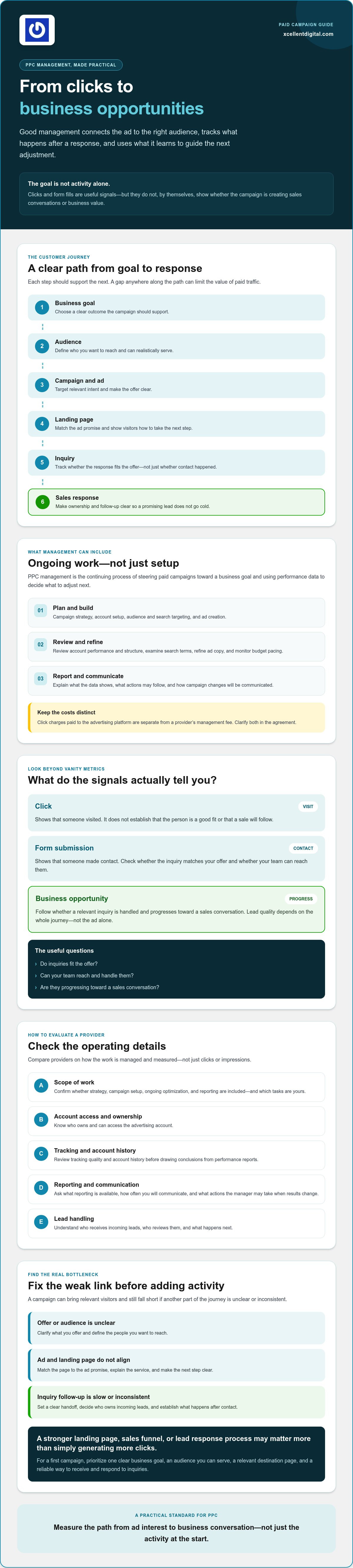
What good is a steady stream of clicks if it doesn’t turn into booked work or sales? If your ad spend feels disconnected from real business opportunities, it’s worth asking what your ppc management services are actually doing. Clicks and form fills matter, but they’re only part of the picture.
Effective management connects the ad message to the right audience, keeps campaigns aligned with clear goals, and tracks what happens after someone responds. Follow-up matters, too: even a promising lead can go cold if the next step is slow or inconsistent.
This guide explains what ongoing PPC management can include and how to evaluate a provider’s goals, reporting, and communication without getting lost in jargon. You’ll also learn how campaign strategy can connect with sales funnel development and lead response, so paid traffic has a clearer path toward a business outcome. The aim is simple: help you judge whether your advertising is building momentum, not just activity.
Key Takeaways
- Use a clear scope of work to see whether ppc management services cover strategy, campaign setup, ongoing optimization, and reporting.
- Match ad messaging and landing pages to what potential customers are looking for, then trace the path from inquiry to sales response.
- Compare providers on account access, tracking, communication, and lead handling, not just clicks or impressions.
- Review account history and tracking quality before drawing conclusions from campaign performance reports.
- Address the actual bottleneck. A stronger landing page, sales funnel, or lead response process may help turn inquiries into business opportunities.
What PPC Management Services Include and What They Should Accomplish
Pay-per-click (PPC) advertising lets a business pay when someone clicks an ad. PPC management services cover the ongoing work of planning, building, reviewing, and improving campaigns, rather than simply placing an ad and leaving it to run.
In plain terms, PPC management is the continuing process of steering paid campaigns toward a business goal and using performance data to decide what to adjust next. That work can include campaign strategy, account setup, audience and search targeting, ad creation, monitoring, optimization, and reporting. The click charges paid to an advertising platform are separate from any management fee. Clarify both in a provider agreement.
Management should support a useful outcome, such as attracting inquiries from people who fit your offer. Campaign results also depend on your offer, audience, landing page, competition, and lead follow-up. A campaign can bring relevant visitors and still fall short if the page is unclear or inquiries aren’t handled consistently.
What does a PPC manager handle each month?
Ongoing work may include reviewing account performance, checking campaign structure and targeting, examining search terms, refining ad copy, and monitoring budget pacing. The manager uses campaign data to identify what may need attention. A one-time setup alone can’t provide that continuing oversight.
Before work begins, confirm the specific deliverables, who owns and can access the advertising account, which tasks are yours, and how often you’ll communicate. Ask what reporting is available and what actions the manager may take when results change.
Which businesses can benefit from professional PPC management?
Professional help may suit a business that wants more control over paid traffic but lacks the time or in-house experience to manage campaigns consistently—to see how an agency structures full-service campaigns and growth strategies, visit Social: Managed.. An agency isn’t necessary for every company. First, check that you have:
- A clear offer and a defined audience to reach.
- A relevant destination page where people can take the next step.
- A reliable way to receive and respond to inquiries.
For a first campaign, prioritize one clear business goal and an audience you can realistically serve. If leads can’t be reached or handled, address that gap before increasing campaign activity. The aim isn’t simply to generate clicks. It’s to create a workable path from ad interest to a business conversation.
How PPC Management Connects Ad Intent to Qualified Leads
A paid campaign works best when each step supports the next: business goal → audience → campaign → landing page → inquiry → sales response. For example, if the goal is to attract people interested in payroll support, the campaign should reach a relevant audience, make the offer clear, and send visitors to a page that explains the service and how to inquire. The business then needs a clear process for handling that inquiry.
Clicks and form submissions are useful signals, but they don’t prove that a campaign is generating revenue. A click shows that someone visited; a submission shows that someone made contact. To judge business value, check whether inquiries match your offer, whether your team can reach them, and whether they progress toward a sales conversation. For a straightforward explanation of how pay-per-click campaigns work, see the Corporate Finance Institute’s overview.
Lead quality depends on the whole journey, from the intent behind the click to the response that follows, not on the ad alone.
How do PPC campaigns attract the right prospects?
Start with a clear offer and a defined audience. For search campaigns, the words people use can reveal intent. Someone looking for a specific service may be closer to taking action than someone researching a broad topic. Audience-based campaigns can also introduce an offer to people who aren’t actively searching. Neither approach is automatically better. The right fit depends on your goal, audience, and ability to follow up.
Keep the ad promise and landing page aligned. If an ad promotes a particular service, the destination should make that service easy to understand and show visitors how to take the next step. For an industry-specific example of intent-focused campaigns, explore this PPC guide for contractors.
Why does lead response matter after the click?
An inquiry can lose momentum if no one knows who owns it, what happens next, or how quickly the business should respond. Set a clear handoff: decide who reviews incoming leads, how they’re contacted, and how the outcome is recorded. A business growth and automation framework can also help you think about how marketing activity fits into business workflows.
Lead response automation may help support prompt, consistent engagement, but it can’t replace a relevant offer or a useful conversation. If you’re assessing how PPC and lead response automation could fit your process, explore XcellentDigital’s PPC and lead response services.
How to Compare PPC Management Services Without Chasing Vanity Metrics
Choosing between ppc management services means looking beyond polished dashboards and promises. Ask how the provider will manage your account, measure meaningful actions, explain decisions, and connect campaign activity to lead quality. A credible agency should be clear about what it can influence and what it can’t control. No provider can guarantee a particular business result.
| Area | What to clarify | What to look for |
|---|---|---|
| Scope | Which campaign tasks are included? | Defined responsibilities for setup, review, and ongoing changes. |
| Account access | Who owns the account, and who can access it? | Your business retains appropriate access and visibility. |
| Tracking | What counts as a conversion? | Actions reflect meaningful inquiries or transactions, not just page activity. |
| Reporting | Which metrics and limitations will be shown? | Reports connect campaign activity to goals and explain gaps in attribution. |
| Communication | Who shares updates, and how are decisions approved? | A clear contact and an agreed communication cadence. |
| Lead handling | How are inquiries routed and reviewed? | Responsibilities for follow-up and sharing lead-quality feedback are understood. |
Which PPC metrics help you judge campaign quality?
Metrics tell different parts of the story. Impressions count ad appearances; clicks count visits from those ads. Click-through rate is the share of impressions that produce clicks. Conversion rate is the share of measured visits or interactions that complete a defined action. Cost per lead is campaign spend divided by the leads recorded.
Those numbers are only useful if the conversion action matters. A page view isn’t equivalent to a qualified inquiry. Compare trends with your own goals, historical data, and feedback on whether leads fit your offer. Treat performance figures published by a competing agency as results from that company’s specific situation, not as a benchmark your campaign should automatically match.
What questions should you ask a PPC management provider?
Ask who owns the advertising account, who approves changes, and how the provider will explain its decisions. Find out how it defines a conversion and a qualified lead, what attribution can and can’t show, and what information your team must supply, such as offer details, landing page access, and sales feedback.
If you’re considering paid social alongside search, use this Facebook Ads lead generation guide to explore how campaign management can differ by channel.
What to Expect During PPC Onboarding, Reporting, and Optimization
A reliable process starts before launch. With ppc management services, onboarding should establish what the campaign is meant to accomplish, verify what can be measured, and clarify how decisions will be made. Without that groundwork, a report may show activity without explaining whether it supports your business goals.
What should PPC onboarding cover?
Expect discovery to cover your goals, target customers, offer, and lead-handling process, along with any existing campaigns and measurement needs. The provider should then review account history and tracking quality. Past results can be misleading if conversion actions were set up incorrectly, changed over time, or don’t reflect meaningful inquiries. Check these before treating performance trends as reliable.
Before launch, confirm which advertising platforms are included and how tracking will be implemented. Agree on account permissions, who approves changes, what information your team must provide, and how the provider will communicate. Clear roles prevent avoidable delays and surprises.
A typical process moves through discovery, account and tracking review, launch planning, monitoring, and recurring review. The plan should identify the agreed goal, intended audience, campaign approach, and signals the team will use to assess progress.
How should PPC reporting guide optimization?
Useful reporting is concise and tied to the goals you agreed on. It should explain what changed, what the available data shows, what remains uncertain, and what the provider recommends doing next. Optimization is an ongoing cycle of testing and informed adjustment, not a promise that every change will improve results.
Bring sales feedback into the discussion. A report may show inquiries, but your team can say whether those leads fit the offer and whether they progressed. Discuss attribution gaps and factors outside ad control, such as changes to the offer, landing page, competition, or follow-up process. That context helps separate campaign signals from business outcomes.
Use this checklist to assess transparency and prepare your team:
- Are goals, deliverables, platform scope, and responsibilities written down?
- Can you access the advertising account and understand who approves changes?
- Has the provider checked account history and confirmed how meaningful inquiries will be measured?
- Does each report explain decisions, limitations, and the next steps?
- Can your team provide offer details, needed access, and timely feedback on lead quality?
If you’re looking for a partner to connect campaign management with broader marketing support, explore XcellentDigital’s digital marketing services.
When PPC Management Services Should Include Funnel and Lead Follow-Up
More campaign activity won’t fix every lead-generation problem. Before adding services, identify where prospects are dropping out. If people click an ad but leave the landing page without taking action, the page may not clearly explain the offer or next step. If inquiries arrive but don’t become conversations, unclear ownership or inconsistent follow-up may be the real bottleneck. The right support depends on what’s actually getting in the way.
That’s when ppc management services may need to connect with a stronger landing page, sales funnel, or lead-response process. These pieces should work together, but they shouldn’t be added automatically. Look at the evidence: where people hesitate, what your team hears from prospects, and what happens after an inquiry comes in.
How can a sales funnel support paid campaigns?
A focused landing page carries the ad’s promise forward. It should make the offer easy to understand, answer relevant questions, and give visitors a clear call to action. After someone responds, a defined handoff helps the right person continue the conversation.
Sales funnel development can help align campaign messaging with the steps that follow, from the first visit to the next sales conversation. The structure should reflect the offer and the friction you’ve observed. For instance, if prospects submit a form but aren’t sure what happens next, clearer next-step information may help address that uncertainty. There’s no universal funnel template that suits every business.
How can lead automation fit alongside PPC management?
Lead response automation may support consistent engagement and routing after an inquiry, helping a business organize what happens next. It works best when the team has agreed on who owns each lead, what messages are accurate and appropriate, and when a person should take over. Automation can support the process, but it doesn’t replace human judgment or a useful sales conversation.
XcellentDigital offers PPC and Facebook Ads, as well as sales funnel development, AI agents, and lead response automation. These services can be discussed as connected parts of a lead-generation process, based on the needs and bottlenecks identified in your business. No service can guarantee a specific lead volume, response time, or campaign result.
Ready to discuss where your paid campaigns may be losing momentum? Talk with XcellentDigital about your PPC goals.
Make Your Ad Spend Work as a Connected System
Strong PPC performance takes more than a well-built campaign. The right audience needs a relevant message and landing page, while clear tracking helps show whether inquiries fit your business goals. Just as important, someone needs to own the next step after a prospect reaches out.
Evaluate ppc management services by the work behind the numbers: campaign oversight, transparent reporting, clear communication, and a plan for learning from lead quality. If inquiries stall, look for the actual bottleneck before adding a landing page, sales funnel, or automation. Focused improvements can make the path from ad click to sales conversation easier to understand and manage.
XcellentDigital offers PPC and Facebook Ads management, along with sales funnel development, AI agents, and lead response automation. These services can be discussed as connected parts of your lead-generation process, based on your goals and needs. Talk with XcellentDigital about your PPC goals and identify the next practical step. With a clear plan and consistent follow-through, you can move beyond counting clicks and build a stronger foundation for growth.
Frequently Asked Questions
What do PPC management services include?
PPC management services typically include campaign planning, account setup or review, audience or keyword targeting, ad creation, ongoing monitoring, optimization, and reporting. The exact scope varies by provider, so confirm which tasks are included and who handles them. Ask how the provider defines a conversion, what account access you’ll retain, and how campaign activity connects to inquiries and sales feedback. Click charges and management fees are separate considerations.
How do I know if PPC management is working?
Look beyond impressions and clicks. Agree on a meaningful conversion, such as a qualified inquiry or completed transaction, then review whether leads fit your offer and progress through your sales process. Compare results with your business goals and account history, while checking that tracking is reliable. A useful report explains what changed, what the data suggests, what remains uncertain, and what action comes next.
How much do PPC management services cost?
Costs depend on the provider’s fee structure, the work included, campaign complexity, and advertising budget. A management fee may be charged separately from the amount paid to advertising platforms, so ask for both to be clearly explained. Some providers use a flat fee, a percentage of ad spend, or a combined model. Request a written scope and clarify whether setup, creative work, reporting, and ongoing optimization are included.
How long does it take for PPC management to show results?
There’s no universal timeline. Early activity may appear soon after campaigns launch, but judging lead quality or business impact can take longer, depending on traffic, competition, the offer, tracking quality, and how quickly inquiries are handled. Ask the provider what early indicators it will review and when it expects enough reliable data to assess progress. Avoid treating a short-term change as proof of lasting performance.
Should I hire a PPC agency or manage campaigns myself?
Manage campaigns yourself if you have the time, skills, and processes to monitor them, assess performance, and make informed changes. An agency may be useful if campaign oversight competes with other responsibilities or you need help connecting paid traffic to lead generation. Compare the expected workload with your internal capacity. Before hiring, clarify account access, deliverables, communication, and what your team must contribute.
Can PPC management services help generate better-quality leads?
They can support better lead quality by aligning targeting, ad messaging, and landing pages with the people your business can serve. Lead quality also depends on the offer, competition, and what happens after someone inquires. Share sales feedback with the campaign manager, including which leads fit and which don’t. If responses are inconsistent, a clearer handoff or lead response process may also be worth considering.
What should I ask before choosing a PPC management company?
Ask what the service includes, who owns and accesses the ad account, and who approves campaign changes. Find out how conversions and qualified leads are defined, what the reports show, and where attribution has limitations. Confirm how often you’ll communicate and what your business needs to provide, such as offer details, landing page access, and feedback on sales outcomes. Look for clear explanations, not guaranteed results.













Leave a Reply
Want to join the discussion?Feel free to contribute!