

Hiring a Local Ad Agency vs. a National One: How to Choose in 2026
The closest ad agency isn’t automatically the best fit, and a national team isn’t automatically out of touch. When you’re weighing hiring a local ad agency vs a national one, the real question is whether the team can understand your customers and turn that insight into measurable growth.
Local knowledge can be valuable, but an agency’s address won’t tell you how it communicates, manages campaigns, reports on performance, or connects advertising with search visibility and lead follow-up. A nearby team may have useful market familiarity, while a nationally serving agency may offer the channel capabilities your business needs.
This guide compares agency models based on local insight, service depth, communication, and measurement. Use the criteria to identify what your business needs and how to evaluate whether an agency can deliver it. You’ll also see how a nationally serving agency can build campaigns around local customer intent, bringing broad digital capabilities and relevant local strategy into the same growth process.
Key Takeaways
- When weighing hiring a local ad agency vs a national one, compare how each team’s operating model fits your goals, customers, and campaign reach.
- Assess how an agency uses audience research, customer feedback, search intent, and campaign data to shape locally relevant messaging.
- Compare agencies using the same goals, channels, audience, and conversion definitions so their strategies and reporting are easier to evaluate.
- Use a practical decision process to identify whether you need focused campaign support or connected marketing and automation.
- Advertising, search visibility, and lead follow-up can work together to support locally targeted customer acquisition.
Hiring a Local Ad Agency vs. a National One: What Actually Changes?
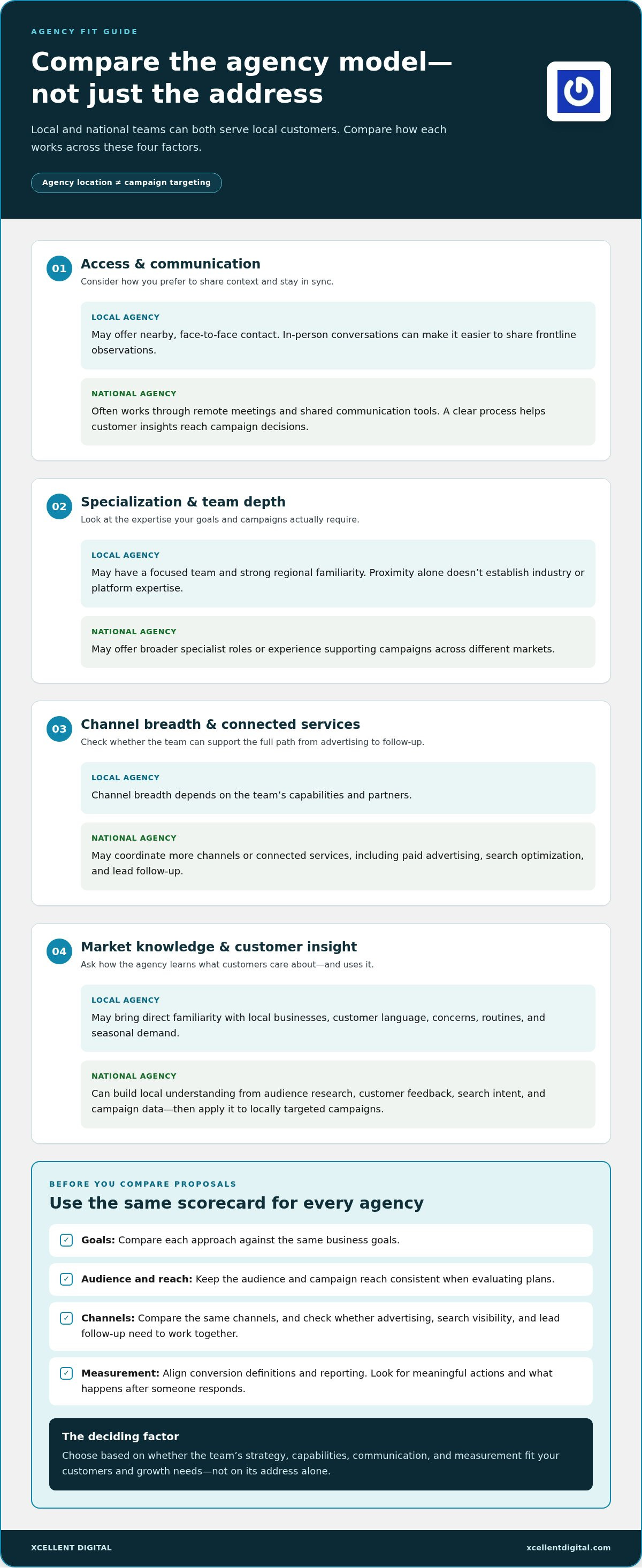
Local familiarity can sharpen an advertising message, but a nearby office doesn’t guarantee a stronger campaign. The difference between local and national agencies is usually how they operate: their team structure, expertise, and experience supporting campaigns across different markets. An agency’s location alone doesn’t determine where your ads can run or how effectively they can reach local customers.
The terms describe an agency’s operating footprint, not the boundaries of its campaign targeting. A local agency may focus on clients in a limited area, while a national agency may serve businesses across a broader footprint. Either can support a business whose customers are local. As local, national or global advertising suggests, campaigns can be planned for different geographic scopes, regardless of where the agency is based.
What makes an ad agency local or national?
Physical proximity may make in-person conversations easier, but it isn’t the same as understanding customer behavior. An agency builds market familiarity by learning what customers search for, what influences their decisions, and what makes them choose one business over another. A national agency can apply that research to locally targeted campaigns. A local agency may bring firsthand familiarity, but still needs a clear strategy and reliable execution.
| Factor | Local agency | National agency |
|---|---|---|
| Access | May offer nearby, face-to-face contact. | Often works through remote meetings and shared communication tools. |
| Specialization | May have a focused team and strong regional familiarity. | May offer broader specialist roles or experience across markets. |
| Channel breadth | Depends on the team’s capabilities and partners. | May coordinate more channels or connected services under one structure. |
| Market knowledge | May bring direct familiarity with local businesses and customer context. | Can build local understanding from audience research, customer feedback, search intent, and campaign data. |
Does being nearby automatically mean better advertising?
Local context can make messaging more relevant. It may help an agency recognize customer concerns, buying triggers, or differences in how people describe a need. But context matters only when it informs the offer, audience, and campaign decisions. Personal access can make conversations easier; it doesn’t replace strategic expertise, consistent campaign management, or clear reporting.
Hiring a local ad agency vs a national one shouldn’t come down to an address. Results depend on whether the strategy fits your goals, the campaign reaches the right audience, and measurement tracks meaningful actions. The offer matters, too, as does what happens after someone responds. A national agency can build around local customer intent, while a local team can deliver broader expertise if it has the right capabilities. Judge the fit by the work and how it’s measured.
Local Knowledge vs. National Capabilities: Which Matters More?
Distance doesn’t prevent an agency from learning a market. Strong local messaging comes from useful customer insight, not an office address. Search terms, customer conversations, reviews, campaign responses, and sales-team feedback can reveal what people care about, how they describe a need, and what makes them take action. The right agency turns those signals into creative and targeting decisions, then reviews performance to see what resonates.
That’s the real choice in hiring a local ad agency vs a national one: which combination of context and capability suits your growth needs? Neither model wins by default. A nearby agency may bring familiarity and convenient face-to-face access. A nationally serving team may bring channel specialists or connected services. Either advantage matters only if it supports your customers and business goals.
Where local agencies can have an advantage
Local familiarity can help an agency recognize the language customers use, the concerns they raise, and the seasonal patterns that shape demand. For example, a business with a predictable busy season may need campaign timing and messaging that reflect how customers plan and buy. In-person conversations can also make it easier to share frontline observations. If you want to explore how a specialized regional firm handles online presence and marketing, you can discover Troyer Websites as an example of focused local service. Still, proximity doesn’t prove an agency has deeper industry knowledge or stronger expertise with a particular advertising platform.
Where a national agency can bring added capability
Broader teams may offer specialists across paid advertising, search optimization, and lead follow-up. That can help when growth depends on more than one channel. Remote collaboration can still incorporate customer interviews, feedback, search intent, and location-based targeting. The important part is having a clear process for sharing insights and applying them to campaign decisions.
Automation and reporting can connect a campaign to what happens after a prospect responds. Lead response automation and AI agents, for example, can support more consistent follow-up, while practical reporting helps teams understand which sources produce meaningful actions. These tools support the process; they don’t replace a relevant offer or thoughtful strategy.
| Consideration | Potential local strength | Potential national strength |
|---|---|---|
| Customer context | Familiarity with local language, routines, and seasonal demand | Research-led insight applied across targeted markets |
| Team capabilities | Direct access and a focused team | Access to channel specialists and connected services |
| Coordination | In-person conversations may feel straightforward | Remote tools can connect campaign work, reporting, and follow-up |
For a clearer picture of how these capabilities can work together, explore connected digital marketing and automation. Choose the model that can use customer insight, execute consistently, and measure progress against the outcomes your business values.
How to Compare Ad Agencies on Strategy, Service, and Results
Make the comparison fair: give each agency the same business goal, target audience, channels, and definition of a conversion. One proposal might count a completed form as success; another might focus on qualified leads or booked opportunities. Without shared definitions, their plans and reports won’t be directly comparable.
Look beyond the pitch. A campaign is a chain of connected work: strategy sets the direction, creative gives people a reason to respond, campaign management reaches the intended audience, reporting shows what is happening, and lead follow-up helps turn interest into a sales opportunity. A gap anywhere in that chain can make advertising activity look stronger than its business value.
What should an agency’s reporting help you understand?
Useful reporting connects campaign activity to outcomes your business cares about. Clicks and form fills can show that people engaged, but they don’t reveal on their own whether those leads fit your offer, booked an appointment, or became customers. A practical report explains which metrics it tracks, how conversions are counted, and what the available data can and can’t attribute to a campaign.
Look for interpretation, not just a dashboard. Reporting should help explain what changed, what appears to be working, and what decision the data supports next. If one channel generates more form fills but those inquiries rarely qualify, that context matters more than the raw lead count.
How should services work together?
Paid advertising, search visibility, and lead response should support one customer journey. Someone may see a Facebook ad, look up the business, compare its online presence, and then submit a request. Campaign messaging, useful search information, and a clear follow-up process can each influence whether that person moves forward.
For channel-specific planning, explore this Facebook Ads local lead generation guide. Google Business Profile optimization can also support locally focused acquisition by helping a business present useful information to people searching for it. This Google Business Profile optimization guide covers that channel in more detail.
- Strategy: Does the plan connect your audience and offer to a defined business goal?
- Creative and campaign management: Is there a clear way to refine messaging and targeting based on performance?
- Measurement: Are conversions defined consistently, with attribution limits explained?
- Lead follow-up: Is it clear how inquiries are handled and how lead quality informs campaign decisions?
This gives you a stronger basis for hiring a local ad agency vs a national one: compare how each approach connects campaign execution to qualified opportunities, not just activity. The right fit makes ownership, measurement, and next steps clear.
A Practical Framework for Choosing the Right Ad Agency
Choose an agency by working backward from the business problem, not forward from a list of services. A focused campaign may solve a clear visibility gap. If leads also need nurturing, search support, and consistent follow-up, a connected approach may fit better. Use these five steps to make the choice practical.
- Name the growth problem. Decide whether you need more visibility, more leads, better-qualified inquiries, or faster responses. Be specific about what needs to change.
- Define your customer geography. Identify where your customers are and where you want to reach them. This helps shape targeting and messaging, and clarifies whether your needs focus on one market or span multiple markets.
- Map the required channels. Match the problem to the work needed. A defined advertising goal may call for focused campaign support. If paid advertising, search visibility, and lead follow-up all need attention, consider how those pieces could work together.
- Check your team’s capacity. Consider who will respond to inquiries, qualify leads, and track what happens after a conversion. If your internal team has limited capacity, lead response automation may help support a more consistent process.
- Set measurable expectations. Agree on what counts as a qualified lead or conversion, what reporting will cover, how often progress will be reviewed, and who makes campaign decisions.
Match the agency model to your immediate business need
A specialized agency or team may suit a single, well-defined campaign need. A broader agency model may be more useful when several channels and lead-handling steps must work together. Neither is automatically better. The fit depends on the challenge, your available staff, and how much coordination you want to manage internally.
Set clear expectations before choosing
Compare proposed strategies against the same goals, audience, channels, and conversion definitions. Look for a clear communication rhythm and clarity about campaign ownership, reporting, and lead handling. Strong planning sets realistic expectations; it doesn’t promise a guaranteed result. Make sure the approach explains what will be measured and how those findings will inform decisions.
When hiring a local ad agency vs a national one, this framework keeps the focus on practical fit: customer reach, capabilities, communication, and accountability. If growth and follow-up need to work together, explore growth and automation support.
How XcellentDigital Connects Local Lead Generation With National Expertise
Hiring a local ad agency vs a national one doesn’t have to mean choosing between local relevance and broader digital capabilities. XcellentDigital serves businesses nationally and focuses on lead generation and business growth. Campaigns can be built around local customer intent, with advertising, search visibility, and follow-up aligned to the audiences a business wants to reach.
Build visibility around the way customers search
Search optimization and Google Business Profile optimization support local discovery by helping businesses appear where potential customers look for relevant information. Paid campaigns, including Facebook Ads and pay-per-click advertising, can focus on relevant audiences and service-area intent. Geofencing offers another location-based advertising approach, while reputation programs help businesses manage their online reputation as prospects research their options.
These channels work best when they reinforce the same offer and make the next step clear. A paid ad can introduce a business; search visibility and a well-maintained profile can provide additional context as someone considers reaching out. The campaign focus should reflect the business’s goals and the customers it wants to attract.
Turn incoming interest into a managed sales process
Generating interest is only part of the job. A sales funnel organizes the steps from an initial click or search through a prospect’s action, helping keep the message and next step connected. Lead response automation and AI agents can support consistent prospect engagement, while practical reporting can help show where inquiries come from and what happens after they arrive.
When advertising, search visibility, and follow-up are disconnected, it can be harder to understand which parts of the process need attention. Connecting them creates a clearer view of the customer journey, from discovery to inquiry and subsequent engagement. For a deeper look at how automation supports a connected growth process, read this lead response automation framework.
XcellentDigital brings advertising, search optimization, Google Business Profile services, geofencing, reputation programs, sales funnels, and automation together around lead generation. The right combination depends on your goals, customer intent, and how your team handles incoming prospects. Explore XcellentDigital’s digital marketing and automation solutions to see how connected campaign support can fit into your growth plans.
Choose the Agency That Moves Your Growth Forward
The right agency isn’t defined by how close its office is. It’s the team that understands your customers, matches its capabilities to your goals, and makes campaign performance clear. As you weigh hiring a local ad agency vs a national one, compare how each approach handles strategy, reporting, and the journey from first click to qualified lead.
Look for a plan that fits your customer geography and your team’s capacity. Strong execution connects advertising with search visibility and lead response, rather than treating each as a separate task. Google Business Profile optimization and reinstatement can also support a business’s local search presence.
XcellentDigital brings digital advertising, search optimization, and lead response automation together to support lead generation and business growth. Explore XcellentDigital’s digital marketing and automation solutions to see how a connected approach can fit your goals. Choose with clarity, measure what matters, and take your next growth step with confidence.
Frequently Asked Questions
Is a local ad agency better than a national one?
Neither is automatically better; the right choice depends on your goals, required services, and how you want to work with the agency. A local team may offer convenient in-person access or familiarity with local customer context. A national agency may bring broader digital capabilities and still build campaigns around local intent. When weighing hiring a local ad agency vs a national one, compare strategy, communication, reporting, and lead follow-up rather than relying on location alone.
Can a national ad agency understand my local market?
Yes. A national agency can build local understanding through audience research, customer feedback, search behavior, and campaign data. For example, it can learn which phrases customers use, what questions they ask, and which messages prompt meaningful inquiries. That insight can shape location-targeted campaigns and locally relevant creative. Distance may affect how you meet, but it doesn’t prevent an agency from learning about your customers and applying that knowledge to advertising decisions.
How do I choose between a local and national marketing agency?
Start with the business problem you need to solve, such as low visibility, too few leads, or slow follow-up. Define your target audience and customer geography, then identify the channels and support required. Consider your team’s capacity to handle incoming inquiries. Compare agencies using the same goals, conversion definitions, and reporting expectations. Choose the model that fits the work and communication style you need, not simply the one with the nearest office.
What should I look for when hiring an ad agency?
Look for a clear strategy tied to your audience, offer, and business goals. Make sure the agency explains what it will manage, how it defines conversions, and what its reporting can and can’t show. Consider how campaign insights inform next steps and how lead quality or follow-up factors into the strategy. Clear communication and ownership matter, too. Strong reporting should help you make decisions, not just display clicks, impressions, or form submissions.
Do national ad agencies work with small businesses?
Yes. National agencies can work with small businesses, including those focused on attracting customers in a defined service area. The important question is whether the agency’s strategy and scope fit your needs. A smaller business may need a focused campaign, while another may benefit from coordinated advertising, search visibility, and lead response support. Set clear goals and expectations so the proposed work aligns with your team’s capacity and growth priorities.
Can one agency manage local advertising and lead follow-up?
Yes. An agency with connected capabilities can coordinate locally targeted advertising with search optimization, sales funnels, and lead response automation. XcellentDigital brings digital advertising, search optimization, and automation together, with services including Facebook Ads, Google Business Profile optimization, AI agents, and lead response automation. This can help connect campaign activity to the next steps in the customer journey, while practical reporting supports decisions about what to refine.
Does hiring a local ad agency guarantee better results?
No. Proximity alone can’t guarantee better advertising results. Performance depends on factors such as the business goal, audience, offer, campaign execution, measurement, and how inquiries are handled. A local agency may bring useful market context, but that insight still needs to inform a well-managed strategy. Set realistic expectations, define meaningful conversions, and review what happens after a lead comes in. Choose the agency whose approach best fits those needs.













Leave a Reply
Want to join the discussion?Feel free to contribute!