

How to Build a Lead Scoring Model for a Small Business
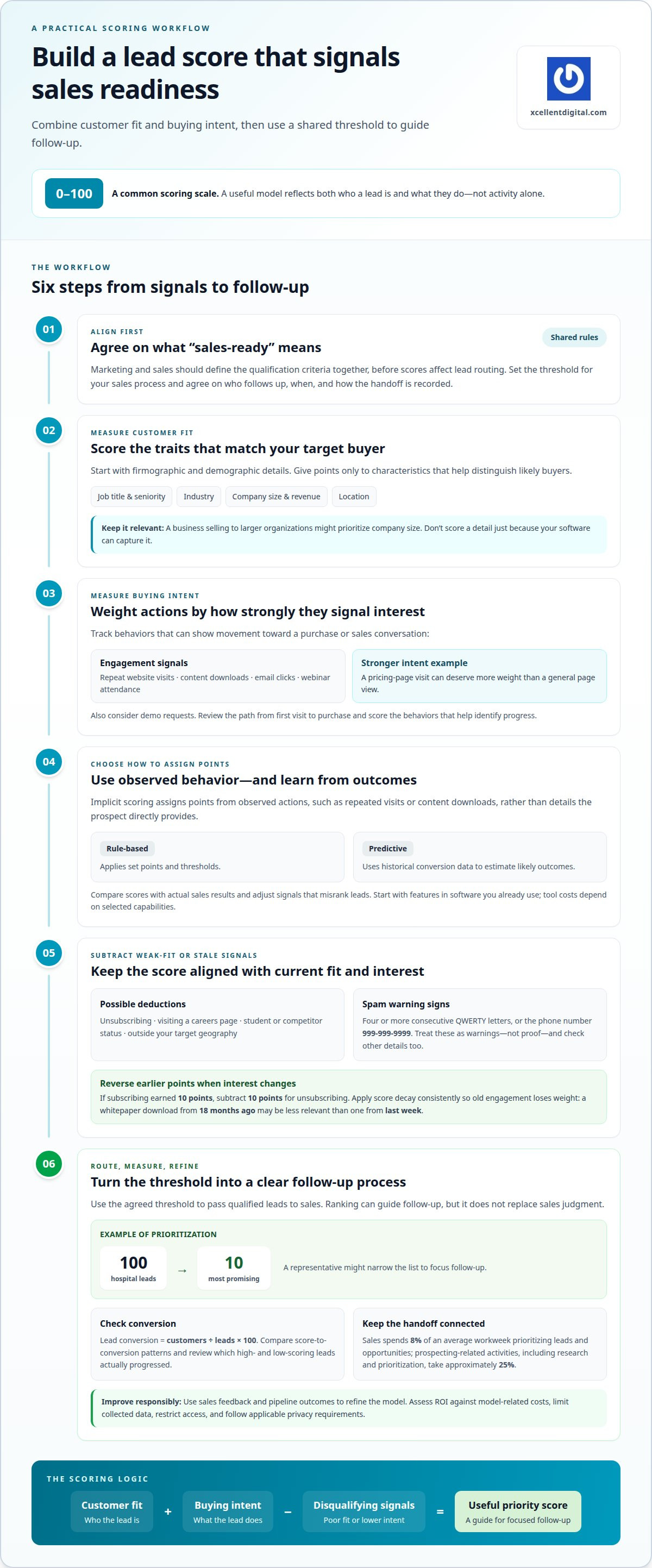
A high lead score should signal sales readiness, not just frequent activity. Lead scoring models for small businesses typically use a 0-to-100-point scale, combining details about a prospect’s fit with actions that show buying intent. The useful model isn’t the most complicated one; it’s the one that helps your team focus on leads that match your goals.
It’s frustrating when sales time goes to poor-fit prospects while promising leads wait for a response. A clear lead scoring model can help your small business prioritize follow-up, but it works only when marketing and sales agree on what makes a lead qualified.
Choose useful scoring signals, set a threshold that fits your sales process, and subtract points for disqualifying signs. Keep the model simple, then refine it as you learn which leads become customers.
Key Takeaways
- Combine customer-fit details with buying signals so scores reflect both who a lead is and what they do.
- Agree on sales-ready criteria across marketing and sales, then connect the threshold to a clear follow-up process.
- Subtract points for signals that suggest poor fit or low intent, so weak prospects don’t crowd out stronger opportunities.
- Start with a simple model, then refine its criteria using sales feedback and the leads that move toward a sale.
What Is a lead scoring model?
A lead scoring model assigns points to prospect details and actions, then combines them into a score. Many models use a scale from 0 to 100, helping a sales team prioritize leads by fit and interest.
-
Identify Behavioral and Demographic Signals
List the characteristics of your target customer, such as job title, seniority, industry, company size, revenue, and location. Assign points to the traits most relevant to your sales goals. For example, a business selling to larger organizations might prioritize company size. Don’t score details just because your software can capture them: each signal should help distinguish likely buyers.
-
Map Firmographic and Behavioral Attributes
Separate company fit from behavior before combining the scores. Firmographic attributes describe a company, such as its industry or size; behavioral attributes reflect a prospect’s actions. A lead from a target industry may be a good fit, while a pricing-page visit can suggest active interest. To keep costs manageable, start with the scoring features in software you already use. When comparing tools, consider their capabilities and pricing structure, since costs depend on the features selected.
-
Score Engagement and Behavioral Data
Choose actions that signal progress toward a purchase, such as repeat website visits, content downloads, email clicks, webinar attendance, and demo requests. Give a pricing-page visit more weight than a general page view when it indicates stronger intent. Don’t treat every interaction equally. Review the path from first visit to purchase, then score the behaviors that help identify movement toward a sales conversation.
-
Apply Implicit Behavioral Scoring
Use implicit scoring to assign points from observed behavior rather than information a prospect directly provides. For example, software can record repeated visits or content downloads as signs of interest. Rule-based scoring applies set points and thresholds; predictive scoring uses historical conversion data to estimate likely outcomes. Compare past scores with actual sales results, then adjust weak signals. Measure accuracy through score-to-conversion patterns; calculate lead conversion by dividing customers by leads and multiplying by 100. Assess ROI by comparing business returns with model-related costs. Limit collected data, restrict access, and handle prospect information according to applicable privacy requirements.
Aligning scoring with sales and marketing goals
Agree on the rules before scores affect lead routing. A shared model connects marketing activity with sales priorities and revenue goals.
-
Prioritize Leads for Sales
Define the score or criteria that make a lead sales-ready, then agree on the next action. A lead scoring threshold marks when a prospect is ready to pass from marketing to sales as a qualified lead. For example, a sales representative might narrow 100 hospital leads to the 10 most promising. Use that ranking to guide follow-up, not as a substitute for sales judgment.
- Connect the threshold to routing and follow-up expectations. Sales representatives spend 8% of an average workweek prioritizing leads and opportunities, and approximately 25% on prospecting-related activities, including research and prioritization. Clear tiers help direct high-priority prospects to sales while keeping other leads in relevant marketing communications. Set shared expectations for who follows up, when, and how the handoff is recorded.
-
Connect Scoring to Team Benefits
Train marketing and sales on the same definitions, examples, and handoff rules. Marketing can use the scoring system to understand which campaigns attract qualified leads; sales can focus effort on prospects whose fit and engagement align with buying goals. Review real lead records together so both teams interpret company size, behavior, and the threshold consistently.
- Use sales feedback to improve the criteria, not to create competing scorecards. Ask the sales team which high-scoring leads progressed and which low-scoring leads still became customers. Compare those observations with pipeline outcomes, then adjust the factors that misrank leads. Predictive lead scoring can support prioritization when historical outcomes are available, but teams still need shared definitions and review. If handoffs remain unclear, a defined sales funnel structure can help connect scoring to the next step.
Negative scoring for disqualifying signals
- List traits and actions that lower the likelihood of a sale, then subtract points consistently. Unsubscribing or visiting a careers page can lower a prospect’s priority. Students, competitors, and people outside your target geography may also receive negative scores. Tie each deduction to a clear reason, so sales teams understand why a lead moved down the queue.
- Add practical spam checks to your intake process. A form response containing four or more consecutive letters from the QWERTY keyboard may signal junk, as may the phone number 999-999-9999. Treat these as warning signs, not proof by themselves. Use them alongside other details, such as a personal email domain or inconsistent company information, before routing a lead.
- Set a score penalty for each disqualifying signal, and reverse points when a lead withdraws an earlier positive action. For example, a lead can lose 10 points for unsubscribing if subscribing originally earned 10 points. This keeps the score aligned with current interest instead of preserving points after the prospect has changed their mind.
- Apply score decay when a prospect has gone quiet for a significant period. Reduce the weight of old engagement so a download from long ago doesn’t outrank recent buying activity. A lead who downloaded a whitepaper 18 months ago may be less sales-ready than someone who downloaded one last week. Use the same decay logic across records.
- Check negative scoring rules against past outcomes and conversion rates. Compare leads with deductions against those sales disqualified or converted, then adjust rules that wrongly suppress good prospects. Predictive scoring can reveal patterns in historical conversion data, but review its signals before changing point values. Down-weight vanity activity and prioritize buying-stage actions to keep the model focused on pipeline progress.
Lead scoring models
Choose a model that fits your sales process, available data, and buyer journey. Lead scoring models for small businesses work best when they solve a real prioritization problem, not when they add complexity for its own sake.
- Combine fit, behavior, and intent for a useful starting point. Fit measures how closely a prospect matches your ideal customer profile; behavior tracks actions; intent highlights buying-stage signals. A target industry may indicate fit, while a pricing-page visit suggests active evaluation. Together, these factors give your team a fuller view of readiness than any single action.
- Choose weights that reflect the customer journey. One sample model assigns 5 points to a blog subscription, 25 to a whitepaper download, 40 to a pricing-page visit, and 50 to a demo request. Treat those values as an example, then compare your own customer paths. Give more weight to actions that regularly precede meaningful sales conversations.
- Set a threshold that triggers a clear next step. One example uses 70 points for marketing-qualified-lead status, but your cutoff should reflect lead quality and sales capacity. Connect the threshold to a defined action, such as routing a prospect for review. The score only helps if everyone understands what qualification means and what happens next.
- Start with manual rules if your records are limited or your criteria are still changing. Predictive scoring estimates outcomes using historical conversion data, so it needs clean outcome records and consistent tracking to identify useful patterns. Keep your small business lead scoring model simple until reliable data supports a more advanced approach.
- Review results against pipeline outcomes and remove factors that add noise. Audit the model quarterly or semi-annually at minimum, comparing scores with actual conversions. If local discovery shapes your customer journey, improve Google Business Profile visibility while tracking which inquiries become qualified leads. Keep the model focused on actions your team can use.
XcellentDigital: Facebook Ads
XcellentDigital offers Facebook Ads to help small businesses attract prospects and bring new inquiries into their lead pipeline. Apply your scoring criteria to assess whether those inquiries match your target audience and show meaningful buying interest. This feedback can reveal whether campaign leads are progressing toward qualified opportunities, rather than measuring performance by inquiry volume alone.
Consider Facebook Ads when you want to reach potential customers and need a clear way to evaluate the leads your campaigns generate. A defined scoring model gives your team a practical framework for sorting incoming prospects and deciding where follow-up deserves attention. Align audience priorities with the characteristics your business values, then track how leads move through your sales process.
Contact XcellentDigital to discuss Facebook Ads for your lead generation goals.
Make Your Next Lead Decision Count
Make sure the model helps with your daily workflow. Use patterns in incoming leads to guide what you refine, whether that means adjusting campaign audiences, improving follow-up, or reconsidering which prospects deserve attention. A small business lead scoring model should adapt as customer behavior and sales priorities shift, not become a scorecard nobody uses.
XcellentDigital can support your broader marketing effort with Facebook Ads, Google Business Profile Optimization, and AI Agents. These services can work together to attract prospects and manage next steps, while your sales criteria remain central.
Contact XcellentDigital to discuss lead scoring and identify a practical next step for your business. Start with the signals that matter most, then keep improving with purpose.
Frequently Asked Questions
How do you score a lead?
Score a lead by choosing sales-relevant attributes and actions, assigning each a weight, and combining the points. Start with the factors that distinguish customers from poor-fit prospects in your own sales records. For instance, a target role combined with a request for a sales conversation may deserve more attention than repeated visits to general information pages. Define how the final score changes follow-up.
How do you avoid over-scoring low-intent activity?
Don’t let casual engagement outweigh signals tied to buying progress. For example, limit repeated credit for email opens and give more weight to actions that suggest a prospect is evaluating a solution. Compare highly scored leads with qualified opportunities and pipeline movement. If frequent, low-intent actions inflate scores without improving those outcomes, reduce their weight or remove them.
Should B2B teams score leads, accounts, or both?
B2B teams selling to buying groups should score both the account and the individual people involved. An account may fit the target market, while a particular contact has the authority or intent to move a purchase forward. Route outreach using both priorities together. This helps avoid treating one engaged person as proof that an entire organization is ready to buy.
What’s a good “starting model” for most teams?
Begin with a simple mix of ideal-customer fit, high-intent behavior, and negative signals. Choose a few criteria that distinguish successful customers from leads that stall, and agree on what sales-ready means. BANT, which covers budget, authority, need, and timeline, can help teams choose useful qualification questions. Add complexity only when sales outcomes show it will help.
What’s the difference between fit scoring and engagement scoring?
Fit scoring measures how closely a prospect matches your customer profile; engagement scoring reflects actions that show interest. A company may fit your target market but show no active buying behavior. Another prospect may interact often yet lack a key qualification. Consider both before prioritizing follow-up, so activity alone doesn’t make a poor-fit lead seem sales-ready.
What is lead scoring and how does it work for small businesses?
Lead scoring ranks prospects using information about their fit and interactions with a business. A small team can track a few useful criteria in its existing sales process, then use the results to decide who gets personal follow-up and who continues to receive marketing. Keep the rules easy to explain so everyone applies them consistently.













Leave a Reply
Want to join the discussion?Feel free to contribute!