

AI Agents for Lead Conversion: How They Move Leads to Sales
The key distinction is what happens after someone shows interest: AI agents for lead conversion help move an existing lead toward qualification, a sales conversation, or a booked appointment. Lead generation attracts or captures potential customers; conversion focuses on what happens next. An agent can collect contact details, assess lead information, and prepare a sales team for a call, while people handle conversations that need judgment and trust.
It’s easy to treat every AI sales tool as a lead generator. But bringing in new inquiries won’t solve the whole problem if follow-up, qualification, or handoff stalls. Well-designed AI agents for lead conversion support the steps between first contact and a meaningful next action, without making the relationship feel automated or impersonal.
This article explains what qualifies as an AI sales agent, how conversion differs from generation, and where human relationships fit. You’ll see how AI agents for lead conversion can support lead assessment, follow-up, and scheduling, and why the strongest approach keeps people involved when a prospect needs a personal conversation.
Key Takeaways
- Recognize how lead qualification and predictive scoring help sales teams prioritize prospects and prepare for timely follow-up.
- Separate lead generation, which attracts potential customers, from conversion, which advances their interest toward a sales outcome.
- Use automation for repeatable tasks while keeping people involved in nuanced conversations, trust-building, and complex needs.
- Connect AI agents with lead response automation to support a clearer path from initial inquiry to sales handoff.
What Counts as an AI Sales Agent for Lead Conversion?
An AI sales agent moves an inquiry toward a sales outcome through qualification, follow-up, or appointment booking. For businesses, AI agents for lead conversion can support these steps by acting on lead information, not simply attracting new prospects.
Lead Qualification and Predictive Scoring
Predictive scoring uses lead data to estimate conversion potential and help prioritize follow-up. AI agents can use lead data, such as demographics, engagement, and buying history, to help sales teams prioritize prospects.
That assessment can update as new answers or engagement arrive, giving sales teams a more timely view of each prospect. For instance, someone requesting a consultation may need a different response from a visitor who has only viewed introductory information.
Appointment Booking After Qualification
Appointment booking connects a qualified lead with a concrete next step, such as a demo or consultation. After gathering relevant details, an agent can offer a booking instead of leaving the prospect in an open-ended follow-up workflow.
This matters when interest is clear but the sales team still needs a conversation to understand the prospect’s needs. The handoff should include the lead’s answers and context, so the representative can continue naturally rather than repeat basic qualification questions.
Platform Features and Integration Options
Platform features determine how smoothly an agent handles information across a CRM, website, and messaging channels. Compare qualification criteria, scoring transparency, follow-up controls, appointment booking, human handoff, and the ability to keep lead records organized.
For CRM integration, assess whether contact details, answers, and engagement can inform the lead record. Website and messaging connections should support a consistent path from inquiry to follow-up. Before launching a campaign, define the audience and message, then test sample questions, answers, and routing.
Agent Setup and Conversion Workflows
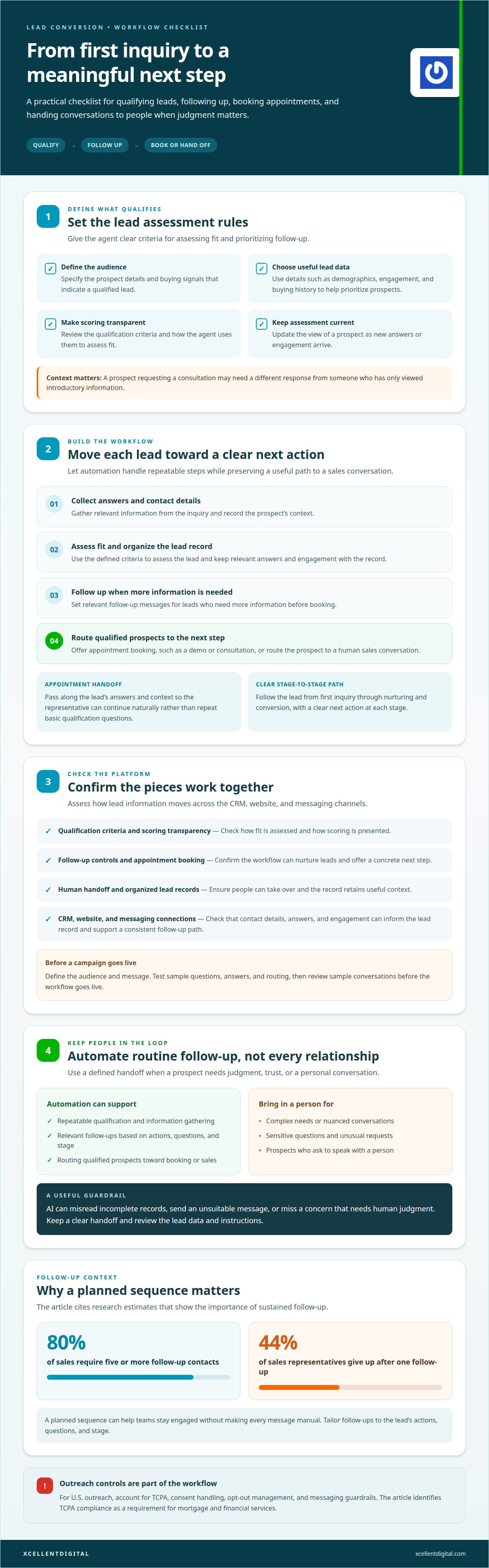
Set up an agent by defining its audience, qualification criteria, responses, and handoff points. A useful workflow follows the lead from first inquiry through nurturing and conversion, with a clear next action at each stage.
- Define the prospect details and buying signals that qualify a lead.
- Configure the agent to collect answers, assess fit, and record relevant context.
- Set follow-up messages for leads who need more information before booking.
- Route qualified prospects to appointment booking or a human sales conversation.
This structure lets AI agents for lead conversion handle repeatable qualification while people address complex needs. Review sample conversations and routing before the workflow goes live.
Balancing sales automation with human relationships
Automation can keep follow-up moving, while sales professionals handle conversations that need judgment. The goal is a useful handoff, not a fully automated relationship.
Automated Follow-Up and Nurturing Journeys
An automated journey sends relevant follow-ups based on a lead’s actions, questions, and stage. This matters because interest can fade when no one responds with a useful next step.
For example, an agent can send an article after an inquiry, then remind a representative when the lead requests a conversation. Research estimates that 80% of sales require five or more follow-up contacts, while 44% of sales representatives give up after one. A planned sequence helps teams stay engaged without making every message manual.
Personalized Automated Outreach
Personalized outreach uses a prospect’s preferences and behavior to make automated messages more relevant. AI tools can analyze those signals and help tailor conversation topics or offers, while a salesperson decides how to handle a complex need.
During a marketing automation platform migration, map lead fields, consent preferences, and active journeys before moving records. Test sample contacts to ensure their source and recent interactions carry forward. This gives the new platform useful context instead of sending a generic message to every prospect.
Risks and Limitations of Lead Conversion Agents
AI can misread incomplete records, send an unsuitable message, or miss a concern that needs human judgment. Keep a clear handoff for sensitive questions, unusual requests, and prospects who ask to speak with a person.
In the United States, outreach planning should account for TCPA, consent handling, opt-out management, and messaging guardrails. TCPA compliance is identified as a requirement for mortgage and financial services. These controls matter because automation can repeat a mistake across an entire journey if its instructions or lead data are wrong.
Use automation to assist routine follow-up, then let people move important conversations forward. Thoughtful lead nurturing workflows can help connect timely outreach with human attention.
Definition of an AI sales agent for lead conversion
An AI sales agent uses data and defined workflows to move prospects toward a sales conversation or meeting. The distinction matters: it can take actions, not just surface recommendations.
What Defines an AI Sales Agent
An AI sales agent can autonomously support marketing and sales by collecting contact information, responding to inquiries, and advancing prospects through defined tasks. This lets a team connect an actual lead action, such as a booked meeting, to its sales process.
For example, an agent can gather a prospect’s answers, record engagement, and route the conversation when a person needs to step in. Its role is to support the path to revenue, not replace human judgment in every interaction.
Sales Agents, SDRs, and Copilots
An AI sales agent performs assigned tasks, an AI SDR focuses on sales-development activities, and a sales copilot assists a human representative. These labels can overlap, so compare the work each system completes rather than relying on its name.
A copilot might help draft an outreach message, while an agent could send a relevant response or organize a follow-up task. An SDR-oriented tool may focus on prospect engagement and qualification. The practical difference is how much action happens without a representative initiating each step.
Autonomous Agents in Sales and Marketing
Autonomous agents carry out connected tasks across sales and marketing workflows, using lead behavior and campaign context to choose a next action. This can help teams coordinate activity across channels instead of treating every inquiry as a separate event.
For example, an agent might collect information from a new inquiry, update its record, and alert a representative when the prospect requests a conversation. Teams still set the boundaries, review messaging, and decide which tasks require human approval.
Agents for Inbound and Aged Leads
For inbound leads, an agent can capture contact details and gather initial answers before routing the prospect. For aged leads, it can support a new, relevant follow-up based on previous engagement or known behavior.
One market estimate suggests 15-25% of leads considered dead may re-engage with the right message at the right time. In financial services, an agent could help organize an initial inquiry and route it to a qualified representative, keeping sensitive decisions with people.
Lead conversion versus lead generation
Lead generation creates opportunities; lead conversion advances those opportunities toward a sale. The distinction matters because a fuller pipeline doesn’t automatically mean more revenue. A campaign can generate inquiries, but each lead still needs a relevant response, follow-up, and a clear next step.
Consider a service business running a campaign. An ad, search listing, or Google Business Profile helps generate interest; the conversion process begins when someone submits an inquiry. AI can help analyze intent and context, then direct the lead toward a useful action, such as a conversation or appointment. If a business measures only how many inquiries its campaigns generate, it misses whether those prospects move forward.
Market estimates put typical lead conversion between 2% and 5%, while another estimate says 95% of leads disappear without converting. These figures underline a practical point: acquisition is only one stage of the pipeline. Teams also need to respond, qualify prospects, and learn from which interactions lead to completed outcomes.
Speed and measurement shape that process. One market estimate says contact rates drop by 80% after five minutes, and traditional lead management may take 8-12+ minutes to respond. An agent can help route an inquiry and prompt a timely response, but the business should judge progress by outcomes such as booked appointments, applications, or completed transfers, not engagement alone.
Keep the two functions connected, but measure them separately. Track whether a channel helps generate inquiries, then assess whether follow-up turns those inquiries into meaningful sales actions. This distinction helps identify whether a weak pipeline needs more qualified interest, stronger responses, or better conversion workflows.
Ready to connect incoming interest with timely follow-up? Strengthen your lead response process around the outcomes that move prospects forward.
XcellentDigital: AI Agents
XcellentDigital helps businesses connect lead interest with timely follow-up through AI Agents and Lead Response Automation. Turn to these services when inquiries are coming in, but qualification, nurturing, or the handoff to sales needs a clearer process.
AI Agents can support sales workflows, while Lead Response Automation helps organize how teams respond to prospects. Facebook Ads and Google Business Profile Optimization can support visibility and lead generation, creating a connected path from discovery to follow-up. The right setup depends on how leads enter your pipeline and what action should move each prospect forward.
Bring your lead conversion goals and current workflow into the conversation. Contact XcellentDigital to discuss a practical next step.
Build a Clearer Path from Interest to Action
Give your next improvement a clear starting point: identify where prospects lose momentum, then decide what the next useful action should be. A focused goal, such as making inquiry handoffs more consistent, gives your team a practical way to shape workflows around real sales needs.
AI agents for lead conversion work best when their role supports that goal and people remain responsible for conversations that need judgment. Decide what information the agent should gather, when a representative should take over, and which outcomes matter to your team. That clarity helps keep automation useful rather than adding another disconnected tool.
XcellentDigital offers AI Agents alongside Facebook Ads and Google Business Profile Optimization, supporting businesses across lead attraction and follow-up. Choose the starting point that matches your current bottleneck, whether that’s generating relevant inquiries or organizing how they move forward.
Contact XcellentDigital to discuss your needs. A clearer process starts with a conversation about what your leads need next.
Frequently Asked Questions
What is AI lead generation?
AI lead generation uses artificial intelligence to help identify potential customers and attract or capture their interest. For example, a business can use campaign engagement and inquiry details to understand which audiences respond to its offers. The goal is to bring new prospects into the pipeline. Once someone becomes a lead, follow-up and sales activity determine whether that interest develops into a customer relationship.
What is the difference between an AI sales agent and a chatbot?
A chatbot mainly handles a conversation, while an AI sales agent can also carry out sales tasks within defined workflows. For example, a chatbot may answer a question about a service, while an agent may collect the prospect’s contact details and arrange a meeting. Some systems combine both roles. Compare what actions the tool completes, how it hands off conversations, and where it records lead information.
Can AI replace sales reps?
AI can support sales representatives, but it doesn’t replace the judgment and relationship-building needed in complex sales conversations. An agent can handle tasks such as gathering initial details or summarizing a call, giving a representative useful context before follow-up. A person remains important when a prospect raises a nuanced concern, needs tailored advice, or is ready to discuss terms. Treat automation as support for the sales team.
How Do Human Marketers Oversee AI Agent Performance?
Human marketers oversee performance by reviewing conversations, checking whether the agent follows the intended workflow, and correcting recurring errors. For example, they can examine cases where a prospect’s request was routed incorrectly or a response missed the question. They can also compare agent activity with meaningful outcomes, then adjust instructions, approved content, or escalation rules as campaigns and customer needs change.
How Do I Prove ROI on AI Agents to a Skeptical CFO?
Build the case around business outcomes, not message volume. Record a baseline for qualified appointments, completed sales handoffs, and time spent on manual follow-up before deployment. Then compare those measures after launch, alongside implementation and operating costs. Use a consistent attribution method so the finance team can distinguish agent-supported results from other campaign activity. A clear measurement plan makes assumptions visible.
How Much Does It Cost to Implement AI Agents in B2B GTM?
Implementation costs depend on the system’s scope, lead volume, communication channels, and required integrations. Enterprise-grade agents commonly use custom pricing based on these factors rather than one universal rate. Pricing depends on the case and is provided after a quote request; lead volume, channels, and integrations shape the estimate. Defining the agent’s role and workflow helps clarify the project scope.












Leave a Reply
Want to join the discussion?Feel free to contribute!