

Local SEO for Service Providers: 2026 Growth Guide
A higher ranking means little if it doesn’t bring the right customers closer to calling. That’s the difference between visibility and growth, and it’s why local seo for service providers needs to do more than improve a position in search results. Your profile, website, reviews, and directory listings should give nearby prospects clear, consistent information so they can find and assess your business.
If you’re unsure what to fix first, or whether more visibility will turn into inquiries, you’re not alone. Running a service business leaves little time to manage every online detail. You don’t need to chase every ranking change or platform at once. You need a focused plan tied to the customers you want to reach.
This guide explains the core parts of local SEO, how to prioritize practical improvements, and what to track beyond rankings. It connects search visibility with reviews, qualified leads, and timely follow-up, so discovery has a clear path to becoming an inquiry.
Key Takeaways
- Understand how map results, organic listings, and business profiles give customers different ways to discover your services.
- See how accurate profile details, useful service pages, consistent directory information, and a strong reputation work together.
- Learn why rankings and impressions don’t tell the whole story, and which customer actions offer a clearer view of lead quality.
- Use a practical sequence to address foundational local SEO tasks first, then build a manageable routine for ongoing improvements.
- Discover how local seo for service providers can connect search visibility with reputation and timely lead follow-up.
What Local SEO for Service Providers Actually Does
Local SEO helps a service business appear when people search online for relevant services in a geographic context. Unlike general SEO, which can target visibility across a broad range of topics and places, local SEO connects a service with a location so potential customers can find businesses that serve their area. Local Search Engine Optimization on Wikipedia offers a foundational overview of the discipline and its core components.
For local seo for service providers, the goal isn’t to force a business into every search. It’s to make its services, business information, and location clear enough to be considered for relevant searches. Visibility can depend on relevance, distance, and prominence together. No single signal guarantees a particular position: a business may match a search but be farther away, or be nearby but less prominent.
How local search helps customers discover service businesses
The journey often starts with a need: someone searches for a service, compares options, and decides whether to call, visit a website, or request more information. A person looking for help urgently may use a direct service search, while someone planning ahead may first research what the service involves. Both can be valuable prospects, but they may need different information before taking the next step.
Search wording varies. A person might include a service, a location, or a sign of urgency. That doesn’t mean every possible phrase belongs on a page. Write naturally about the services you offer, who they help, and the areas you serve. Clear, useful details help customers judge whether your business is a fit without turning website copy into a list of keyword variations.
Where service providers appear in local search
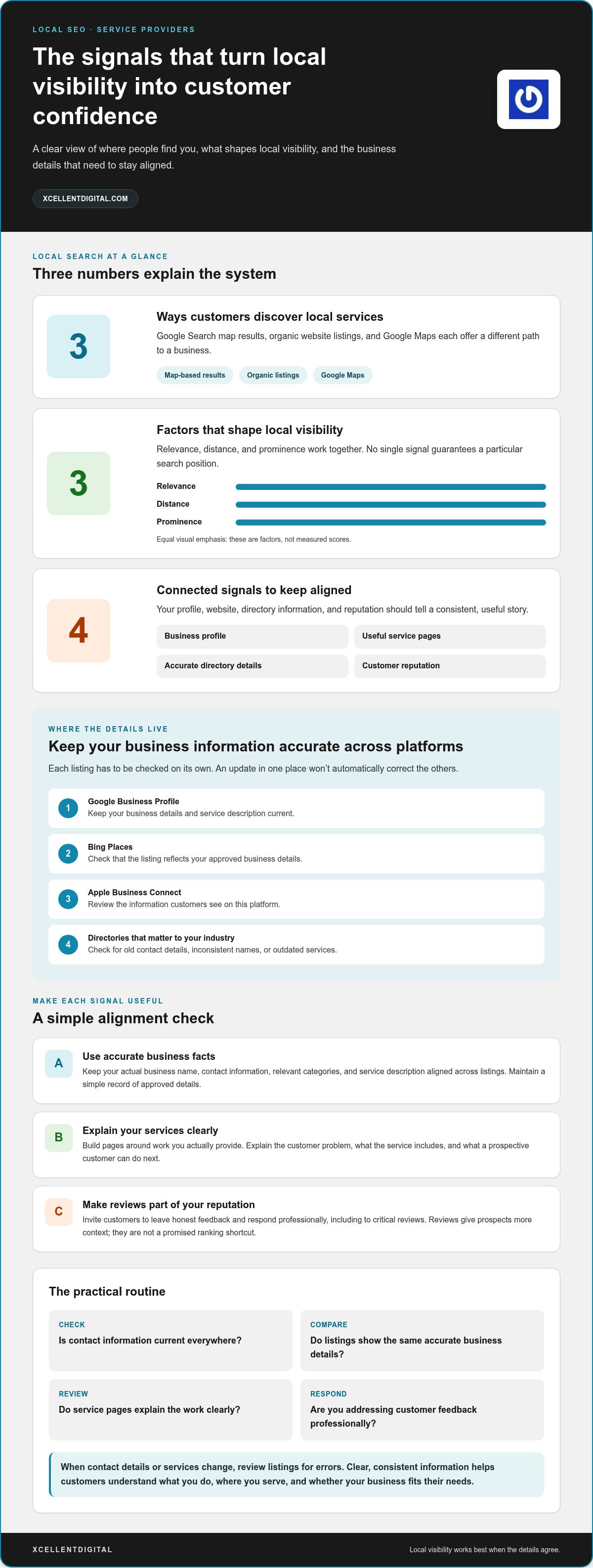
Customers can find a business through several routes. Google Search may show map-based results alongside organic website listings. Google Maps helps people explore businesses by location, while organic results can lead them to service pages and more detailed explanations. These routes serve different needs: one customer may compare nearby options, while another may want to understand a service before making contact.
A Google Business Profile supports discovery by presenting key business details in Google’s search and map experiences. It’s an important part of local visibility, but not the whole strategy. A profile can introduce the business; a useful website can explain services in greater depth; and consistent information and a trustworthy reputation can help customers feel ready to act. Profile optimization and search optimization work best together. For a closer look at profile setup and management, explore the Google Business Profile optimization guide.
Think of local search as a set of connected entry points, not a single ranking to chase. Ask whether someone who finds your business can quickly understand what you do, where you serve, and how to take the next step.
The Local SEO Signals Service Providers Need to Keep Aligned
Local visibility is built from connected signals, not a single profile or page. Your business information should match across platforms, your website should clearly explain what you do, and your reputation should help prospective customers assess whether you’re a good fit. Together, these make it easier for people and search engines to understand your business.
Consistent, useful business information helps customers recognize your business and understand how your services fit their needs. Consistency means keeping real details accurate and aligned, not repeating the same keywords everywhere. For local seo for service providers, clear facts beat awkwardly stuffed phrases.
Keep business profiles and directory information accurate
Start with the details a customer needs to identify and reach you: your actual business name, contact information, relevant categories, and a clear description of your services. Review these details on Google Business Profile, Bing Places, Apple Business Connect, and directories that matter to your industry. Each platform has its own listing, so an update in one place won’t automatically correct the others.
Outdated phone numbers, inconsistent names, or old service descriptions can create friction. A prospect may hesitate if one listing points to a different number or suggests you offer something your website doesn’t mention. Keep a simple record of approved business details and use it as a reference when reviewing listings. Check for errors after contact information or services change, too.
Make the website and reputation reinforce local relevance
Your website should fill in what a profile or directory listing can’t. Build clear pages around the services you actually provide. Explain the customer problem each service addresses, what its scope includes, and what a prospective customer can do next. Specific, useful details help visitors decide whether to get in touch. Copying a template and swapping in location terms rarely gives them the same clarity.
Reviews add another important layer. Create a consistent process for inviting customers to leave honest feedback, and respond professionally, including to critical reviews. Reviews help people assess the experience of working with a business and can strengthen its reputation. Don’t treat them as a promised ranking shortcut. Their practical value includes giving prospects more context as they compare options.
Use a routine review to spot gaps across these signals: Is the contact information current? Do your service pages explain the work clearly? Do listings reflect the same accurate business details? Are you responding to customer feedback? A focused Google Business Profile audit checklist can help you assess profile details systematically, while a broader review keeps your website and reputation in view.
Organize these checks rather than waiting for a problem to surface. XcellentDigital’s search optimization support can connect profile accuracy with the wider work of building local visibility.
Why Local SEO Rankings Alone Do Not Guarantee Service Leads
A prominent search position can increase exposure without producing a phone call or a suitable job. A person may see your listing but choose another business, discover that you don’t offer the service they need, or leave because it’s unclear how to get in touch. That’s why local seo for service providers should be assessed against customer actions and business outcomes, not rankings alone.
Track the steps between being seen and winning work. Visibility metrics show whether people encounter your business. Lead and sales records show whether that exposure brings relevant inquiries and booked work. Neither group tells the full story by itself.
Which local SEO metrics indicate visibility, and which indicate demand?
Impressions count how often your listing or page appears in search. Position indicates where it appears for a query. Profile interactions may include actions such as website visits or calls. Organic visits are sessions from unpaid search results, while calls and submitted forms record direct contact. Compare each measure over consistent periods and look for patterns rather than treating one change as proof.
Then qualify the response: total inquiries include every contact, qualified inquiries match your services and business criteria, and booked work reflects inquiries that become customers. A rise in total inquiries matters less if the additional contacts aren’t a good fit.
Visibility indicators
- Impressions and positions: Show how often and where your business appears.
- Profile interactions and organic visits: Show engagement with your listing or website, not whether someone became a customer.
Lead and sales indicators
- Calls and submitted forms: Record direct inquiries, but still require review for service fit.
- Qualified inquiries and booked work: Show whether contacts match your services and progress toward a sale.
How to find where local search leads are being lost
Follow the customer path: search result, profile or landing page, inquiry, response, and outcome. At each step, look for a reason someone might stop. Does the page make the service and next step clear? Is the phone number easy to find? Are forms straightforward? Are inquiries being answered and recorded? This turns a vague concern about SEO performance into specific issues you can investigate and improve.
Keep analytics alongside call and inquiry records. Attribution is imperfect: a customer may see a profile, return later through another route, or call without completing a tracked form. When practical, ask new callers how they found you, record the answer, and compare it with website and profile trends. Use the combined picture to see whether visibility, service fit, contact options, or follow-up may need attention.
Service businesses can apply the same measurement principles while accounting for industry-specific search behavior. The 2026 HVAC SEO guide offers an industry-focused companion for HVAC providers.
A Practical Local SEO Action Plan for Service Providers
Local SEO is easier to manage when you stop treating it as an endless list of marketing tasks. Start with accurate essentials, make it easy for customers to understand and contact your business, then review whether your changes are helping. This staged plan for local seo for service providers keeps the work focused on discovery and qualified inquiries.
Start with the local SEO foundations
Handle foundational fixes first. Before making several changes at once, note your current visibility and inquiry measures. Then work through these steps in order, assigning one person to own each task and setting a recurring review date that fits your team.
- Check your business information and profile. Review your business name, contact details, categories, service descriptions, and available contact options. Correct inaccurate or outdated information. Assign a profile owner and add a recurring check to the calendar, especially after business details change.
- Review directory listings. Compare important listings with your approved business information. Update errors and note which platforms still need attention. Give one person responsibility for the listing record and schedule a periodic review so updates don’t depend on someone remembering them.
- Test the customer contact path. Visit your website as a prospective customer. Can you find the relevant service, understand what it involves, and see how to get in touch? Check that phone and form options work. Assign website fixes to an owner and keep a record of completed changes.
- Make service pages useful. Identify gaps in the pages that explain your core services. Add clear details about the customer problem, the scope of the service, and the next step. Prioritize pages that leave visitors uncertain about whether your business can help.
- Record a starting point. Capture available impressions, search positions, profile interactions, organic visits, calls, submitted forms, qualified inquiries, and booked work. Keep the same measures for future reviews so you can compare trends without mistaking a single change for proof.
Build a sustainable improvement and review cycle
Once the basics are in order, keep the work moving at a pace your team can maintain. Set an owner and recurring cadence for each activity. A simple calendar makes responsibilities visible and helps prevent important follow-through from slipping.
- Service content: Collect genuine customer questions and use your business expertise to shape useful answers. Assign a content owner and plan regular reviews or updates based on what customers are asking.
- Customer feedback: Invite honest reviews through a consistent, policy-compliant process. Respond professionally and avoid sharing private customer details. Give someone responsibility for monitoring feedback and setting a regular response check.
- Performance review: Compare search visibility with calls, forms, qualified inquiries, and booked work. Review the trends on a recurring schedule, then choose the clearest friction point to address next.
Progress depends on your market, starting point, and consistent execution, so don’t plan around a promised ranking date. Focus on dependable improvements and meaningful customer actions. If you want support organizing the work, explore local search optimization support.
Connect Local SEO Visibility to Leads with XcellentDigital
Local visibility matters when it helps the right person understand your service, trust your business, and take a useful next step. A profile or page can create an opportunity, but it can’t guarantee a ranking, inquiry, or sale. Strong local seo for service providers connects clear business information and relevant search visibility with the experience customers have after they find you.
Businesses can lose momentum between discovery and action. A prospect may find your profile but need clearer service details. They may visit your website and hesitate if the next step is hard to find. Or they may reach out and wait too long for a response. Treat discovery, trust, and follow-up as connected parts of the customer journey, not separate marketing tasks.
Coordinate search visibility with reputation and follow-up
XcellentDigital brings search optimization and Google Business Profile optimization together to support how customers discover and evaluate a service business. Clear profile details and helpful website content give prospects a better sense of what the business does before they make contact. The goal is useful, consistent information, not a promise of a particular search position.
Reputation management supports the decision that follows discovery. Reviews and thoughtful responses help prospective customers understand others’ experiences and assess whether the business feels like a fit. Once an inquiry arrives, lead-response automation can help organize follow-up so a potential customer doesn’t disappear between first contact and the next step. Each capability plays a different role, but together they support a more connected path from search to conversation.
This approach also helps identify what needs attention. If the profile is being found but visitors aren’t contacting the business, examine the service information and contact path. If inquiries arrive but don’t progress, look at fit, response handling, and the customer’s next step. The right improvement depends on where the process is breaking down.
Choose a next step based on the current bottleneck
Start with the clearest gap rather than trying to fix everything at once. If discovery is weak, review profile accuracy and whether service pages clearly explain what the business does. If visibility is present but inquiries are limited, inspect how easy it is to contact you, whether the service details answer customer questions, and whether your reputation gives prospects useful context. If inquiries aren’t progressing, review how they’re handled after they arrive.
Connect the work to outcomes you can observe: relevant inquiries, conversations, and booked work, alongside search and profile activity. Keep expectations grounded. Results depend on your business, market, and consistent execution, so a joined-up strategy is more useful than chasing a ranking promise.
Learn how XcellentDigital can support this work through its growth services.
Make Your Next Local SEO Move Count
You don’t need to overhaul every marketing task at once. Choose one point in the customer journey that deserves attention, make a focused improvement, and observe what changes. That steady approach keeps local seo for service providers connected to real business priorities instead of turning it into another endless checklist.
XcellentDigital can help bring that work together. Search optimization and Google Business Profile optimization support discovery, while reputation management and lead-response automation help carry the customer journey forward. The aim is a clearer path from finding your business to making an inquiry, without relying on promises about rankings or revenue.
Take the next step at a pace that makes sense for your business. Explore XcellentDigital’s growth services for support connecting visibility with customer action.
Frequently Asked Questions
Can a service-area business use local SEO without displaying its address?
Yes. A service-area business can build local visibility without displaying an address where customers aren’t served. Google Business Profile guidance says eligible service-area businesses should hide an address if it isn’t a staffed location. Set your service areas accurately, and keep your profile and website clear about where you work. Don’t use an address just to appear closer to searchers; it won’t create genuine proximity to them.
How long does local SEO take to produce results for a service business?
There’s no dependable timeline that applies to every business. Progress depends on factors such as your starting visibility, competition, website condition, and how consistently improvements are made. Look for early signs like more relevant search impressions or profile activity, then assess whether inquiries and booked work also change. Record a baseline before updates and review trends over time, rather than treating a short-term fluctuation as a final verdict.
Can a service provider rank in areas beyond its main location?
Yes, a business may appear for searches in places beyond its primary location, but visibility can vary by searcher location, competition, and relevance. A service-area setting doesn’t guarantee equal exposure throughout every area listed. Make pages for areas only when they reflect real service coverage and offer useful details, such as how the service works there. Avoid creating near-identical pages that change only the place name.
Do paid ads improve organic local SEO rankings?
No. Paying for search ads doesn’t directly raise a website’s organic position or Google Maps ranking. Paid advertising and organic SEO are separate ways to gain visibility. Ads can provide another route to potential customers while SEO work develops, and campaign responses may help you understand which service messages attract interest. Measure those results separately so paid clicks don’t get mistaken for organic growth.
Does every service provider need a separate page for each service?
No. Create a separate page when a service has distinct customer needs, enough useful information, and a clear next step of its own. If two services are closely related and customers would benefit from one complete explanation, a combined page may be clearer. For example, don’t publish several short pages that repeat the same description with minor wording changes. Prioritize helpful detail over page count.
Do online reviews matter if a service business already gets referrals?
Yes. Referrals introduce your business, but a referred prospect may still look for reviews before deciding to make contact. A thoughtful review profile can provide context about customer experiences and help people without a personal recommendation assess your business. Invite honest feedback consistently, and respond professionally. Don’t disclose private details when answering a review, even if you’re correcting a misunderstanding.
Ready to connect local search visibility with reputation and lead follow-up? Explore XcellentDigital’s growth services.













Leave a Reply
Want to join the discussion?Feel free to contribute!