

B2B Lead Generation Strategies 2026: Choose Inbound or Outbound
Outbound isn’t automatically better for fast growth, and inbound isn’t always the safer bet. The right B2B lead generation strategies for 2026 depend on how quickly you need qualified conversations, how buyers find solutions, and whether your team can follow up consistently. For many businesses, the practical answer is to combine both: use outbound to start targeted conversations and inbound to earn trust over time.
It’s frustrating when marketing generates activity but sales still lacks the right prospects. More channels alone won’t fix the gap. Clear handoffs, useful content, and timely follow-up matter as much as deciding where to reach buyers.
This guide shows how to choose an inbound, outbound, or blended approach and connect it with sales and marketing alignment, paid channels, AI, CRM, and automation. Use these practical steps to build a lead-generation system that fits your goals and turns interest into meaningful sales conversations.
Key Takeaways
- Set shared lead-quality criteria and clear handoff rules so marketing and sales work toward the same outcome.
- Choose paid, event, and partnership channels based on your audience and how quickly you need to create conversations.
- Make content easy to find and useful to buyers by aligning it with search intent, including AI-driven search.
- Use CRM and automation to prioritize follow-up, reduce manual work, and keep promising leads from going cold.
1. How do you align marketing and sales around B2B lead generation?
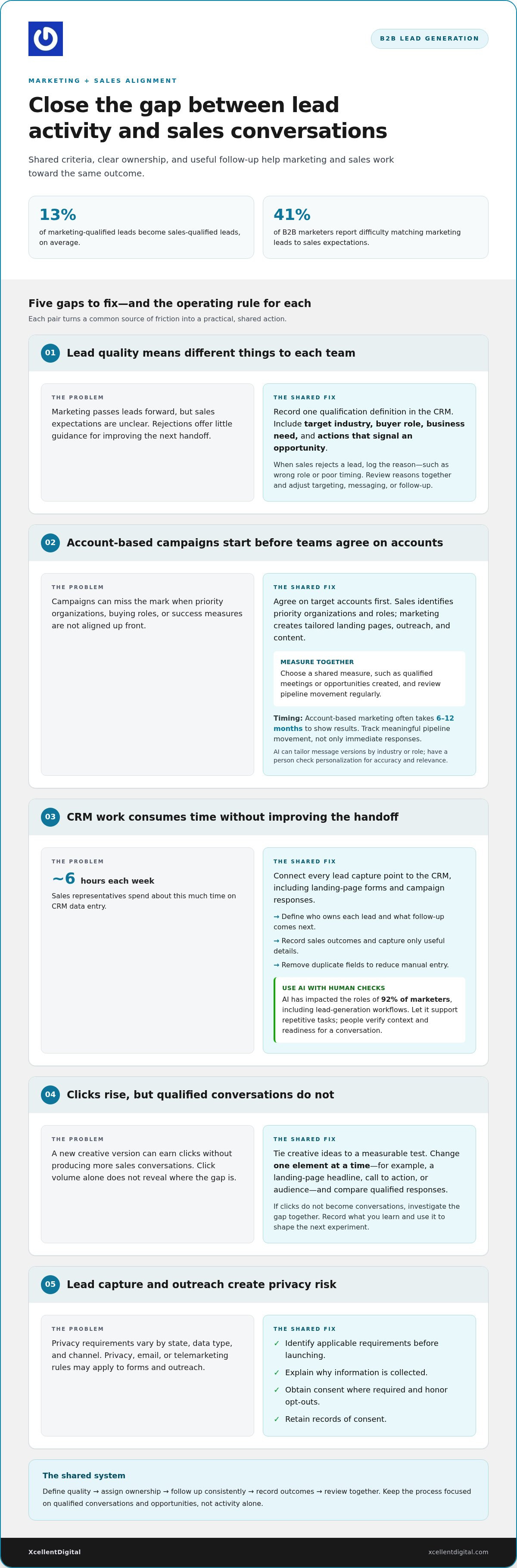
Start with one shared definition of a qualified lead, recorded in your CRM. An average of 13% of marketing-qualified leads become sales-qualified leads, while 41% of B2B marketers report difficulty matching marketing leads to sales expectations. Set clear criteria: target industry, buyer role, business need, and actions that signal an opportunity. When sales rejects a lead, record a reason, such as the wrong role or poor timing. Review those reasons together and adjust targeting, messaging, or follow-up.
For account-based marketing, agree on target accounts before creating campaigns. Sales can identify priority organizations and buying roles; marketing can build tailored landing pages, outreach, and content for those prospects. Set a shared measure, such as qualified meetings or opportunities created, then review progress regularly. Account-based marketing often takes 6–12 months to show results, so track meaningful movement through the pipeline, not just immediate responses. AI can help tailor a version of a message to an account’s industry or role. Have a person review personalization for accuracy and relevance.
Connect every lead capture point to the CRM, including forms on landing pages and campaign responses. Define who owns each lead, what follow-up comes next, and how sales records outcomes. Sales representatives spend about 6 hours a week on CRM data entry, so remove duplicate fields and capture only useful details. AI has already impacted the roles of 92% of marketers, including lead generation workflows. Use it to support repetitive tasks, while people verify lead context and decide whether a prospect is ready for a conversation.
Tie creative ideas to a measurable test. Change one element at a time, such as a landing-page headline, call to action, or audience, and compare qualified responses. If a new version earns clicks but few sales conversations, marketing and sales can investigate the gap together. Record what you learn and use it to shape the next experiment.
US privacy requirements vary by state, data type, and channel, and privacy, email, or telemarketing rules may apply. Explain why you collect information, obtain consent where required, honor opt-outs, and retain consent records. Identify the applicable requirements before launching forms or outreach.
2. Paid advertising, webinars, events, and partnerships
Choose campaigns based on buyer intent and audience fit, not channel popularity. Paid search can reach prospects actively researching a solution, while LinkedIn can target people by professional role and organization. Email supports relevant follow-up, especially after a webinar or event. Give each channel a distinct purpose and use a landing page that matches its message.
No channel guarantees the highest conversion or ROI across every B2B audience. Benchmarks report SEO-driven leads closing at 14.6%, compared with outbound leads at 1.7%; these figures measure different lead sources, not a universal channel ranking. Track qualified opportunities, conversion, and eventual revenue to see which campaigns work for your offer.
On LinkedIn, reach relevant professional audiences with useful, specific messages. Use email for personalized outreach and continued conversation. Paid search responds to active queries, so align keywords and ad copy with the buyer’s stated need, then carry that message through to the landing page. Compare channels using consistent measures, such as qualified leads and sales opportunities.
Make webinars and roundtables useful enough to earn attention. Build the agenda around one buyer challenge, then invite a focused audience through partners, email, and targeted campaigns. Use registration forms to capture role, company, and stated interest. Trigger event follow-up within 24 hours, sharing the presentation or a relevant next step. Track registrations, attendance, and subsequent conversations separately.
Trade shows can create face-to-face conversations, while online events can reach buyers who cannot attend in person. For either format, set a clear goal before launch, such as booked meetings or qualified follow-up. Executive events work best when the discussion addresses a shared business issue. A private dinner can bring together 8 to 12 decision makers, with time for focused discussion rather than a broad sales pitch.
Search and social advertising can produce results in 2–8 weeks, but judge performance by qualified outcomes, not clicks alone. Use consistent campaign tracking and review which audience, message, and landing page produced real opportunities. If organic visibility also matters, explore Search Optimization for B2B as a complementary channel.
3. AI-driven search and content optimization
B2B buyers conduct over 12 searches on average before visiting a vendor’s site, and 93% of B2B buying processes start with an online search. Build content around the questions prospects ask at each stage, from early problem research to comparing solutions. A useful content marketing plan connects search topics to webinars, landing pages, and clear next steps that move interest toward the pipeline.
AI-powered search results are changing how people discover information, but reported traffic effects vary. While 48% of B2B marketers say AI-powered search has had no impact on their web traffic so far, 47% say it has increased traffic. Focus on clear, accurate pages that answer a specific buyer question. Use headings, examples, and direct explanations so both readers and search systems can understand the page.
SEO and content marketing build organic visibility over time. A typical results timeframe for SEO and content is 3–9 months, so monitor qualified visits, relevant inquiries, and assisted opportunities along the way. Avoid publishing for volume alone: update a page when buyer questions change, add useful examples, and connect related topics. A consistent set of useful pages can support lead generation beyond a single campaign.
Generative AI can help draft tailored emails, landing pages, or LinkedIn posts for different industries and roles. Treat each draft as a starting point: verify facts, remove generic claims, and reflect the recipient’s actual interests. Test one change at a time, such as a headline or call to action, and compare qualified conversions rather than clicks alone.
Make every experience engaging on mobile, where 54% of internet traffic occurs. Use short paragraphs, readable forms, and visuals that explain a product or process at a glance. LinkedIn reports interactive content generates 4–5x more page views than static content, making calculators, assessments, and polls worth testing. Track completion and follow-up behavior to learn which formats create genuine buyer conversations.
4. CRM, automation, and lead generation tools
A CRM should show how each prospect moves through the buying process, not just store contact details. Record the original channel, company, relevant activity, funnel stage, next action, and owner. This gives marketing and sales one view of the journey, whether a prospect arrived through social media, search traffic, or a partner campaign. Keep fields focused on information that helps qualify or advance an opportunity. Make this system the backbone of your b2b lead generation strategies 2026, not a separate reporting task.
Automation can handle repeatable steps without replacing human judgment. For example, route a form submission to the right sales owner, create a follow-up task, and send a relevant confirmation. Use different paths for a webinar attendee and someone requesting a product discussion. Effective lead nurturing matters: 79% of marketing leads never convert into sales due to ineffective nurturing. Companies that excel at nurturing generate 50% more sales-ready leads at a 33% lower cost.
AI can produce inaccurate details or repeat biased assumptions, so review messages before sending. Purchased lists may include outdated contacts or people with no relevant buying interest. Outreach can feel irrelevant when it ignores context, and excessive messages can damage trust. Use targeted, permission-aware contact practices and give recipients a clear way to opt out.
Measure tool performance by lead progression, not by the number of automated messages. Review where prospects pause, which channels attract qualified conversations, and whether follow-up leads to sales-ready opportunities. Adjust one workflow at a time, then compare results against the previous process. For a more consistent handoff from inquiry to follow-up, strengthen your lead response workflow.
XcellentDigital: Facebook Ads
XcellentDigital can put your lead-generation strategy into action with Facebook Ads, Search Optimization, Google Business Profile Optimization, and AI Agents. Use Facebook Ads to reach a defined audience with campaign messaging, then connect each ad to a relevant landing page and clear follow-up path. Search Optimization supports buyers actively looking for answers, while AI Agents can support lead-generation workflows.
The right mix depends on your audience, offer, and how prospects move from initial interest to a sales conversation. First identify the gap: attracting qualified attention, improving visibility, or responding consistently to incoming leads. Then connect your digital marketing activity to a sales process with a clear next step for every inquiry. Contact XcellentDigital to discuss a practical path forward.
Make your next move measurable
Build B2B lead generation strategies for 2026 around a decision your team can act on now: identify the biggest gap between attracting interest and creating sales conversations. Choose one improvement, assign an owner, and decide what evidence would show it’s working. That gives your team a manageable starting point instead of another sprawling marketing plan.
Keep the process practical. Review lead quality regularly with feedback from sales, then adjust campaigns based on what buyers respond to. If the path from first click to meaningful follow-up is unclear, get support connecting the moving parts and setting a focused direction.
Contact XcellentDigital today to discuss your lead-generation priorities. Start with the challenge you most want to solve, and take the next step with a clearer plan.
Frequently Asked Questions
Which is better: Inbound or Outbound B2B Lead Generation?
Neither approach is universally better. The stronger choice depends on buyer behavior and your sales capacity. Inbound suits buyers researching a problem who need useful information before talking. Outbound can help you reach a defined account that may not find you organically. For example, publish a practical guide for inbound discovery while sales contacts a shortlist of organizations with a relevant business need.
How do you align marketing and sales around B2B lead generation?
Align both teams by agreeing on what makes a sales conversation useful and reviewing outcomes together. Compare leads that became opportunities with those that stalled, then look for differences in role, need, or timing. Use these patterns to refine campaign messages and sales conversations. This keeps the shared goal focused on qualified business, not activity that looks positive but leads nowhere.
How do you attract B2B leads?
Attract B2B leads by addressing a specific problem your target buyer is already trying to solve. A software firm, for example, could offer a concise implementation checklist that helps operations leaders compare approaches. Make the resource easy to find, explain its value clearly, and give interested readers a relevant next step. Strong attraction starts with practical usefulness, not a broad pitch aimed at everyone.
How do you generate qualified B2B leads?
Generate qualified leads by matching your audience, message, and offer to a real buying need. Before launching a campaign, define the organizations and roles most likely to benefit. Use a focused form or conversation to understand the prospect’s problem. A high inquiry count matters less than finding prospects whose needs fit your solution and who are open to discussing next steps.
How do you measure the effectiveness of your B2B lead generation?
Measure effectiveness by tracking leads from first interaction through opportunity and revenue. Compare sources using consistent definitions, and assess whether each creates relevant opportunities, not just form submissions. Review a campaign’s qualified opportunities and resulting sales alongside its initial response volume. Track the time between stages, too, to see whether leads progress or stall before a sales conversation.
How do you qualify a B2B lead?
Qualify a B2B lead by checking whether the organization fits your target market and whether the contact has a meaningful reason to act. Ask about the problem, its business impact, who participates in the decision, and what would need to happen next. A prospect with a clear use case and an appropriate role deserves a different follow-up from someone exploring options without an active need.













Leave a Reply
Want to join the discussion?Feel free to contribute!