

Instant Lead Engagement System: Turn New Leads Into Timely Follow-Up
What good is a new inquiry if it sits unanswered while your team is busy? An instant lead engagement system can help close that gap, but speed alone isn’t enough. If leads arrive through disconnected channels or receive generic messages, automation can create more friction instead of a better first impression.
The challenge is responding consistently without relying on someone to notice every notification, while still making each conversation feel relevant. The right process connects lead capture with a timely first response, useful qualification, and a clear handoff to the person who can continue the conversation.
In this guide, you’ll learn how to map that workflow, route inquiries so your team can prioritize conversations, and keep automated messages helpful rather than impersonal. You’ll also see what to measure to understand whether faster, structured engagement is supporting your sales process. XcellentDigital’s lead response automation, AI agents, and sales funnel development can connect lead generation to a more organized follow-up process, with automation supporting human conversations rather than replacing them.
Key Takeaways
- Connect lead capture, acknowledgment, routing, and follow-up so every inquiry has a clear next step.
- An instant lead engagement system should use the inquiry’s context and guide it toward the right person.
- Compare manual-only, automated-first, and blended workflows to balance consistency, personalization, and human judgment.
- Map lead sources, assign ownership, write responses, and test the workflow before refining it.
- Record a baseline for response time and conversion so you can assess whether changes are improving your sales process.
What Is an Instant Lead Engagement System, and Why Do Delays Cost Attention?
A new inquiry can arrive while your team is on a call, helping another customer, or working against a deadline. The message lands, but no one owns the next step. By the time someone notices, the person who reached out may have moved on or started speaking with another business. The problem isn’t necessarily a lack of interest from your team. It may be a process that depends on someone being available at exactly the right moment.
An instant lead engagement system connects the steps between someone expressing interest and your business sending a useful response. It brings lead capture, acknowledgment, routing, and follow-up into a defined workflow. A form submission, an ad inquiry, or a search-generated call can each trigger an appropriate next action rather than disappearing into a separate inbox. This structured approach is part of broader lead management, which connects the way a business attracts prospects with how it handles and follows up with them.
Why do delays matter? An inquiry signals interest at a particular moment. A timely response gives you the opportunity to understand what the person needs while that interest is active. It doesn’t guarantee a sale or even a conversation, but it makes the next step clearer for both the lead and your team.
What makes lead engagement a system rather than an autoresponder?
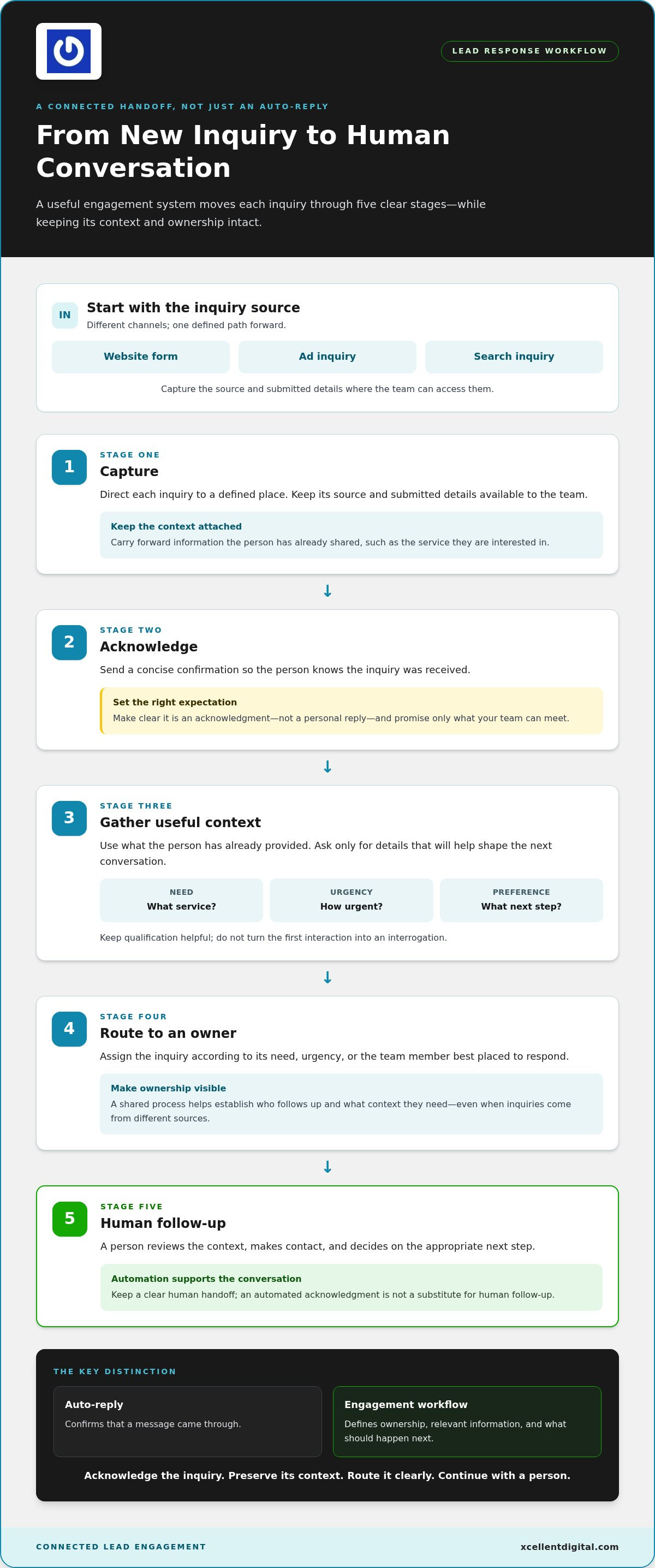
A one-time auto-reply confirms that a message came through. A workflow goes further: it defines who takes ownership, what information matters, and what should happen next. The lead source, inquiry details, and your business rules can shape the response and routing. In short: an auto-reply acknowledges an inquiry; an engagement workflow gives it a next step. Automation helps carry out that process consistently, but it can’t guarantee conversion or replace sound judgment.
For example, someone asking about a specific service may need a different response path from someone requesting general information. A useful workflow accounts for that difference without pretending to know more than the lead has shared. The goal is relevant continuity, not automation for its own sake.
Which businesses benefit most from structured lead response?
Any team that can’t reliably respond as soon as an inquiry arrives may benefit from a clearer process. That includes businesses whose staff spend time on calls or appointments, as well as teams handling inquiries outside their usual working hours. The workflow should define what happens when a person can’t respond immediately, without treating an automated acknowledgment as a substitute for human follow-up.
Multiple lead sources make ownership even more important. If inquiries come from paid ads, search, and website forms, different staff members or tools may see different pieces of the picture. A shared process establishes who follows up and what context they need. Keep it realistic: tailor response steps to your team’s capacity and sales cycle. A small team with a considered buying process may need a different pace and handoff from a team handling straightforward requests. Build a workflow people can follow, then refine it as you learn where inquiries stall.
How an Instant Lead Engagement System Moves an Inquiry Toward a Conversation
A workable response process gives every inquiry a path forward, regardless of where it began. A form submission, an advertising response, and a search inquiry may arrive through different channels, but each should reach a clear destination and an accountable owner. That’s the practical value of an instant lead engagement system: it doesn’t just send a quick message, it moves the inquiry through connected steps toward a relevant human conversation.
Think of the workflow as a handoff, not a single automated action:
- Capture: Direct each inquiry to a defined place where the team can access its source and submitted details.
- Acknowledge: Send a concise confirmation that lets the person know their inquiry was received. Make clear that it’s an acknowledgment, not a personal reply.
- Gather context: Use the information already provided, and ask only for details that will help shape the next conversation.
- Route: Assign the inquiry according to its need, urgency, or the team member best placed to respond.
- Follow up: Have a person review the context, make contact, and decide on the appropriate next step.
Capture and acknowledge a new lead
Start by mapping where inquiries originate and where each one should go. Someone responding to an ad may ask about a particular service, while a search inquiry may begin with a broader question. A business running Facebook Ads for local lead generation can use the ad’s subject and the person’s submitted details to shape the first acknowledgment. Keep the message specific to what they asked, avoid suggesting a person has already reviewed it, and set only expectations your team can meet.
Avoid asking people to repeat information they’ve already shared. If a form captures the service they’re interested in, carry that context into the handoff. The first message should feel connected to their inquiry, not like a generic script sent to everyone.
Qualify, route, and hand off the inquiry
Qualification should help the next person respond well, not turn the first interaction into an interrogation. Ask only useful questions, such as what service the person needs, how urgent the request is, or what next step they prefer. Each answer should inform a decision: who handles the inquiry, what context they need, or whether another follow-up path makes more sense.
Set routing rules your team can apply consistently. A specific service request might go to the person responsible for that service, while a general question might need a broader first conversation. At handoff, make the inquiry details and responses easy for the human owner to review. They can acknowledge the person’s actual need, ask for missing context, and guide the discussion. XcellentDigital’s lead response automation supports a defined follow-up process as part of broader sales funnel development, keeping automation in service of a relevant human conversation.
Automation vs. Manual Follow-Up: Choose the Right Engagement Mix
Choosing between automation and personal follow-up isn’t an all-or-nothing decision. Manual processes let staff adapt in the moment, but an inquiry can wait if everyone is busy. Automation can handle predictable steps consistently, yet a message that ignores what someone asked can feel like a dead end. A practical instant lead engagement system uses each approach where it adds value, with a clear person responsible for taking over.
Compare the approaches against the work your team actually needs to do:
| Workflow | Consistency | Personalization | Staffing demands | Human judgment |
|---|---|---|---|---|
| Manual-only | Depends on staff availability and habits | Can adapt to each inquiry | Staff must notice and handle each lead | Present throughout |
| Automated-first | Reliable for defined, repeatable steps | Limited if messages don’t use inquiry context | Reduces routine first-response work | Needed for exceptions and complex needs |
| Blended | Repeatable steps have a defined process | Automation uses known details; people add nuance | Staff focus on assigned conversations | Applied where understanding and discretion matter |
A blended approach is often a useful starting point: automate predictable steps, then make human ownership explicit. For example, a confirmation can acknowledge a form submission and explain what happens next, while a staff member handles a detailed question about service fit. This divides the work without treating every lead as identical.
When should automation handle the first step?
Use automation for timely acknowledgment and routine administrative steps, such as confirming receipt or asking for a relevant missing detail. Keep the message tied to what the person submitted, and state what happens next in language your team can stand behind. Don’t present an automated note as a personal reply or imply staff have reviewed the request if they haven’t.
That distinction protects trust. A short, accurate message is more useful than a polished but generic script that could apply to any business. If an inquiry falls outside the workflow’s rules, provide a clear path for human review rather than forcing it through an unsuitable response.
When should a person take over?
Escalate complex questions, unusual requests, and situations that require judgment to an appropriate team member. Assign an owner at that point so the lead doesn’t sit between an automated message and a human response with nobody accountable. Give staff the submitted details and prior messages, too. They can continue the conversation with context instead of asking the prospect to repeat information they already provided.
Set the handoff rule before launch: define what automation can resolve, what triggers a person’s review, and who owns the follow-up. XcellentDigital’s lead response automation and AI agents support workflows built around those decisions, with people guiding conversations that call for a human touch.
How to Implement and Measure a Lead Engagement Workflow
Build the process before adding more automation. A clear workflow shows where an inquiry comes from, who owns the next step, and how you’ll know whether the handoff is working. Start simply, record how the current process performs, then improve the points where leads wait or lose context. That gives your instant lead engagement system a practical foundation instead of a set of disconnected messages.
Use this implementation sequence:
- Map lead sources: List the channels inquiries arrive through and where each one currently goes.
- Assign ownership: Name the person or role responsible for reviewing and following up on each type of inquiry.
- Design responses: Write relevant acknowledgments and define which inquiries need staff review.
- Test the workflow: Check that messages, routing, and handoffs work as intended.
- Refine the process: Review results and adjust rules, ownership, or messaging where leads get stuck.
Map the process before automating it
Write down each source, current destination, response owner, and common delay. Decide which inquiries need an acknowledgment and which need direct staff review. Then set escalation rules: what happens when a request is complex, and who takes ownership if the usual contact is unavailable? A simple map can expose unclear handoffs before you build them into automation.
Before making changes, record a baseline from your existing process. Track how long leads wait for a first response and what happens afterward. Without that starting point, you can’t tell whether a new workflow changed performance or whether differences reflect normal variation in lead volume and timing.
Choose measures that connect daily follow-up to meaningful progress:
- Response time: How long it takes for an inquiry to receive its first response.
- Contact rate: How often the team reaches the person who submitted an inquiry.
- Qualification: Whether the conversation establishes a relevant need and fit.
- Booked next steps: How often a qualified conversation leads to an agreed follow-up action, such as a meeting.
Set targets based on your lead volume, staffing, and sales cycle. A team with limited capacity may need a different response plan from one handling a steady flow of inquiries. Avoid treating a universal benchmark as a fit for every business. Measure consistently and look for changes over comparable periods.
Test, review, and improve the workflow
Before a wider rollout, test realistic scenarios: a clear service request, a broad question, and a lead that needs human judgment. Check that each message reflects the inquiry, the right owner receives the follow-up, and a fallback applies when needed. Then review lead records for missed handoffs, repeated questions, and missing context. Related business growth and automation planning can help keep workflow changes aligned with broader processes.
Use what you learn to improve one step at a time. XcellentDigital’s lead response automation and sales funnel development support a more structured process. Build a clearer lead follow-up workflow around your team’s capacity and sales process.
Build a Lead Engagement System Around Your Sales Process
A strong lead engagement workflow doesn’t start with automation. It starts with how your business sells: what happens after someone responds to an ad, finds you through search, or submits an inquiry, and who takes responsibility from there. Connect the source to a relevant acknowledgment, a clear owner, and human follow-up. Then shape the workflow around your team’s actual capacity and the decisions leads need to make.
What a connected approach should accomplish
Advertising and search can bring inquiries into your business, but lead generation is only one part of the journey. A connected process helps each inquiry move toward an appropriate next action. Staff can see where it came from, what the person asked, and who should respond. That context makes ownership easier to track and reduces the chance of an inquiry passing between people without a clear handoff.
Keep each part of the workflow focused:
- Lead source: Preserve useful context about how the person found you and what prompted the inquiry.
- Relevant acknowledgment: Confirm receipt in a way that reflects what the person submitted.
- Clear ownership: Make it apparent who is responsible for the next step.
- Human follow-up: Let a team member handle questions and conversations that need understanding or judgment.
Automation can help carry out repeatable steps consistently. It shouldn’t be expected to make every sales decision or stand in for a meaningful conversation. XcellentDigital’s lead response automation and AI agents fit within broader sales funnel development, connecting lead generation to follow-up. Tailor the process to your sources, team roles, and sales cycle instead of assuming one setup or message suits every business.
Turn the framework into a practical next step
Start with one lead source, not every channel at once. Trace what happens from the moment an inquiry arrives: where it goes, how it’s acknowledged, who sees it, and what the lead is expected to do next. Identify the biggest gap. Maybe the owner isn’t clear, the response lacks context, or the next action isn’t recorded. Fix that point first, then review whether the handoff works as intended.
This process map gives your team something concrete to improve before expanding the workflow. It also helps distinguish a technology issue from a responsibility issue. If the right person doesn’t know they own the follow-up, adding another automated message may not solve the underlying problem.
An instant lead engagement system should fit the way your business handles prospects, not force your team into a generic sequence. XcellentDigital connects lead response automation, AI agents, and sales funnel development with the lead generation work that feeds your pipeline. Ready to connect lead generation with a clearer follow-up process? Talk with XcellentDigital about building a workflow around your sales process.
Make Your Next Lead Easier to Act On
Your next step doesn’t need to be a full-scale overhaul. Choose one place where inquiries tend to stall, then decide what a better handoff would look like for your team. That gives you a practical starting point for an instant lead engagement system that fits your sales process, rather than adding automation for its own sake.
XcellentDigital brings lead response automation and AI agents into broader sales funnel development, helping businesses connect lead generation to follow-up. The goal is a workflow your team can use consistently, with automation supporting the process and people guiding conversations that need a human touch. No system can promise every inquiry will become a customer, but a clearer process gives your team a better way to respond and learn.
Build a faster, more connected lead response process with XcellentDigital. Start with the gap that matters most and take the next step toward follow-up that feels organized, relevant, and true to your business.
Frequently Asked Questions
How quickly should a business respond to a new lead?
There’s no single response-time target that suits every business, lead source, or sales cycle. First, review a sample of recent inquiries and note when each arrived, when it received a response, and whether anyone owned the follow-up. Then set an internal target your team can meet consistently. Review response speed alongside contact and qualification rates, so staff aren’t pushed to send rushed messages that don’t address what the lead needs.
Does an instant lead engagement system guarantee more sales?
No. An instant lead engagement system can help reduce avoidable delays, but it can’t guarantee a sale. Results also depend on the lead’s intent, whether your offer fits their needs, the quality of the conversation, and what happens afterward. Treat the workflow as operational support, not a revenue promise. Compare performance with a pre-launch baseline and review relevant outcomes before deciding whether a process change is helping.
Can lead response automation qualify prospects?
Yes, it can support basic qualification when questions are relevant and easy to answer. For example, a workflow might ask which service someone needs or what time they’d prefer to talk. Use each answer to prepare the next interaction, not to create a long screening form. Keep complex, sensitive, or unusual questions available for staff review, and make sure qualification doesn’t create unnecessary friction or rule out a suitable prospect.
Should AI replace a salesperson when responding to leads?
No. AI can support parts of the response process, but human judgment remains valuable for nuanced questions, exceptions, and personal conversations. An automated step might acknowledge an inquiry or gather basic context, while a salesperson discusses a request that doesn’t fit the usual path. Make the transition clear. Prospects should know when they’re receiving an automated response and when a person has taken over.
Which leads should trigger an automated response?
Start with inquiry types that have a clear origin and a predictable, appropriate first step. A common form submission may suit a brief receipt confirmation, while a detailed request may need staff review before anyone responds. Before enabling automation, identify the route, responsible owner, useful context, and escalation point. If two inquiry types need different expectations or next steps, don’t force them into the same message sequence.
What should a business track after launching lead engagement automation?
Track measures that show how inquiries move through the process: time to first response, successful contact, qualification, completed handoffs, and booked next steps where relevant. Compare these with your pre-launch baseline and review results by lead source, since one channel may need a different workflow from another. Pair the numbers with a review of sample conversations. That can reveal confusing messages or missing context that a metric alone won’t explain.













Leave a Reply
Want to join the discussion?Feel free to contribute!